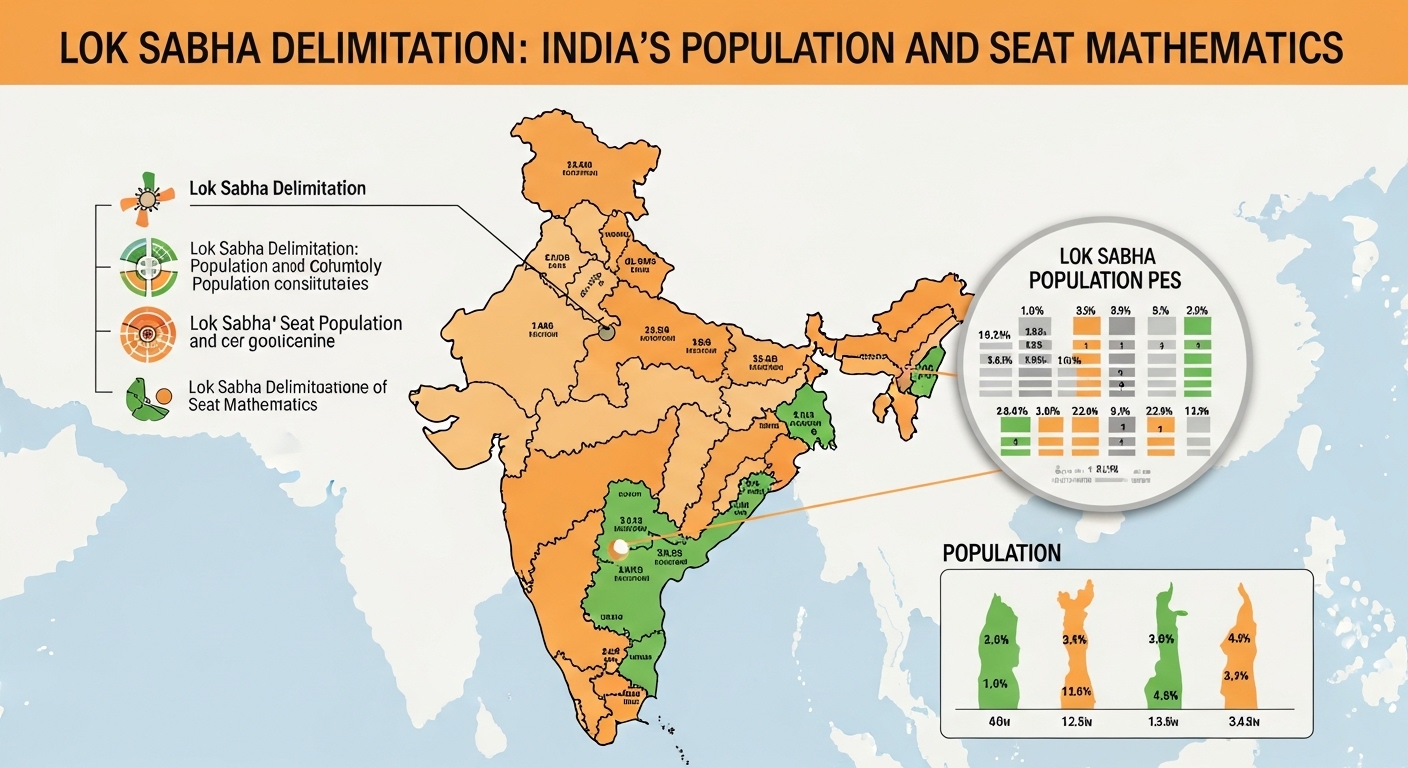
How Could the Allocation of Seats Change Based on a Ratio of 2 Million People Per MP? Which States Stand to Gain, and Where Will Representation Decline? Know What is Lok Sabha Delimitation
If you have been following political News recently, you have undoubtedly heard discussions regarding “delimitation.” Many perceive this merely as a process to increase the number of seats; however, in reality, it represents the most significant mathematical exercise that determines the future trajectory of the country’s politics.
Simply put, delimitation determines the extent of political power that each state will wield.
- What is Delimitation?
Delimitation refers to the reallocation of Lok Sabha seats based on population figures.
In other words:
Higher Population → More MPs
Lower Population → Fewer MPs
The Current Scenario
Since 1976: The number of Lok Sabha seats has remained relatively static at approximately 543, while the population has continued to grow steadily; this is precisely where the imbalance begins.
- The Reality Today: Population vs. Seats
On average, today:
1 MP ≈ Represents 2 to 2.3 million (20 to 23 lakh) people; however, this ratio is not uniform across every state. Under-represented States
Uttar Pradesh → ~2.5 million per MP
Bihar → ~2.6 million
Maharashtra → ~2.3 million
Here, a single MP is responsible for a very large number of people.
Better-represented States
Kerala → ~1.6–1.7 million
Tamil Nadu → ~1.8 million
Here, a single MP represents a smaller number of people.
The Significant Disparity
Uttar Pradesh vs. Kerala:
Uttar Pradesh → ~2.5 million per MP
Kerala → ~1.6 million
In other words:
One MP from Uttar Pradesh represents a population equivalent to that of approximately one-and-a-half MPs from Kerala.
- If the ‘2 Million Rule’ Were Applied
Assumption:
1 MP = 2 million people
Potential Changes
The Biggest Gains
Uttar Pradesh → +20 seats
Bihar → +12 seats
Maharashtra → +8 seats
Rajasthan → +9 seats
Theoretical Reduction (but not in practice)
Tamil Nadu → -3 seats
Kerala → -3 seats
Reality: Seats are never reduced; they are only increased.
- Who Gains, Who Loses?
North India
Population has grown rapidly; seats will also increase rapidly, leading to increased political power.
South India
Population growth has been lower; the increase in seats will be limited, potentially resulting in a reduced share of representation.
- Why the Controversy?
The Southern Perspective
“We successfully controlled our population growth—so why should we be penalized for it?” >The North Indian Perspective
“Where the population is higher, representation should also be higher.”
- The Math of Real Power
If this rule is implemented:
Just 3 states—Uttar Pradesh, Bihar, and Maharashtra—combined could influence over 200 to 250 seats.
- The Largest State: Uttar Pradesh
Currently → 80 seats; Under the ‘2 Million Rule’ → Approximately 100 seats. This means this state will wield the greatest influence in the country’s politics.
- The Future Landscape
Delimitation is likely to take place after 2026. At that time, the number of Lok Sabha seats will increase, and the political power of the states will shift. The debate between the North and the South is set to intensify. Delimitation is not merely about the allocation of seats; it will determine how much power each state holds, and which states will take the lead in national politics.
As projected here: Estimated State-wise Lok Sabha Seats (Post-Delimitation)
The Hindi Belt (The Biggest Beneficiary)
| State | Current Seats | Projected Seats |
|---|---|---|
| Uttar Pradesh | 80 | 120 |
| Bihar | 40 | 60 |
| Madhya Pradesh | 29 | 43–44 |
| Rajasthan | 25 | 37–38 |
West + Central India
| State | Current | Projected |
|---|---|---|
| Maharashtra | 48 | 72 |
| Gujarat | 26 | 39 |
| Chhattisgarh | 11 | 16–17 |
Eastern India
| State | Current | Projected |
|---|---|---|
| West Bengal | 42 | 63 |
| Odisha | 21 | 31–32 |
| Jharkhand | 14 | 21 |
Southern India (Seat-to-Power Ratio Remains Consistent)
| State | Current | Projected |
|---|---|---|
| Tamil Nadu | 39 | 58–59 |
| Karnataka | 28 | 42 |
| Andhra Pradesh | 25 | 37–38 |
| Telangana | 17 | 25–26 |
| Kerala | 20 | 30 |
North + Smaller States
| State | Current | Projected |
|---|---|---|
| Punjab | 13 | 19–20 |
| Haryana | 10 | 15 |
| Delhi | 7 | 10–11 |
| Uttarakhand | 5 | 7–8 |
| Himachal Pradesh | 4 | 6 |
North-East (Estimated) Trends)
| Region | Current | Projected |
|---|---|---|
| Assam | 14 | 21 |
| Other NE States | 1–2 | same या slight increase |
Total Seats
Current: 543 Future: ≈850
State-wise Precise Seat Predictions + Who Wins in Each State (Detailed Map), Actual Seat Estimates (≈850 Seat Model)
State-wise Seat Estimates + Winners
The Hindi Belt (The Decider)
| State | Seats (Projected) | Winner |
|---|---|---|
| Uttar Pradesh | 120 | 🟩 BJP Dominant |
| Bihar | 60 | 🟩 BJP/NDA Edge |
| Madhya Pradesh | 43 | 🟩 BJP Strong |
| Rajasthan | 38 | 🟩 BJP Strong |
| Haryana | 15 | 🟩 BJP |
Western India
| State | Seats | Winner |
|---|---|---|
| Maharashtra | 72 | 🟨 Mixed (BJP slight edge) |
| Gujarat | 39 | 🟩 BJP Strong |
| Chhattisgarh | 16 | 🟩 BJP Edge |
Southern India (Opposition Stronghold)
| State | Seats | Winner |
|---|---|---|
| Tamil Nadu | 59 | 🟥 DMK/Opposition |
| Kerala | 30 | 🟥 Opposition |
| Telangana | 26 | 🟥 Mixed/Opp |
| Andhra Pradesh | 38 | 🟨 Mixed |
| Karnataka | 42 | 🟨 Swing State |
Eastern India
| State | Seats | Winner |
|---|---|---|
| West Bengal | 63 | 🟥 TMC Strong |
| Odisha | 31 | 🟨 BJD/BJP Fight |
| Jharkhand | 21 | 🟨 Mixed |
Northern + Smaller States
| State | Seats | Winner |
|---|---|---|
| Punjab | 20 | 🟥 Opposition |
| Delhi | 11 | 🟩 BJP Edge |
| Uttarakhand | 8 | 🟩 BJP |
| Himachal | 6 | 🟩 BJP |
North East
| Region | Seats | Winner |
|---|---|---|
| Assam | 21 | 🟩 BJP |
| Others | 1–2 each | 🟩 BJP advantage |
Final Seat Tally (Simulation)
BJP / NDA
Hindi Belt → 220–240
West → 110–120
East → 60–70
South → 50–70
TOTAL: 420–480 Seats
Opposition
South → 140–160
Bengal + Punjab → 80–90
Mixed states → 100–120
TOTAL: 350–400 seats
The most crucial point: Where will the election be decided?
In just 2 states:
Uttar Pradesh
Bihar
Together, these two account for: Approximately 180 seats.
The path to the Prime Minister’s chair runs through Uttar Pradesh—which alone holds 120 seats—a reality that remains largely unchanged even today. All in all, this presents a tremendous advantage for the BJP; the Hindi-speaking states will ultimately determine who becomes the next Prime Minister, and the BJP holds a strong foothold in this region.