
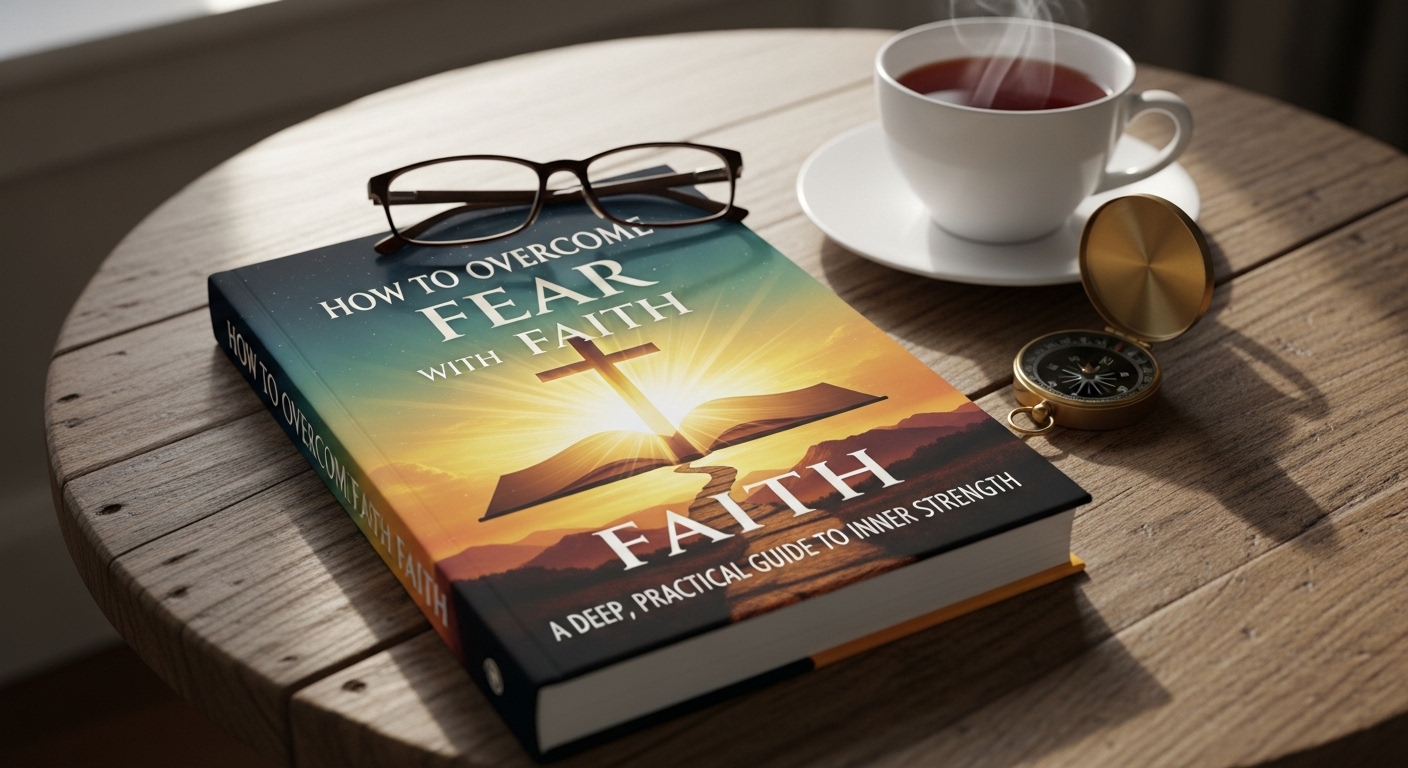
how to overcome fear with faith: in uncertain times, people are rediscovering faith—not just as belief, but as a way to live through fear
Fear rarely knocks before entering your life.
It slips in quietly—sometimes as a lingering thought, sometimes as a tightness in your chest, and sometimes as a vague sense that something isn’t right. It doesn’t always have a clear reason. You might feel it about your future, your work, your Health, or even things you can’t quite explain.
And that’s what makes fear so powerful—it doesn’t need proof to feel real.
That’s why more people today are searching for something deeper. Not just ways to escape fear, but ways to live with it—and move beyond it. This is where the idea of learning how to overcome fear with faith begins to matter.
Not as a dramatic transformation, but as a quiet, steady shift that builds over time.
Fear Isn’t the Problem—Losing Control Is
Fear, in itself, isn’t wrong.
It’s part of being human. It helps you stay alert. It warns you when something feels unsafe. In the right moments, it protects you.
But the problem starts when fear doesn’t fade.
When it lingers longer than it should. When it follows you into your decisions, your thoughts, even your sleep. When it starts shaping what you avoid, what you delay, and what you no longer attempt.
That’s when fear stops helping—and starts holding you back.
Without noticing, you begin shrinking your World. You hesitate more. You second-guess yourself. You imagine outcomes that haven’t happened—and may never happen.
Understanding Faith in a Real-World Way
Faith is often misunderstood as something abstract or purely religious.
But in everyday life, faith is much more practical than that.
It’s the ability to trust—especially when you don’t have full control.
- Trust that uncertainty doesn’t always mean danger
- Trust that not every outcome needs to be predicted
- Trust that even if things go wrong, you’ll find your way through
Learning how to overcome fear with faith isn’t about eliminating fear. It’s about changing how you respond to it.
The Shift That Changes Everything
Fear usually begins with a question:
“What if something goes wrong?”
Faith introduces a different perspective:
“What if I can handle whatever happens?”
That small shift changes your focus completely.
Instead of obsessing over outcomes you can’t control, you begin to trust your ability to respond, adapt, and recover.
That’s where real strength begins—not in certainty, but in resilience.
Why Fear Feels Stronger
If faith is so powerful, why does fear feel louder?
Because fear is immediate.
It grabs your attention. It creates urgency. It paints vivid worst-case scenarios in your mind.
Faith doesn’t do that.
It’s quieter. Slower. Less dramatic.
But also more stable.
Learning how to overcome fear with faith is, in many ways, about learning to pause—and listen to the quieter voice.
Faith Is Built, Not Found
One of the biggest misconceptions is that faith appears suddenly.
It doesn’t.
It’s built over time, through small, consistent choices.
- Choosing not to panic immediately
- Taking action even when you feel unsure
- Accepting that uncertainty is part of life
These moments don’t feel significant in the moment—but over time, they reshape how you think and respond.
Practical Ways to Overcome Fear with Faith
Understanding the idea is one thing. Living it is another.
Here are simple, realistic ways to apply it in daily life:
1. Let Go of Constant Control
Fear often comes from the need to control everything.
But life rarely follows a perfect plan.
When you accept that not everything can be controlled, you stop fighting reality—and that alone reduces anxiety.
2. Question Your Thoughts
Not every fear is based on truth.
Pause and ask:
- Is this actually happening right now?
- Do I have evidence, or just worry?
This habit creates space between you and your fear.
3. Take Small Steps Forward
Faith isn’t passive.
It shows up through action.
You don’t need to feel fully ready. Just take one small step. Then another.
Movement builds confidence—and confidence strengthens faith.
4. Create Daily Stability
A calm mind supports stronger faith.
Simple habits help:
- Quiet reflection in the morning
- Writing down thoughts
- Deep breathing or meditation
- Prayer, if it’s part of your life
These are small anchors that keep you steady.
5. Accept That Fear May Stay
The goal isn’t to remove fear completely.
It’s to stop letting it control you.
Even confident people feel fear. The difference is—they don’t let it decide their actions.
A Simple Real-Life Reflection
Think about someone starting something new—a business, a career move, or even a major life decision.
There are no guarantees.
There is risk. There is uncertainty.
But they move forward anyway.
That decision—to act despite uncertainty—is what faith looks like in real life.
Living with Uncertainty
Uncertainty is part of modern life.
Things change quickly—jobs, technology, global conditions. Trying to remove uncertainty completely is impossible.
But learning to live with it—that’s where growth happens.
Faith doesn’t remove uncertainty. It helps you move through it without breaking down.
Faith Is Not Blind
Faith doesn’t mean ignoring reality.
It means seeing clearly—and still choosing not to panic.
You acknowledge risks. You understand challenges. But you don’t let them paralyze you.
It’s not denial. It’s balance.
Strength Comes from Repetition
Mental strength isn’t built in a single moment.
It’s built through repetition.
Every time you:
- Choose calm over panic
- Act instead of avoid
- Trust instead of overthink
You’re training your mind.
And slowly, fear loses its control.
When Faith Feels Low
There will be days when faith feels distant.
That’s normal.
On those days:
- Keep things simple
- Avoid overthinking
- Focus on small, manageable actions
You don’t need perfect faith.
You just need enough to take the next step.
The Truth Most People Miss
You don’t eliminate fear.
You learn to carry it differently.
Fear and faith exist together.
The real question is—which one are you following?
Types of fears
Fear of Death, Fear of Physical Harm, Fear of Poverty, Fear of Losing Job, Fear of Failure, Fear of Rejection, Fear of Judgment, Fear of Uncertainty, Fear of Losing Control, Fear of Loneliness, Fear of Losing Loved Ones, Fear of Illness, Fear of Aging, Fear of Meaninglessness, Fear of the Unknown, Fear of Ghosts / Supernatural, Fear of Darkness, Fear of Public Speaking, Fear of Success, Fear of Change,
How to Actually Deal with Each Type of Fear (Without Toxic Positivity)
1. Fear of Death
What helps:
- Realize that nobody has life figured out. Uncertainty is just part of being human.
- Focus on what you can actually do today.
- Do things that make you feel like your life matters—loving someone, helping out, building something.
- Stop doomscrolling. Seriously. The News makes it worse.
Shift your thinking from: “What if I die?” → “Am I living today in a way that feels right to me?”
2. Fear of Physical Harm
What helps:
- Take basic safety seriously, but don’t let it run your life.
- Avoid obviously stupid risks (you know which ones).
- Get a little stronger—work out, learn a few self-Defense moves. It’s not about being tough, it’s about feeling less helpless.
- Learn to tell the difference between real danger and your imagination running wild.
Goal: Be prepared, not panicked.
3. Fear of Poverty
What helps:
- Write down a simple budget. Just seeing the numbers lowers the anxiety.
- Save something—anything. Even $20 a week helps.
- Learn one skill that people will pay for. Doesn’t have to be fancy.
- Focus on earning more over time, not just pinching pennies.
Truth: You’ll feel safer when you know you can create value, not just hoard cash.
4. Fear of Losing Your Job
What helps:
- Keep learning. Don’t let your skills get stale.
- Have a side thing—freelance, small business, anything.
- Talk to people in your field before you need them.
- Keep your resume and portfolio updated (it takes 20 minutes).
What actually keeps you secure: Your ability to adapt.
5. Fear of Failure
What helps:
- Tell yourself: failure is just expensive learning.
- Start tiny. Risk something small and see what happens.
- Keep a log of progress, even tiny wins.
- Read about people who failed hard before they made it.
Remember: Taking action kills fear faster than thinking ever will.
6. Fear of Rejection
What helps:
- Accept that rejection is just part of being alive. Everyone gets it.
- Don’t attach your worth to someone else’s “yes” or “no.”
- Do small things where you might get rejected—ask a question, apply for something, speak up.
- Think in terms of “do we fit?” not “do they like me?”
Reality check: Not everyone is supposed to say yes to you.
7. Fear of Judgment
What helps:
- Honestly? Most people are way too worried about themselves to judge you.
- Do tiny public things—post something, share an opinion, speak in a meeting.
- Work on liking yourself first.
- Stop comparing your inside to someone else’s outside.
Freedom starts when you stop needing everyone’s approval.
8. Fear of Uncertainty
What helps:
- Accept that you will never have 100% certainty. Ever.
- Don’t try to solve the whole future. Just figure out the next step.
- Create small routines that ground you.
- Practice being flexible (it’s like a muscle).
Focus on: What you do, not what happens to you.
9. Fear of Losing Control
What helps:
- Make two lists: what you can control, what you can’t.
- Stop trying to micromanage everything (it’s exhausting and pointless).
- Practice going with the flow in small ways.
- Train yourself to respond well, not predict perfectly.
You can’t control the situation, but you can control your reaction.
10. Fear of Loneliness
What helps:
- Learn to be okay with just you. Take yourself out. Sit in silence.
- Go for a few good people instead of a crowd.
- Join something—a club, a class, a group that meets regularly.
- Don’t make one person your everything.
Being alone doesn’t have to mean being lonely.
11. Fear of Losing Loved Ones
What helps:
- Accept that nothing lasts forever. It hurts, but it’s true.
- Be present with them now. Right now is all you actually have.
- Tell them you love them. Don’t save it.
- Stop imagining future tragedies—that’s just borrowing pain.
Focus on the connection you have right now.
12. Fear of Illness
What helps:
- Do the basics: sleep, move, eat okay.
- Don’t Google every symptom. You’ll convince yourself you’re dying.
- Get checked out regularly. Facts are better than imagination.
- Limit time on health forums and “worst case” content.
Awareness is good. Obsession is not.
13. Fear of Aging
What helps:
- Focus on how you feel and what you can do, not your birth year.
- Keep learning, keep talking to people, keep moving.
- Remind yourself: growth doesn’t stop at 30, 40, or 70.
- Find older people you admire and watch how they live.
Aging happens. Decline doesn’t have to.
14. Fear of Meaninglessness
What helps:
- Get clear on what actually matters to you.
- Set small goals that feel meaningful.
- Do something for someone else.
- Build anything—a skill, a relationship, a project.
Meaning isn’t something you find. It’s something you make.
15. Fear of the Unknown
What helps:
- Break the scary unknown into small, knowable pieces.
- Learn a little bit about it.
- Take one step forward, even if you’re not ready.
- Get comfortable with being uncomfortable.
The more you face it, the less scary it gets.
16. Fear of Ghosts / Supernatural
What helps:
- Remind yourself: your brain is wired to see patterns and get spooked.
- Stop watching scary stuff before bed.
- Use logic—what’s the most likely explanation?
- Stay in familiar, well-lit spaces when you’re already anxious.
Most of the time, your imagination is scarier than reality.
17. Fear of Darkness
What helps:
- Slowly get used to it. Dim the lights bit by bit.
- Use grounding tricks—feel the floor, name what you see.
- Don’t let your brain run wild with stories.
- Go at your own pace.
Exposure really does reduce fear.
18. Fear of Public Speaking
What helps:
- Prepare, but don’t memorize like a robot.
- Practice with one or two people first.
- Focus on your message, not on how you look.
- Know that feeling nervous is totally normal.
Confidence shows up after you start, not before.
19. Fear of Success
What helps:
- Ask yourself: what do I secretly believe about success? (Too much pressure? People will expect more?)
- Accept that growth feels weird and uncomfortable.
- Picture good things happening. Really imagine them.
- Say yes to small opportunities first.
Success brings change. Change is okay.
20. Fear of Change
What helps:
- Change one tiny thing today.
- Look for what you’ll gain, not just what you’ll lose.
- Remind yourself: you’ve adapted before. You’ll do it again.
- Discomfort doesn’t mean danger—it just means new.
Growth and change are the same thing.
The One Rule That Works for Every Fear
No matter what you’re scared of, this four-step loop actually helps:
- Notice it – “Oh, that’s fear. Okay.”
- Don’t fight it – “I feel scared right now. That’s allowed.”
- Do one small thing – Even a tiny step forward.
- Do it again – And again. And again.
You don’t have to be brave. You just have to show up.
Conclusion
Fear will always be part of life.
But it doesn’t have to lead your decisions.
When you learn how to overcome fear with faith, you don’t become fearless—you become steadier, clearer, and stronger.
And in the long run, that matters far more.