
Cities: Robots Building: The Future of Cities-How Robots Could Build Entire Urban Spaces in the Desert
Building a city in the middle of a desert has always sounded like an enormous challenge—extreme heat, endless sand, and almost no natural resources to work with. But that idea is slowly shifting.
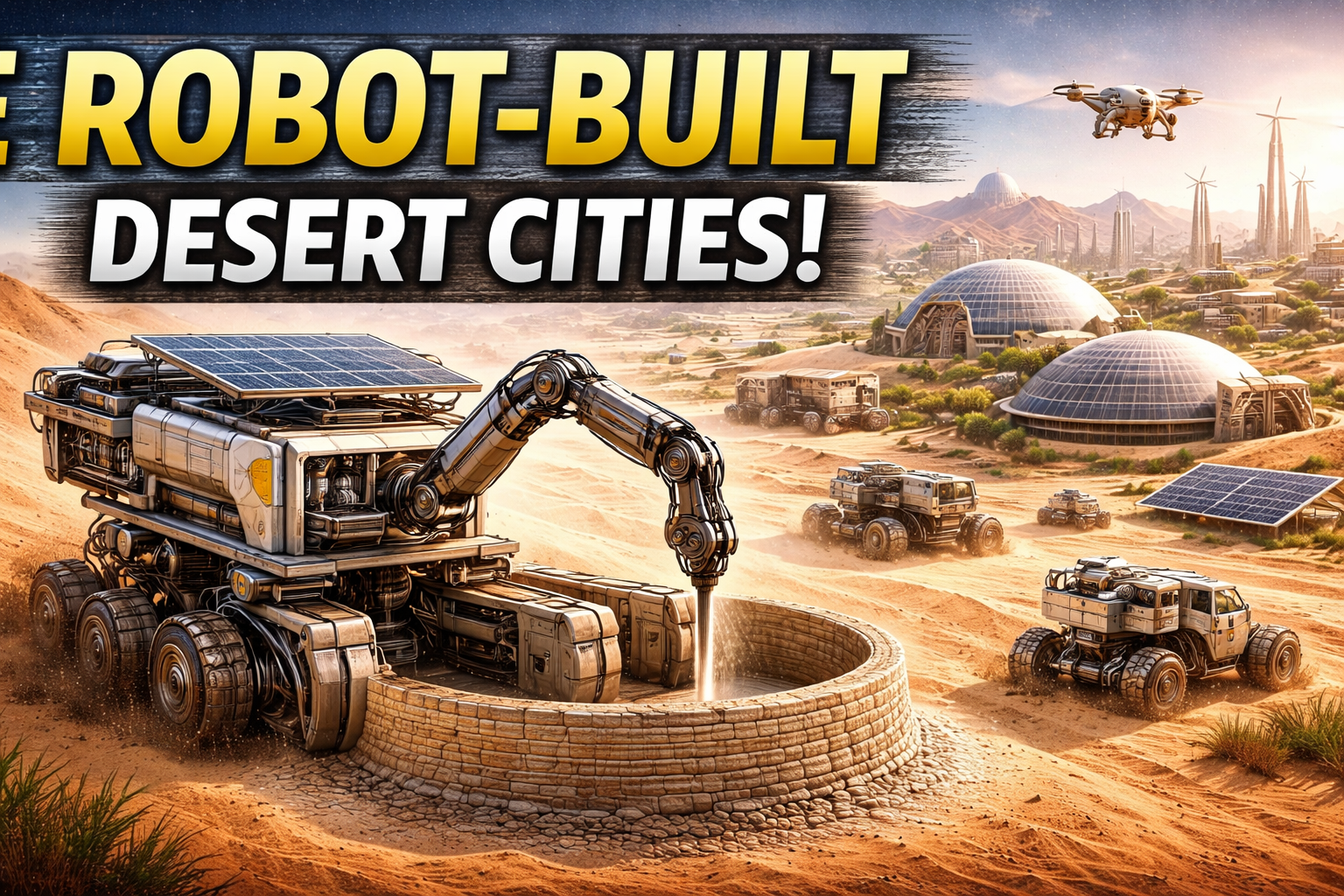
A growing number of engineers and researchers now believe that the cities of the future—especially in desert regions—may not be built primarily by human workers at all. Instead, they could be constructed by autonomous machines working together, using local materials like sand and powered almost entirely by solar energy.
If current progress continues, some experts say that by the end of this decade, we could begin to see early versions of Robot-built urban areas in places like the American Southwest and parts of the Middle East.
A very different way of building
Traditional construction is slow, labor-intensive, and heavily dependent on supply chains. Materials have to be transported, large crews need to be coordinated, and projects can take years to complete.
Robotic construction is trying to change that model.
Instead of relying on a single large system, many of these new approaches use multiple smaller machines that work together. Some dig and prepare the ground, others level and compact it, while a separate set focuses on actually building structures.
These machines are often guided by drones that scan the landscape and send back real-time data, helping everything stay aligned and efficient. Because the systems are electric and automated, they can operate for longer hours with fewer safety risks and less waste.
It’s less like a traditional construction site and more like a coordinated network of machines, each handling a specific role.
Building with what’s already there
One of the most interesting ideas being explored is the use of desert sand itself as a building material.
Transporting concrete or steel into remote desert regions is expensive and complicated. So instead, researchers are working on ways to process sand locally and turn it into something structurally strong.
Some experimental systems aim to convert sand into a form of engineered limestone that is both durable and more environmentally friendly than traditional materials. In some cases, the process could even help reduce carbon emissions rather than add to them.
If that becomes scalable, it would remove one of the biggest barriers to desert construction—bringing in materials from elsewhere.
Designing buildings that stay cool naturally
Heat is one of the biggest challenges in desert environments. Cooling buildings usually requires a huge amount of energy, especially when relying on conventional air conditioning.
That’s where design plays a big role.
With robotic construction, it becomes easier to create complex shapes and internal structures that would be difficult or expensive to build manually. This includes airflow channels, shaded surfaces, and layouts that reduce direct heat exposure.
The goal is to let buildings cool themselves as much as possible—using natural ventilation and smart design rather than relying entirely on mechanical systems.
Combined with solar power and other renewable energy sources, this could significantly reduce the energy demand of entire cities.
From concept to real-World projects
While much of this still sounds experimental, some large-scale projects are already trying to bring similar ideas to life.
In the United States, a proposed city called Telosa aims to rethink urban living with sustainability at its core, including renewable energy and modern infrastructure.
Meanwhile, in Saudi Arabia, the massive NEOM development includes The Line, a planned city designed to run entirely on clean energy, with no traditional roads or cars.
These projects aren’t fully dependent on robotic construction yet, but they reflect the same broader shift—rethinking how cities are designed, powered, and built.
The challenges are still real
Despite the optimism, there are still plenty of obstacles.
Desert environments are tough on machines as well as humans. High temperatures, dust, and sandstorms can interfere with sensors, reduce efficiency, and increase maintenance needs.
Cost is another major factor. Many of these projects require huge upfront investment, often running into billions—or even hundreds of billions—of dollars.
And there’s also a track record to consider. Not every ambitious “city of the future” concept has worked out as planned. Some have struggled to attract residents, while others have faced delays or scaling issues.
What happens next
Even with those challenges, the direction is clear: construction technology is evolving quickly, and automation is becoming a bigger part of the process.
By 2030, it’s possible that we’ll see the first real examples of partially or fully robot-built communities in desert regions.
If those early projects succeed, the model could expand beyond a few high-profile locations. Similar approaches might eventually be used in other harsh environments—from parts of Africa to Australia—where traditional construction is difficult and expensive.
A quiet shift in how cities are made
What’s changing here isn’t just the tools—it’s the entire approach to building.
Instead of moving materials and people into challenging environments, the idea is to use what’s already there and let machines handle much of the work.
It’s still early, and a lot remains uncertain. But if these technologies continue to develop, the cities of the future may not just look different—they may also be built in ways that would have seemed almost impossible just a decade ago.