
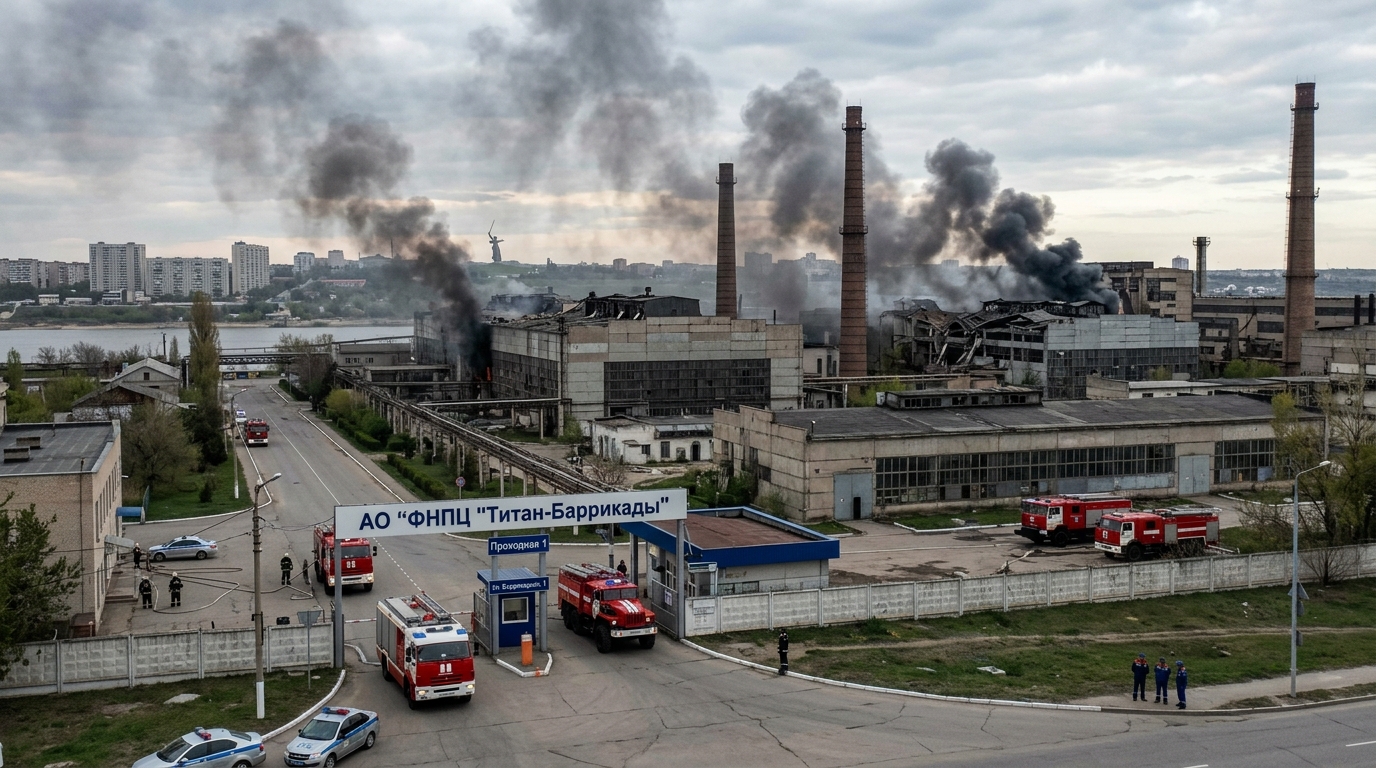
Ukrainian Sources Claim Multiple Impacts on Key Russian Military Industry Site in Volgograd
A major Defense manufacturing facility in Russia’s Volgograd region reportedly came under attack on June 27, drawing fresh attention to the growing reach of long-range strike operations in the Russia-Ukraine conflict. According to Ukrainian sources and open-source intelligence (OSINT) analysts, multiple impacts were recorded at the Titan-Barrikady plant, one of Russia’s most important defense industry enterprises.
The facility is known for producing launch systems, artillery equipment, and components linked to several Russian missile programs. Reports circulating on social media and among OSINT communities indicated that several projectiles struck the site, causing visible explosions and renewed discussion about the vulnerability of strategic industrial facilities located deep inside Russian territory.
The reported Volgograd Defense Plant Strike has become one of the most closely watched military developments of the week as analysts assess its potential implications for Russia’s defense manufacturing sector.
Reports of Multiple Impacts
According to preliminary information released by Ukrainian-linked sources, the attack targeted the JSC “FNPC Titan-Barrikady” enterprise in Volgograd. Open-source analysts reported observing several separate impacts within the industrial complex.
Videos and images shared online appeared to show explosions and flashes near the facility. While independent verification of all claims remains ongoing, OSINT groups tracking developments stated that multiple strike points were identified within the plant’s grounds.
The Volgograd Defense Plant Strike quickly gained attention because of the facility’s strategic role within Russia’s military-industrial network.
Local authorities in Russia acknowledged air defense activity in the region but did not immediately provide detailed assessments regarding damage at the site. As often happens during wartime incidents, information from both sides remained limited during the initial hours following the reported attack.
Importance of Titan-Barrikady
Titan-Barrikady is widely regarded as one of Russia’s key defense manufacturing enterprises.
The facility has historically specialized in the production of heavy artillery systems, launch platforms, and equipment associated with strategic missile programs. Publicly available information indicates that the plant has participated in the manufacture of components linked to several major Russian weapons systems.
Industry observers describe the enterprise as an important element of Russia’s broader military production chain. Because of this role, the plant has been included in various international sanctions programs imposed following Russia’s military actions in Ukraine.
The reported Volgograd Defense Plant Strike has therefore attracted significant attention not only because of its location but also because of the facility’s strategic significance.
Growing Focus on Defense Industry Targets
Since the beginning of the war, both Russia and Ukraine have increasingly targeted military infrastructure, logistics hubs, and industrial facilities connected to defense production.
Military analysts note that modern conflicts increasingly involve efforts to disrupt production capabilities rather than focusing solely on battlefield positions. Defense factories, ammunition depots, and logistics centers have become critical targets because they support long-term military operations.
The attack reported in Volgograd fits into a broader pattern of strikes aimed at facilities considered important to military supply chains.
Supporters of such operations argue that disrupting production can reduce an opponent’s ability to sustain combat activities. Critics warn that attacks on industrial infrastructure may increase escalation risks and expand the conflict’s geographical scope.
Previous Reported Incidents
The Volgograd incident follows a series of previously reported strikes against military-related industrial sites and storage facilities in Russia.
Open-source researchers have documented multiple incidents over the past year involving defense enterprises, logistics centers, and military warehouses. Several facilities connected to missile production, ammunition storage, and explosives manufacturing have reportedly experienced attacks.
These incidents have fueled discussions about evolving military technology and the growing ability of long-range systems to reach strategic targets far from front-line positions.
The latest Volgograd Defense Plant Strike adds another chapter to this trend, highlighting how industrial infrastructure has become increasingly exposed to modern precision operations.
OSINT Community Plays Major Role
One notable feature of recent military developments has been the growing influence of open-source intelligence communities.
Independent researchers often analyze satellite imagery, social media videos, geolocation data, and publicly available information to assess battlefield events. Their findings frequently circulate online before official statements are released.
In the case of Volgograd, OSINT groups quickly began reviewing available footage and images to identify impact locations and estimate potential damage.
While such assessments can provide valuable insights, analysts caution that early reports should be treated carefully until independently verified through multiple sources.
The rapid dissemination of information surrounding the Volgograd Defense Plant Strike demonstrates how digital technology has transformed the way conflicts are documented and discussed.
Strategic Implications
Military experts suggest that attacks on defense manufacturing facilities can have both practical and symbolic significance.
From a practical perspective, disruptions at industrial sites may affect production schedules, maintenance activities, or supply chains. Even temporary interruptions can create logistical challenges.
Symbolically, strikes on high-profile facilities can send political and psychological messages, demonstrating an ability to reach locations previously considered relatively secure.
The strategic impact of the reported Volgograd incident will likely depend on the extent of any actual damage and how quickly normal operations can resume.
At this stage, no comprehensive official assessment of damage has been publicly released.
Regional Security Concerns
The reported attack has also renewed debate about regional security and the expanding range of military operations.
As strikes increasingly reach deeper into national territories, governments face growing pressure to strengthen air defense systems and protect critical infrastructure.
Security analysts note that industrial facilities linked to defense production are likely to remain high-priority assets for protection efforts in the months ahead.
The Volgograd Defense Plant Strike underscores how modern warfare increasingly extends beyond traditional front lines and affects strategic infrastructure far from active combat zones.
Looking Ahead
The coming days may provide greater clarity regarding the consequences of the reported attack.
Officials, independent analysts, and international observers will continue monitoring developments as additional information becomes available. Satellite imagery, official statements, and further OSINT analysis may help determine the scale of the incident and its potential impact.
For now, the reported Volgograd Defense Plant Strike highlights the continuing evolution of the Russia-Ukraine conflict and the growing importance of industrial infrastructure within modern military strategy.
As both sides continue adapting to changing battlefield conditions, facilities connected to defense production are likely to remain at the center of strategic calculations, making incidents like the one reported in Volgograd a significant focus for military analysts and policymakers alike.