If Iran’s Leadership Transition Comes Under Fire : A change at the top of Iran’s leadership would almost certainly become more than a funeral—it would be used to reinforce legitimacy at home and project resolve abroad.
Authoritarian governments rarely separate national grief from political strategy. In Iran, where religion, state institutions, and military power are deeply intertwined, any leadership transition would almost certainly be choreographed as both a domestic demonstration of loyalty and an international display of strength.
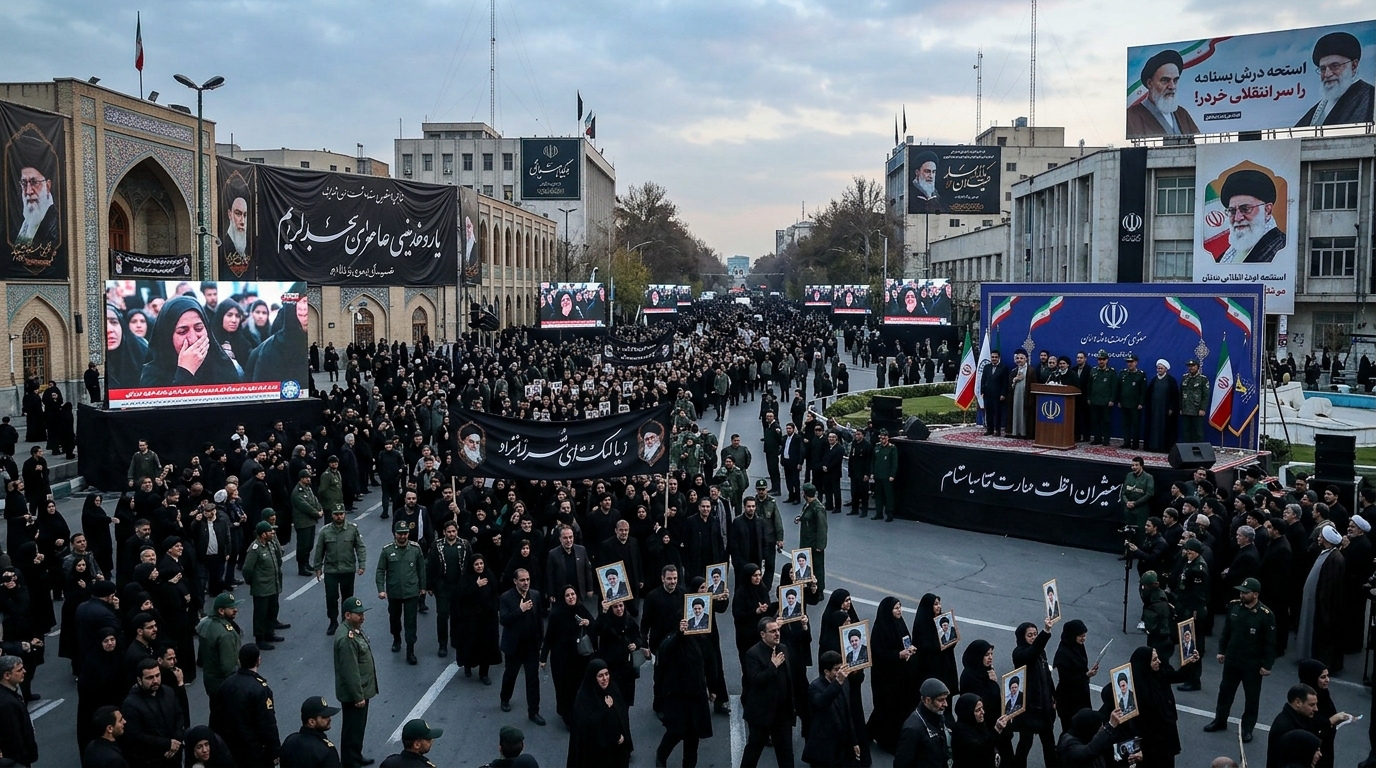
If such a moment were to arrive, the funeral of a supreme leader would likely become far more than a farewell. It would serve as a carefully managed political event designed to reassure supporters, discourage rivals, and send messages beyond Iran’s borders.
Large public ceremonies have long been central to the Islamic Republic’s political identity. Massive crowds, official speeches, religious symbolism, and state-controlled media coverage all help reinforce the narrative that the country’s leadership continues to enjoy broad public support. Whether those displays accurately reflect public sentiment is a separate question, but their political purpose is difficult to miss.
A leadership transition would also provide an opportunity to strengthen the legitimacy of whoever emerged as Iran’s next supreme leader. Rather than presenting succession as uncertainty, the state would likely frame it as continuity—emphasizing that the country’s strategic direction remains unchanged despite changes in individual leadership.
That message would not be intended solely for domestic audiences.
Iran’s regional rivals, particularly Israel and the United States, would almost certainly interpret any leadership transition as a potential moment of vulnerability. Tehran, aware of that perception, would likely seek to project confidence instead of weakness through official statements, military messaging, and highly public public ceremonies.
This pattern has appeared before.
Throughout the Islamic Republic’s history, periods of external pressure have frequently been accompanied by rhetoric emphasizing resistance, national unity, and deterrence. Political symbolism often becomes inseparable from military signaling.
The nuclear issue would almost certainly remain central to that messaging.
Successive Iranian governments have consistently argued that the country’s nuclear program represents a matter of national sovereignty rather than foreign negotiation. Critics abroad remain skeptical of Tehran’s intentions, while Iranian officials continue portraying outside pressure as an attack on national independence.
A future leadership transition would be unlikely to alter those competing narratives overnight.
Likewise, maritime security in the Persian Gulf and the Strait of Hormuz would probably continue serving as another platform for strategic messaging. Iran has repeatedly emphasized the importance of these waterways to its national security, while Western governments continue insisting on freedom of navigation through one of the World’s most critical energy corridors.
Those disputes are larger than any individual leader.
One reason political transitions attract so much international attention is because they offer rare opportunities to assess whether long-standing policies may evolve. Yet history suggests that institutions often matter more than personalities. In Iran, where the Revolutionary Guard, religious authorities, and the broader security establishment hold significant influence, continuity frequently outweighs dramatic policy change.
That is why expectations of immediate moderation—or immediate escalation—should be approached cautiously.
Political theater is not unique to Iran. Governments around the world use ceremonies, commemorations, and symbolic events to strengthen legitimacy and shape public perception. What differs is the scale, the geopolitical stakes, and the degree to which those events become intertwined with military and diplomatic messaging.
If Iran eventually experiences a major leadership transition, observers should expect every image, every speech, and every public appearance to be scrutinized for clues about the country’s future direction. Some signals will be genuine. Others may be intended primarily for psychological or political effect.
Distinguishing between the two will remain one of the greatest challenges for policymakers, intelligence analysts, and the international media.
Ultimately, the most important question will not be how elaborate any funeral becomes, but whether the next generation of Iranian leadership chooses continuity or meaningful change.
Until that answer becomes clear, symbolism should be interpreted carefully—and never confused with certainty.