Drone Activity, Tanker Attacks, and Rising Tensions Highlight Challenges Facing Post-War Stability
The ceasefire agreement between the United States and Iran was intended to mark the beginning of a more stable period in the Middle East after months of military confrontation. However, a series of fresh incidents across the Gulf region is raising questions about whether the truce can hold and whether both sides are truly committed to de-escalation.
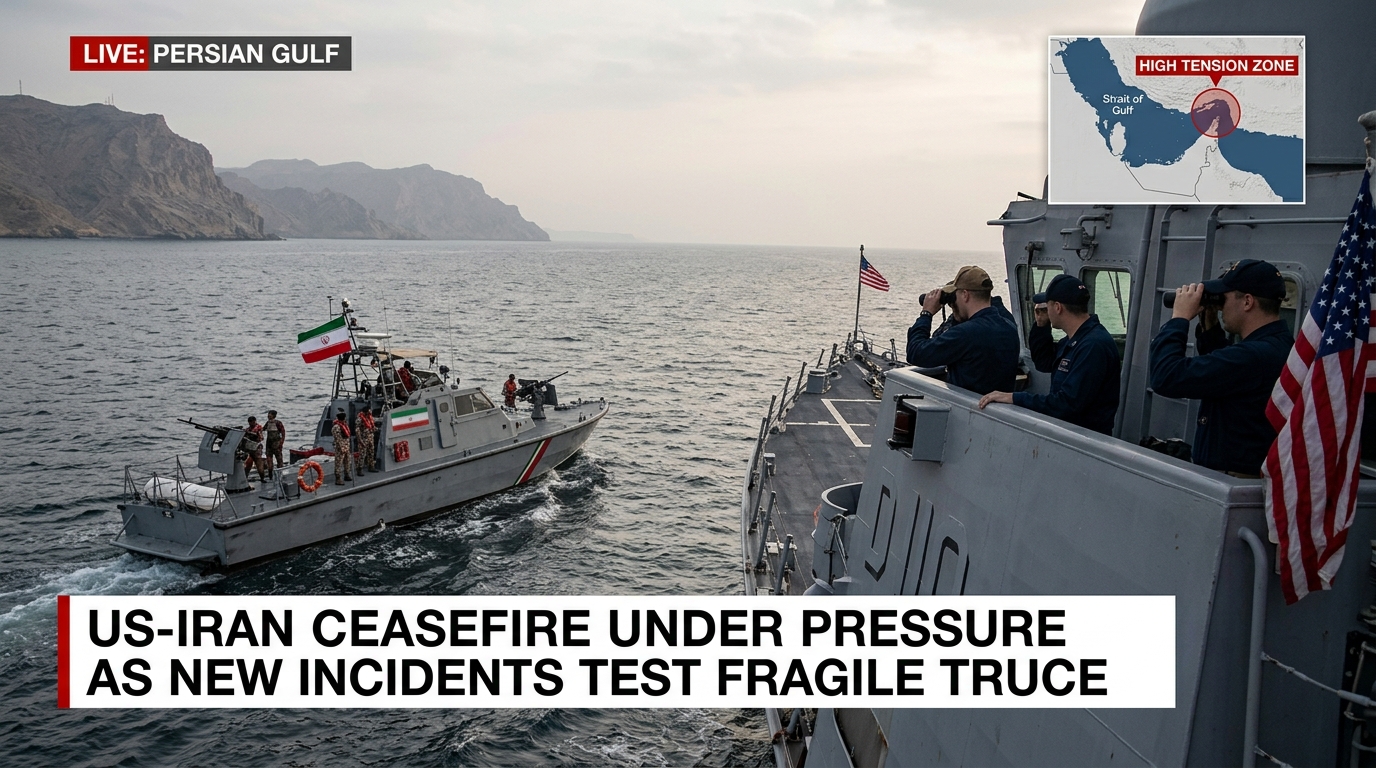
Only hours after U.S. military strikes targeted Iranian missile and radar facilities, reports emerged of Iranian attack drones entering airspace over Bahrain. At nearly the same time, another commercial vessel traveling through the Strait of Hormuz reportedly came under attack, marking the second such incident involving a tanker in just a matter of days.
The developments have placed the spotlight on what many analysts describe as a ceasefire that remains active on paper but increasingly fragile in practice.
The US Iran Ceasefire Under Pressure story reflects a broader reality facing both Washington and Tehran. Neither side appears eager to return to full-scale war, yet neither is willing to step back completely from actions designed to demonstrate strength and maintain leverage.
American officials accused Iran of violating the ceasefire framework by targeting a commercial vessel operating in one of the World’s most important shipping corridors. In response, U.S. forces reportedly carried out strikes against coastal military infrastructure near the Strait of Hormuz and on Qeshm Island.
Iran rejected the accusations and described its actions as defensive measures. Officials in Tehran argued that recent U.S. military operations constituted aggression and insisted that Iran would continue protecting what it called its sovereignty and national interests.
As a result, the current situation has become less about direct military confrontation and more about strategic signaling.
The US Iran Ceasefire Under Pressure situation demonstrates how modern conflicts often continue even after formal agreements are reached. Instead of large-scale offensives, both sides are engaging in limited actions designed to communicate resolve without crossing the threshold that could trigger a wider war.
Nowhere is this dynamic more visible than in the Strait of Hormuz.
The strategic waterway remains one of the most important routes for global energy transportation. Millions of barrels of oil pass through the strait each day, making stability in the region a priority not only for countries directly involved in the conflict but also for international markets.
Despite assurances that maritime traffic would remain secure following the ceasefire agreement, shipping companies continue to face uncertainty. Reports of attacks on vessels, including incidents involving tankers and cargo ships, have forced insurers, ship operators, and traders to reassess risk levels.
Every new security incident increases concerns about potential disruptions to trade and energy supplies.
The US Iran Ceasefire Under Pressure narrative is also influencing financial markets. Oil prices have reacted sharply to reports of attacks and military activity, often rising immediately after incidents before falling back as investors conclude that neither Washington nor Tehran wants a major escalation.
Market analysts say this pattern reflects growing confidence that both sides remain committed to avoiding a return to open warfare, even as tensions remain elevated.
Beyond the Gulf, attention is also focused on developments along the Israel-Lebanon border.
The United States has supported an arrangement aimed at reducing tensions in southern Lebanon. Under the proposed framework, Israeli forces would withdraw from limited areas while the Lebanese Army assumes greater responsibility for security.
Supporters argue that such measures could reduce the likelihood of cross-border clashes and create conditions for longer-term stability.
However, the proposal faces significant challenges.
Hezbollah leaders have publicly rejected aspects of the arrangement and stated that they do not consider themselves bound by provisions they did not formally negotiate. The group’s position highlights one of the most difficult realities of modern diplomacy: agreements between governments do not always guarantee cooperation from powerful non-state actors.
The situation has reinforced concerns that regional stability remains dependent on the actions of multiple groups with different interests and objectives.
For many observers, the US Iran Ceasefire Under Pressure developments reveal the limits of military victories and diplomatic agreements alike.
The conflict itself demonstrated that neither side could achieve all of its objectives without accepting enormous costs. The ceasefire created a framework for reducing violence, but it did not eliminate the underlying disagreements that fueled the confrontation in the first place.
As a result, the post-war environment has become a testing ground where both sides continue probing the boundaries of what the agreement allows.
Military experts describe the current phase as a controlled competition rather than genuine peace. Drone flights, limited strikes, maritime incidents, and carefully worded political statements have replaced major bombardments, but the strategic contest remains active.
Diplomats hope that communication channels established during ceasefire negotiations can prevent isolated incidents from escalating into something larger. Yet every new confrontation increases pressure on the agreement and raises fresh doubts about its durability.
The US Iran Ceasefire Under Pressure challenge is therefore not simply about enforcing a truce. It is about determining whether a deeply rooted rivalry can be managed without returning to a cycle of retaliation and escalation.
International governments are closely monitoring the situation. European and Asian countries with strong economic interests in Gulf shipping routes have urged restraint from all parties. Energy markets, shipping firms, and regional allies are likewise watching developments carefully.
For now, neither Washington nor Tehran appears prepared to abandon the ceasefire entirely. Both sides continue to emphasize their commitment to avoiding a wider conflict while simultaneously defending actions that critics argue undermine the agreement.
That contradiction may define the next stage of the crisis.
On paper, the region is experiencing de-escalation. In reality, the ceasefire is being tested daily through military signals, economic pressure, and competing narratives. The challenge for policymakers now is ensuring that these limited confrontations remain limited.
Whether the truce ultimately evolves into a lasting peace or collapses under the weight of repeated violations will depend on decisions made in the weeks ahead. Until then, the Middle East remains in a tense and uncertain period where diplomacy and deterrence continue to operate side by side.