
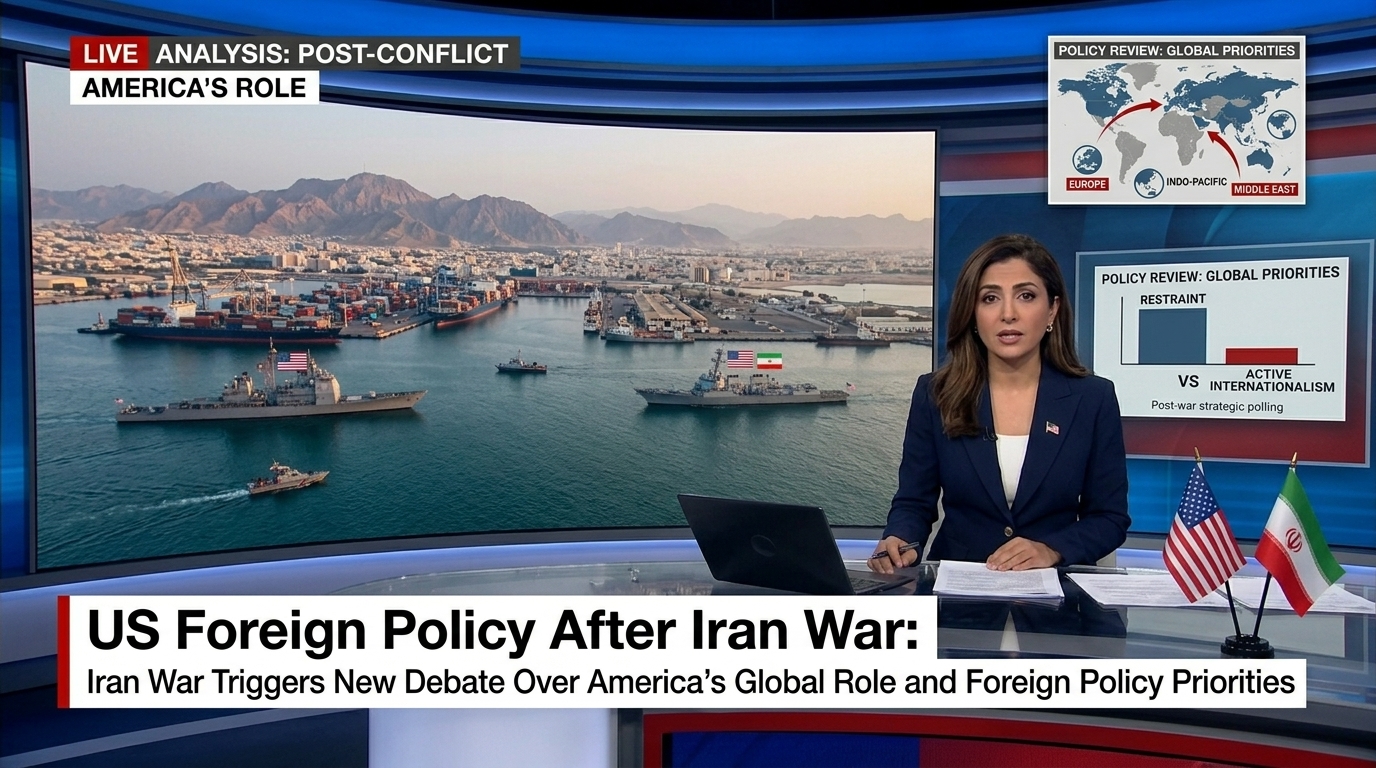
Analysts Call for Strategic Reassessment as Washington Weighs Lessons From Costly Conflict
The end of the Iran conflict and the signing of a ceasefire agreement have sparked a growing debate across the United States about the future of American foreign policy. As policymakers, analysts, and political leaders assess the consequences of the war, many are questioning whether decades of military engagement in the Middle East continue to serve America’s long-term interests.
The discussion goes far beyond the ceasefire itself. Instead, it centers on what lessons Washington should learn from a conflict that consumed significant military resources, affected global energy markets, and tested the limits of American power in a rapidly changing international environment.
For many observers, the most important question is not how the war ended, but what comes next.
The US Foreign Policy After Iran War debate has emerged as one of the most significant strategic discussions in Washington, with experts offering sharply different views on America’s future role in global affairs.
One school of thought argues that the conflict demonstrates the need for the United States to reduce its military footprint in the Middle East. Supporters of this position contend that decades of involvement in regional conflicts have required enormous financial investments while producing mixed results.
They argue that military deployments, overseas bases, and repeated interventions have stretched American resources and diverted attention from domestic priorities. According to this view, regional challenges should increasingly be managed by countries within the region rather than by outside powers.
Advocates of a reduced military presence also point to the changing strategic importance of the Middle East. While the region remains important for global energy supplies and international trade, they argue that its direct importance to American security has declined compared with previous decades.
The US Foreign Policy After Iran War conversation therefore includes renewed calls for a more restrained approach to international engagement.
Supporters of this strategy believe the United States should focus more heavily on protecting its homeland, strengthening economic competitiveness, and addressing domestic challenges rather than attempting to shape political outcomes abroad.
At the center of the debate is a broader question about global leadership.
For more than three decades following the end of the Cold War, the United States maintained a foreign policy built around extensive international engagement and military superiority. That strategy sought to preserve American influence across multiple regions and deter potential rivals through a combination of alliances, military presence, and economic power.
However, some analysts argue that the international system is becoming increasingly multipolar.
Rising powers, technological advancements, and new military capabilities are changing the balance of global influence. Modern drones, precision missiles, cyber capabilities, and other technologies have made it easier for smaller states and non-state actors to challenge larger military powers.
The Iran conflict is frequently cited as an example of this trend.
Despite significant military capabilities, the United States faced challenges in translating battlefield advantages into lasting political outcomes. Analysts note that military success does not automatically guarantee strategic success, particularly when conflicts involve complex regional dynamics and multiple actors.
The US Foreign Policy After Iran War discussion increasingly reflects these realities.
Many experts argue that future strategies should place greater emphasis on diplomacy, economic competition, technological innovation, and alliance management rather than relying primarily on military power.
Another major issue raised by the conflict involves energy security.
The war highlighted how quickly disruptions in key shipping routes can affect global markets. Concerns surrounding the Strait of Hormuz repeatedly caused fluctuations in Oil Prices and renewed attention on the vulnerability of international energy supplies.
Although the United States remains one of the World’s largest energy producers, economists point out that oil prices are largely determined by global market conditions rather than national production levels alone.
As a result, disruptions anywhere in the global supply chain can have consequences for consumers and businesses worldwide.
The US Foreign Policy After Iran War debate has therefore expanded to include discussions about energy diversification and long-term resilience.
Many experts argue that investments in renewable energy, advanced battery technologies, and alternative power sources could reduce exposure to geopolitical shocks. Supporters of diversification view these technologies not only as environmental initiatives but also as strategic tools that enhance national security.
By reducing dependence on volatile energy markets, governments may be better positioned to withstand future crises.
The ceasefire agreement itself remains another source of debate.
Critics argue that the arrangement provided economic relief and diplomatic concessions to Iran without securing enough long-term guarantees in return. Others counter that such arguments overlook a fundamental reality: negotiations often reflect the balance of power and circumstances at the moment they occur.
Supporters of the agreement maintain that ending the conflict was the most important objective.
They argue that prolonged warfare would have imposed additional costs on all parties involved while increasing risks to regional stability and global economic growth.
From this perspective, the ceasefire should be viewed not as a perfect agreement but as a practical step toward reducing violence and creating opportunities for future diplomacy.
International reactions have reflected similar divisions.
Some allies welcome efforts to reduce tensions and prevent further military escalation. Others remain concerned about how the agreement could affect regional security dynamics in the years ahead.
Meanwhile, financial markets have generally responded positively to signs of stabilization, particularly regarding shipping routes and energy supplies.
For policymakers in Washington, the challenge now extends beyond managing relations with Iran. The larger task involves determining how America should position itself in an increasingly complex international environment.
The US Foreign Policy After Iran War debate is likely to shape strategic planning for years to come. Decisions about military spending, overseas deployments, energy investments, and diplomatic priorities may all be influenced by lessons drawn from the conflict.
Whether leaders ultimately choose greater international engagement or a more restrained approach remains uncertain. What is clear, however, is that the war has reignited important questions about power, security, and national priorities.
As the United States moves into the post-war period, the focus is shifting from battlefield outcomes to long-term strategy. The ceasefire may have ended active fighting, but the broader debate about America’s role in the world is only beginning.
For many analysts, the conflict serves as a reminder that military power remains an important tool, but not the only one. The future of American influence may depend just as much on economic strength, technological leadership, energy resilience, and effective diplomacy as it does on force projection.
Those questions will continue to define discussions in Washington long after the final chapter of the Iran conflict has been written