
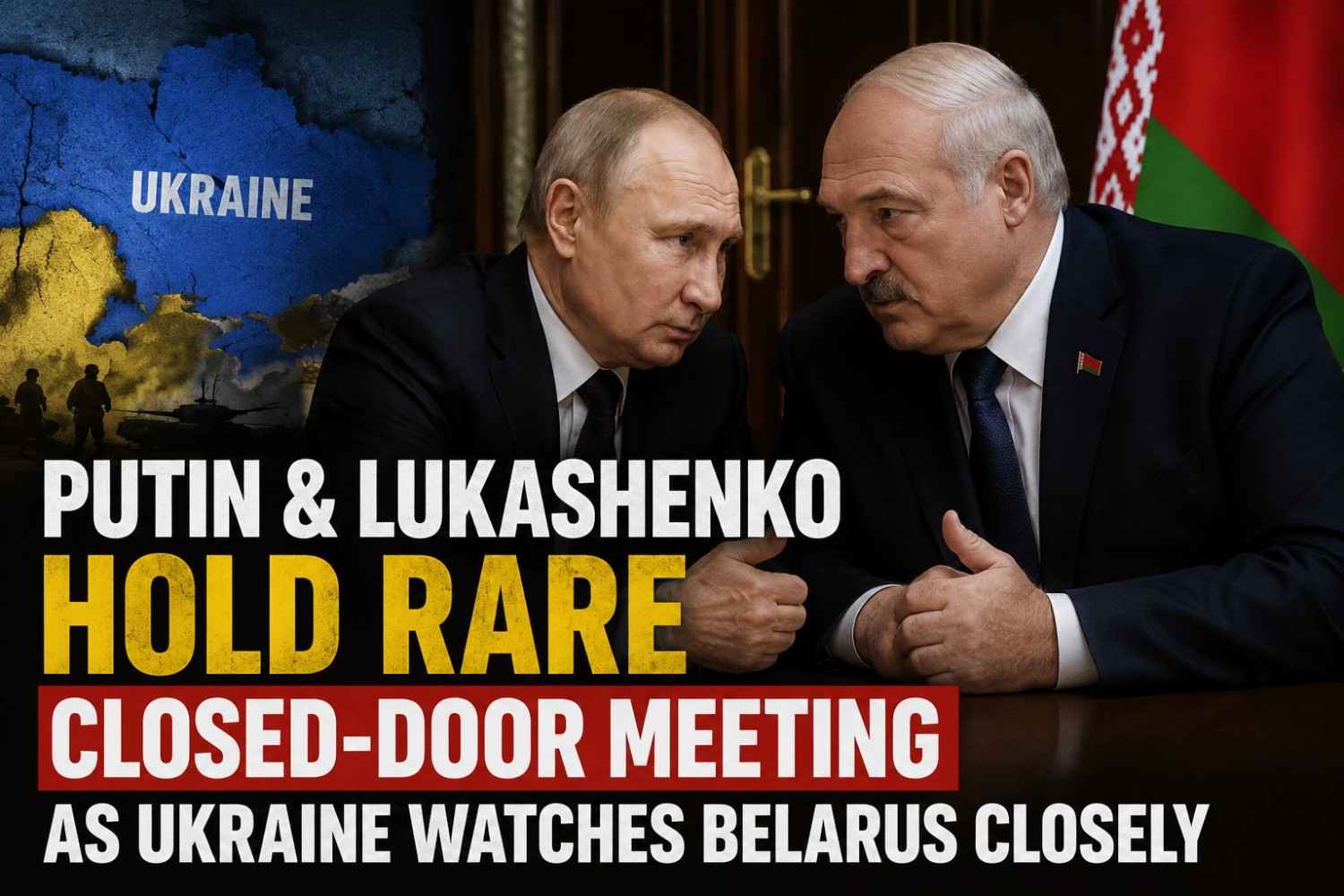
Two-Day Talks End Without Public Statement, Fueling Questions About Belarus’ Role in the Ongoing Ukraine War
Russian President Vladimir Putin and Belarusian President Alexander Lukashenko have concluded a rare two-day meeting without issuing a public statement, drawing attention from observers across Europe as tensions surrounding the war in Ukraine continue to rise.
The unusual talks took place at Putin’s residence in Valdai, a location not commonly used for meetings with foreign leaders. While both Moscow and Minsk confirmed that discussions took place, neither side released a detailed summary of what was discussed, leading to speculation about the purpose and significance of the gathering. Reports indicate that the leaders focused on regional security, economic cooperation, trade, and issues related to the ongoing conflict in Ukraine.
The Putin and Lukashenko Meeting comes at a particularly sensitive moment in the war. Ukraine has recently increased pressure on Belarus, accusing Minsk of indirectly assisting Russian military operations through infrastructure allegedly used to support drone attacks. Ukrainian officials have warned Belarus against becoming more deeply involved in the conflict, while Belarus has repeatedly stated that it does not intend to enter the war directly.
The lack of a public readout following the talks has become one of the most notable aspects of the meeting. Kremlin officials confirmed beforehand that no joint statements or press conferences were planned. Such secrecy is unusual given the importance of the relationship between Russia and Belarus and the ongoing security concerns in the region.
According to officials familiar with the meeting, discussions covered trade cooperation, joint economic projects, and regional security matters. However, analysts believe the timing suggests that the conflict in Ukraine was likely one of the most important topics on the agenda.
The Putin and Lukashenko Meeting occurred shortly after a period of growing diplomatic tension between Belarus and Ukraine. Ukrainian President Volodymyr Zelenskyy recently accused Belarus of allowing Russian military infrastructure on its territory to support attacks against Ukraine. Kyiv demanded that certain relay systems allegedly used in Russian drone operations be removed. Later, Ukrainian officials reported that the systems had stopped operating, though independent verification remained limited.
Belarus occupies a strategically important position in the conflict. During the early stages of Russia’s full-scale invasion in 2022, Russian forces used Belarusian territory as a launching point for operations targeting northern Ukraine. Since then, Belarus has remained one of Moscow’s closest allies, maintaining strong military, political, and economic ties with Russia. At the same time, Minsk has avoided directly deploying its own troops into combat operations inside Ukraine.
Lukashenko has repeatedly emphasized that Belarus does not want to be drawn into direct fighting. In recent comments, he stated that Belarus has no intention of sending troops into Ukraine and warned against attempts to pull his country into the conflict. He also revealed that he had recently met representatives connected to the Ukrainian leadership and conveyed concerns about rising tensions along the border.
The Putin and Lukashenko Meeting has also attracted attention because of reports suggesting Russia may be seeking greater cooperation from Belarus as the war enters another critical phase. Various reports have indicated that Moscow views Belarus as an important strategic partner capable of providing logistical, military, and economic support. Both Russia and Belarus have publicly denied claims that Minsk is being pressured to expand its involvement in the conflict.
Military analysts note that Belarus remains important to Russia for several reasons. The country shares borders with Ukraine and several NATO members, making it a significant geographic and strategic partner. Belarus also hosts Russian military assets and has participated in joint Defense exercises with Moscow for years. These factors continue to make Belarus a key player in regional security discussions.
At the same time, Belarus faces a difficult balancing act. While its government remains closely aligned with Russia, Lukashenko has shown caution about becoming directly involved in combat. Analysts argue that entering the war could create political, economic, and security challenges for Belarus, which has already faced international sanctions and increased scrutiny from Western governments.
The Putin and Lukashenko Meeting has therefore become a focal point for observers attempting to understand the future direction of the conflict. Without an official statement, questions remain about what agreements may have been discussed behind closed doors and whether new security arrangements could emerge in the coming months.
Across Ukraine, officials continue monitoring activity near the Belarusian border. Kyiv has repeatedly warned about military infrastructure developments and what it describes as unusual activity in Belarus. Ukrainian authorities maintain that vigilance remains necessary even though Belarus has so far refrained from direct participation in the war.
For Russia, maintaining strong ties with Belarus remains strategically valuable as the conflict continues. For Belarus, avoiding deeper involvement while preserving its alliance with Moscow presents an increasingly complex challenge.
As international attention remains focused on Eastern Europe, the closed-door talks between Putin and Lukashenko have generated fresh questions about regional security, future military cooperation, and the evolving relationship between Russia, Belarus, and Ukraine.
With no official details released and geopolitical tensions remaining high, the significance of this meeting may only become clearer in the weeks ahead. Until then, the secretive nature of the discussions ensures that the Putin and Lukashenko Meeting will remain a major topic of interest among diplomats, security experts, and political observers around the World.