
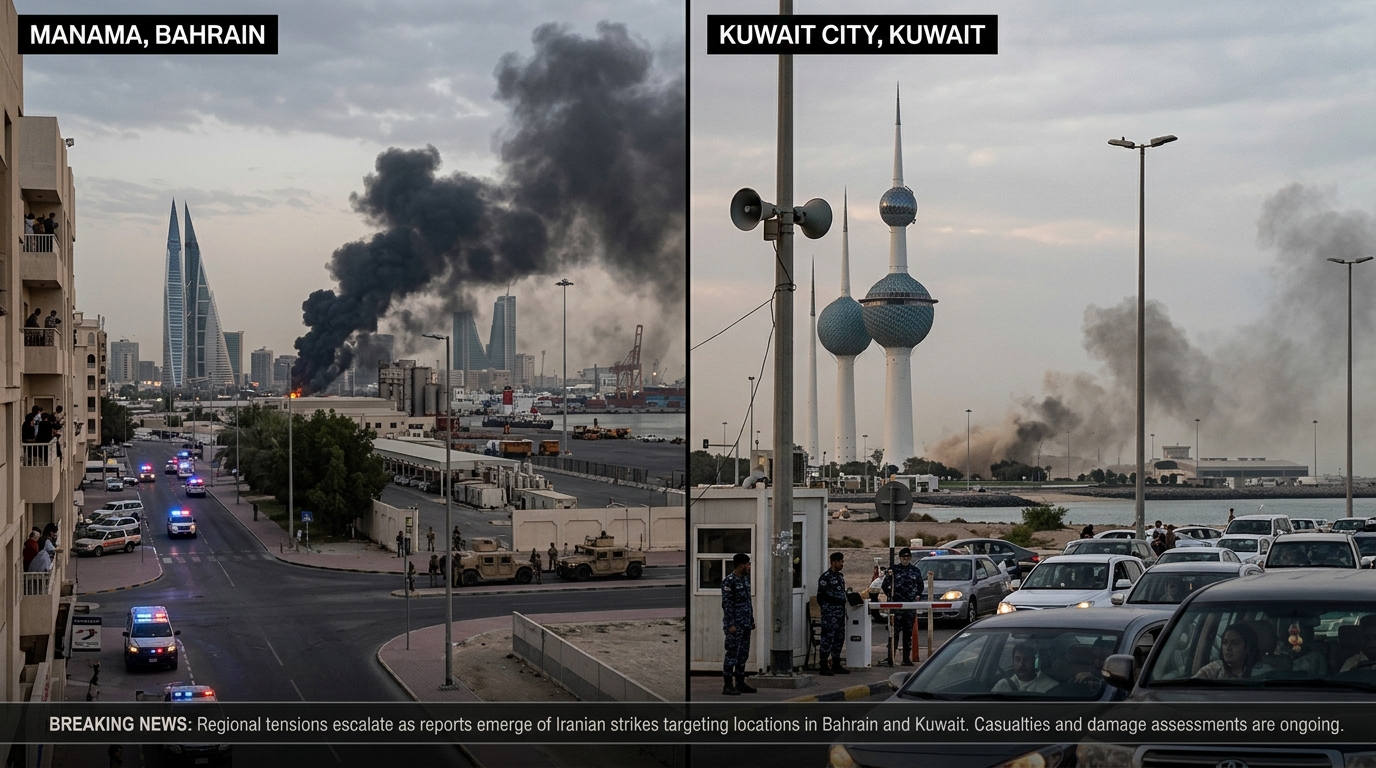
Fresh Military Exchanges Between Tehran and Washington Raise Fears of Wider Gulf Conflict
A new wave of military escalation has shaken the Middle East after Iran launched drone and missile attacks targeting Bahrain and Kuwait, while the United States carried out fresh airstrikes against Iranian military positions. The latest developments have raised concerns about the future of regional stability and the survival of a fragile agreement that was intended to reduce tensions between the two countries.
According to officials in the region, Iranian forces launched attacks against locations linked to U.S. military operations in Bahrain and Kuwait. The strikes came shortly after American forces targeted Iranian military infrastructure in response to an earlier attack on a commercial vessel in the Strait of Hormuz, one of the World’s most strategically important waterways.
The Iran Strikes Bahrain and Kuwait incident marks one of the most serious escalations in recent weeks and has intensified fears that the broader conflict could spread further across the Gulf region.
Authorities in Kuwait reported that air Defense systems intercepted incoming missiles before they reached their intended targets. Initial reports indicated no casualties, although officials confirmed that security forces remained on high alert. In Bahrain, damage was reported to a residential building, but no major injuries were immediately announced.
The attacks followed fresh U.S. military operations against Iranian facilities. American officials stated that the strikes targeted surveillance networks, air defense systems, drone storage sites, and capabilities believed to support military operations near the Strait of Hormuz. Washington described the action as a response to Iranian attacks on commercial shipping and a measure aimed at protecting freedom of navigation in the region.
The Strait of Hormuz remains a vital route for global energy supplies. A significant share of the world’s oil exports passes through the narrow waterway each day. Because of its importance, any military activity near the strait immediately attracts international attention and often affects energy markets worldwide.
The Iran Strikes Bahrain and Kuwait crisis has emerged despite recent diplomatic efforts to reduce hostilities. Earlier this month, the United States and Iran reached an initial framework agreement designed to ease tensions, reopen shipping routes, and continue negotiations over broader security issues. The agreement was seen as a major step toward preventing further military confrontation.
However, the latest exchange of attacks has placed that process under severe strain. Iranian officials accused Washington of violating previous understandings, while U.S. leaders argued that Tehran’s actions against commercial vessels represented a direct breach of commitments made during negotiations.
Former President Donald Trump, who remains at the center of U.S. policy decisions in this conflict scenario, warned that additional military action could follow if Iran continues attacks on shipping or American interests in the region. Iranian military officials responded with warnings of further retaliation if U.S. strikes continue.
The Iran Strikes Bahrain and Kuwait confrontation has also alarmed neighboring countries. Gulf governments are closely monitoring developments due to concerns that continued escalation could threaten regional security and disrupt trade routes that are critical to their economies.
Military analysts note that modern conflicts increasingly involve drones, missiles, and precision strikes rather than large-scale troop deployments. These technologies allow countries to project force across long distances while limiting direct battlefield engagement. However, they also increase the risk of rapid escalation because attacks can occur with little warning.
Global financial markets have reacted cautiously to the latest developments. Investors are watching the situation closely because prolonged instability near the Strait of Hormuz could affect oil supplies and transportation costs. While markets have not experienced major disruption so far, analysts warn that further military exchanges could increase volatility.
Beyond the immediate military implications, the crisis carries significant diplomatic consequences. Several international actors have called for restraint and urged both sides to return to negotiations. Diplomatic observers argue that preserving communication channels remains essential to preventing a broader regional conflict.
The Iran Strikes Bahrain and Kuwait episode also highlights the fragile nature of ceasefire and de-escalation agreements in highly volatile environments. Even after months of negotiations, a single incident involving commercial shipping or military assets can quickly reverse diplomatic progress and reignite tensions.
Regional security experts believe the coming days will be critical. If both sides continue retaliatory actions, the risk of a wider confrontation could increase significantly. On the other hand, renewed diplomatic engagement could still help prevent further escalation and stabilize the situation.
Meanwhile, commercial shipping operators remain focused on developments in the Strait of Hormuz. Shipping companies are reviewing security procedures and monitoring military activity as vessels continue to navigate one of the world’s busiest energy corridors. Any disruption to maritime traffic could have consequences extending far beyond the Middle East.
For residents of Bahrain, Kuwait, and neighboring Gulf states, the latest attacks serve as a reminder of how quickly regional tensions can affect daily life. Air defense alerts, heightened security measures, and uncertainty about future military action have once again placed the region on edge.
As international leaders call for calm, the focus now shifts to whether diplomacy can regain momentum before the crisis deepens further. The latest exchange of strikes has demonstrated how fragile regional stability remains and why developments involving Iran, the United States, and the Strait of Hormuz continue to command global attention.
With tensions high and both sides standing firm, the world is watching closely to see whether the situation moves toward renewed negotiations or a more dangerous phase of confrontation.