
Understanding Orbital Physics, Atmospheric Entry, and the Science Behind Extreme Kinetic Forces
April 3, 2026 – You’ve probably seen videos of shooting stars or heard about satellites falling back to Earth. But have you ever wondered what actually happens when an object drops out of orbit and slams into our atmosphere at nearly 28,000 kilometers per hour? Thanks to new digital simulations, scientists are now getting a much clearer—and more shocking—picture.
Here’s the surprising part: at those speeds, an object doesn’t need explosives or fuel to cause massive amounts of energy. All it needs is motion. Pure, terrifying motion.
First, Let’s Talk Orbit
Objects in low Earth orbit—like old satellites or space debris—are constantly moving at insane speeds, roughly 28,000 km/h (or 17,500 mph). At that speed, they’re basically falling forever—but they keep missing the Earth. They keep missing the planet because they’re moving forward just as fast as they’re being pulled down by gravity.
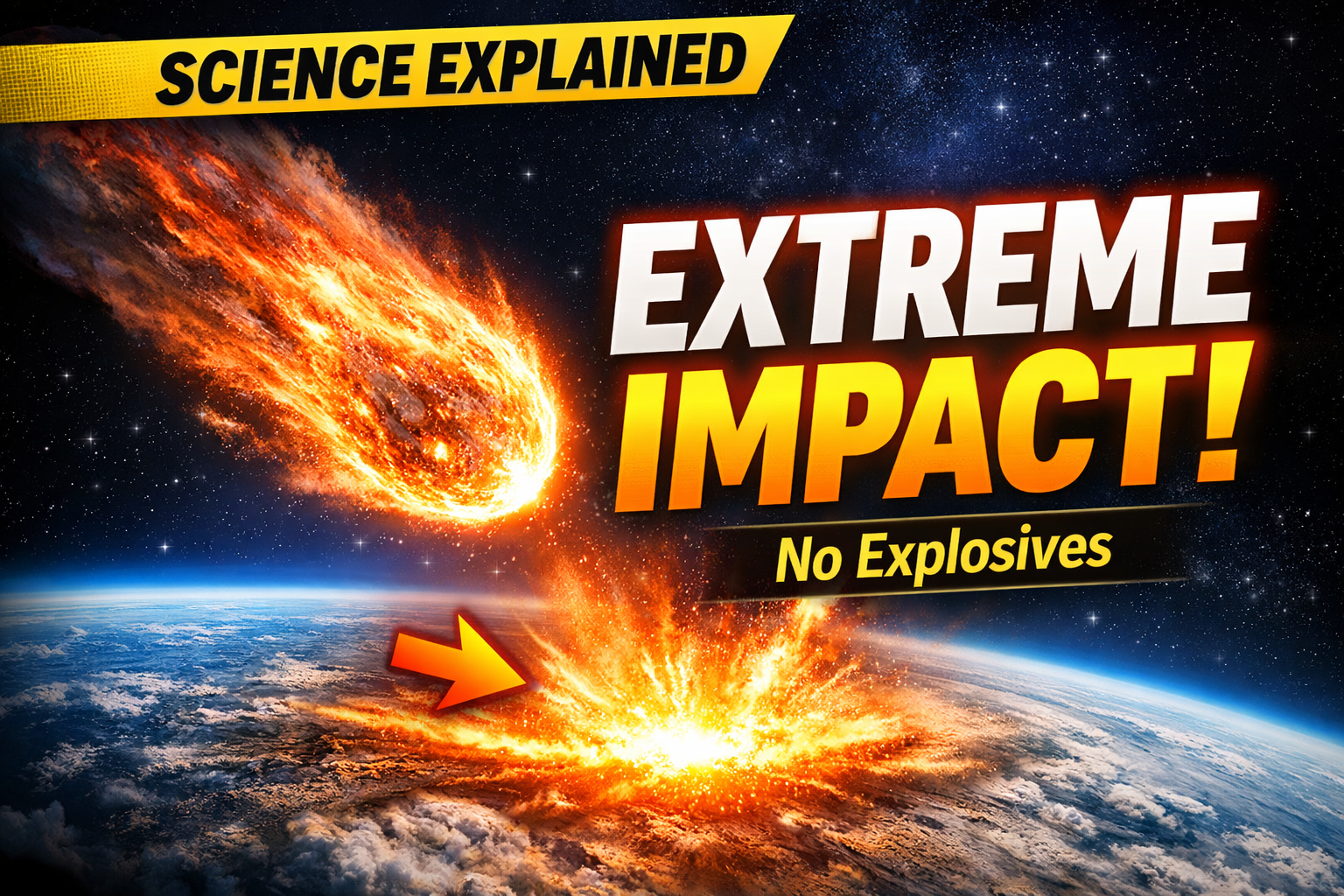
But when something actually leaves orbit and starts its descent, gravity really takes over. As it plunges into thicker and thicker air, it gets hit with massive air resistance. That resistance isn’t gentle. The air doesn’t just push back—it slams into the object. Hard. That creates crazy heat, insane pressure, and a sudden, violent slowdown.
So what’s actually going on here? It comes down to kinetic energy. Fancy term aside, it’s really just the energy something packs because it’s moving. And here’s where things get crazy—that energy doesn’t just go up a little when you speed up. It goes up by the square of your speed. Because it grows with the square of your speed.
In plain English? If you double your speed, you don’t just double the energy—you multiply it by four. So even a tiny bump in speed can mean a massive, sometimes jaw-dropping, jump in energy.
Friction with air molecules heats things up so much that the object starts to glow—sometimes brighter than the sun.
Shockwaves form in front of it, like a boat’s wake but in the air.
Slamming into denser air slows it down, fast.
Most smaller objects—like tiny meteoroids or bits of space junk—completely burn up before ever touching the ground. But if something is big or heavy enough, it can survive the trip through the fire and hit the ground. That’s how meteorites are born.
Digital Simulations Are Changing the Game
Instead of just theorizing, researchers can now simulate these high-speed dives on a computer. They run models that track:
The object’s exact path as it falls
How hot it gets during reentry
Whether it breaks apart under stress
How much energy gets released if it hits the ground
These simulations help estimate how much punch a falling object carries. And the results are sobering: even a modestly sized object moving fast enough can release energy comparable to a small bomb—without a single gram of chemical explosive.
Why Should We Care About This?
This isn’t just interesting physics; it matters for a few very real reasons: Keeping an eye on space junk
There are thousands of dead satellites and debris fragments zipping around Earth. Agencies like NASA track them constantly so we know when something might fall. Better models mean fewer surprises—and less risk to people or buildings.
2. Defending the planet
The European Space Agency and others are studying what happens when asteroids enter the atmosphere. If we ever need to deflect one, we first have to understand exactly how fast-moving objects behave.
3. Building better spacecraft
If we want to bring astronauts home safely, we need heat shields that can handle reentry. That engineering relies directly on this kind of atmospheric science.
Pure Motion, Pure Energy
One of the most fascinating takeaways from all this research is that you don’t need a chemical reaction or a fuel tank to create enormous power. Just speed and mass. That’s why even a small rock from space can make a big dent—literally. It’s also why meteor impacts are so dramatic, even though no explosives were involved.
The Bigger Picture: Peaceful Science First
Like any powerful science, this one comes with responsibilities. The international community has long agreed—through treaties like the Outer Space Treaty—that space should stay peaceful. Most researchers today focus on safety, collision prevention, and space exploration. Not conflict. And experts say that transparency and global collaboration are the only ways to make sure these technologies benefit everyone, not just a few.
What’s Next?
Scientists will be able to predict high-speed impacts with more accuracy than ever as simulation technology gets better. That will help us:
Protect Earth from rogue asteroids
Manage space traffic (yes, that’s a thing)
Plan safer space missions, especially those involving return landings
These studies also serve as a humbling reminder: space isn’t quiet or empty. It’s full of enormous forces, and just a little speed—paired with gravity—can produce jaw-dropping amounts of energy.
Conclusion
When something falls from space at 28,000 km/h, it doesn’t just drop. It fights the air, burns brighter than a star, and unleashes pure kinetic energy on impact. No explosion required. Thanks to modern simulations, we’re finally understanding just how intense that process really is.
And while it’s easy to get caught up in the wow factor, the real value here is practical: keeping us safe, advancing space exploration, and reminding us that sometimes the most powerful forces are the simplest ones—speed, mass, and gravity doing their thing.