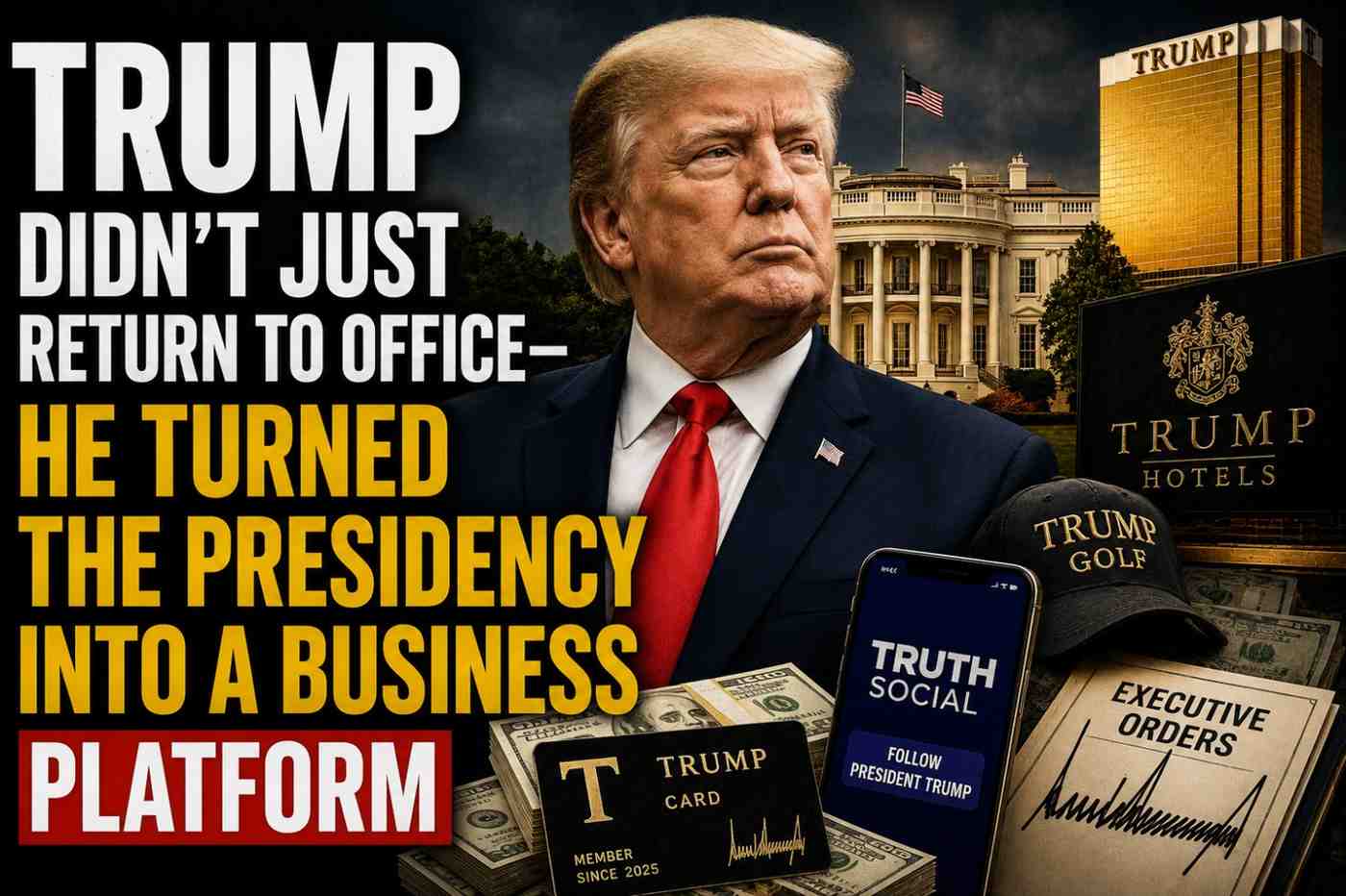
Trump Didn’t Just Return to Office : Donald Trump’s latest financial disclosure paints a picture unlike any previous modern presidency. Whether supporters see it as proof of entrepreneurial success or critics view it as a warning about blurred ethical lines, one thing is difficult to ignore: the White House now exists alongside an unusually large private business empire.
According to Trump’s 2025 financial disclosure, his reported income and assets expanded dramatically compared with previous years. A significant share of that growth reportedly comes from cryptocurrency ventures linked to the Trump family, a sector that has rapidly become one of the most influential—and controversial—parts of modern finance.
That development raises broader questions that extend beyond one individual. How should a sitting president navigate an industry that the federal government also regulates? At what point do private commercial interests and public responsibilities begin to overlap? Existing ethics laws offer some answers, but many critics argue they were never designed for today’s political and financial landscape.
The center of attention is World Liberty Financial, a cryptocurrency venture associated with the Trump family. Public reporting has described it as one of the primary drivers of Trump’s recent financial gains. Supporters argue the business reflects innovation and investor confidence. Critics counter that the scale of presidential involvement in a rapidly evolving financial sector creates unavoidable questions about conflicts of interest.
The discussion becomes even more complicated because cryptocurrency is no longer a niche market. Federal agencies influence everything from digital asset regulation and securities enforcement to sanctions policy and international financial oversight. A president connected to major crypto ventures inevitably invites scrutiny, regardless of whether any legal boundaries have been crossed.
Another point of debate surrounds the $TRUMP memecoin, which generated enormous attention shortly before Trump’s inauguration. Like many speculative digital assets, its value experienced dramatic swings. Supporters describe it as another example of market enthusiasm surrounding the Trump brand. Critics argue it illustrates how political identity and financial speculation have become increasingly intertwined.
International business relationships add another layer to the conversation.
Reports have highlighted investments and commercial partnerships involving entities connected to countries including the United Arab Emirates, Saudi Arabia, Qatar, Vietnam, India, Turkey, Indonesia, and others. None of this automatically proves improper influence. International business is common among large global companies. Yet when those relationships involve a sitting president responsible for foreign policy decisions, questions about appearance and public trust naturally become more prominent.
The White House has maintained a consistent response. Administration officials argue that the president acts solely in the interests of the American people and note that federal conflict-of-interest statutes generally do not apply to the president in the same way they apply to executive branch employees. From a legal standpoint, that may settle the immediate issue.
From a political standpoint, however, many Americans remain unconvinced.
Modern ethics laws were largely written during an era when presidents typically separated themselves from day-to-day business management or placed assets into blind trusts. Today’s environment is fundamentally different. Personal brands generate billions of dollars through licensing agreements, social media platforms, digital assets, and international commercial ventures that often operate simultaneously across multiple jurisdictions.
Whether that evolution represents healthy capitalism or an erosion of public accountability depends largely on one’s political perspective.
Supporters argue that Trump’s business success demonstrates competence, market confidence, and financial independence. They contend that a wealthy president has less incentive to misuse public office for personal enrichment and that existing disclosure requirements provide sufficient transparency.
Critics reach the opposite conclusion. They argue that no legal framework can fully separate presidential decision-making from financial incentives when global investors, private companies, and foreign governments all understand that commercial relationships may carry political significance.
Neither side is likely to persuade the other anytime soon.
What makes this moment historically significant is not simply the size of Trump’s reported wealth but the changing relationship between politics and private enterprise. The presidency increasingly resembles a platform where branding, media, technology, finance, and governance intersect in ways that previous generations rarely imagined.
That transformation extends beyond one administration. Future presidents of either party may inherit a political system where digital assets, online platforms, licensing agreements, and global investment portfolios are standard components of public life.
The challenge for lawmakers will be deciding whether ethics rules written decades ago remain adequate for this new reality.
Public confidence depends not only on legal compliance but also on trust. Citizens expect government decisions to be made because they serve the national interest, not because they may indirectly benefit private ventures connected to elected officials.
Trump’s financial disclosure does not answer every question. Instead, it intensifies an ongoing debate about where business ends and public service begins.
Regardless of where Americans stand politically, one conclusion appears increasingly difficult to avoid: the relationship between wealth, technology, and presidential power has entered a new era. Whether that evolution strengthens democratic institutions or places new strains upon them will remain one of the defining political questions of the years ahead.