
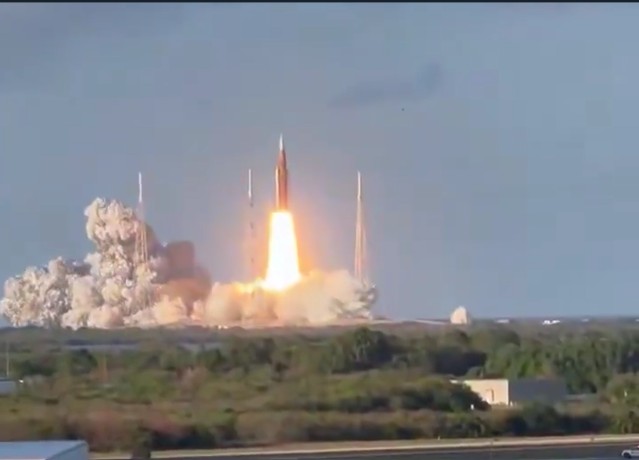
Four Astronauts Begin Historic 10-Day Mission From Kennedy Space Center
NASA launched its Artemis II mission on Tuesday evening, sending four astronauts on a 10-day journey that will take them around the Moon before returning to Earth. It’s the first crewed mission to travel this far since Apollo 17 mission in 1972.
The rocket lifted off from Kennedy Space Center just after sunset, cutting a bright path through the sky as it carried the crew aboard the Orion spacecraft into orbit.
For many watching, it felt like something long overdue.
Not a landing—but still a major step
This mission won’t put astronauts on the Moon. That’s planned for later.
Instead, Artemis II is more of a proving run.
The idea is simple: send humans out, take them around the Moon, and make sure everything works the way it’s supposed to—life support, navigation, communication, all of it.
If anything goes wrong on a mission like this, there’s no quick fix. So this flight is about testing under real conditions, not simulations.
NASA Administrator Bill Nelson called it the start of a “new era,” but also made it clear—this is just one step in a much longer plan.
A crew that reflects a changing space program
The four astronauts on board bring a mix of experience—and a bit of history with them.
- Reid Wiseman is leading the mission
- Victor Glover is serving as pilot
- Christina Koch joins as mission specialist
- Jeremy Hansen represents Canada
There are a few notable firsts here.
Koch is set to become the first woman to travel around the Moon. Glover will be the first Black astronaut to go this far from Earth. And Hansen is the first non-American astronaut to leave low Earth orbit.
It’s a small crew, but it says a lot about how spaceflight is evolving.
What the next 10 days will look like
After launch, the spacecraft didn’t head straight to the Moon. It first settled into orbit around Earth—part of the normal sequence—before firing its engines to begin the trip outward.
From there, it’s a long arc around the Moon, passing thousands of miles above the surface, and then heading back.
There’s no landing. No spacewalks. No dramatic maneuvers for the cameras.
Most of the work is quieter than that.
The crew will spend much of their time monitoring systems, running checks, and staying in close contact with teams back on Earth. Every detail matters, because future missions will depend on what’s learned here.
Why this mission matters more than it looks
At first glance, a flyby might not sound as exciting as a landing.
But for engineers and mission planners, this is the mission that answers the big questions.
Can the spacecraft handle deep space for days at a time?
Do the systems hold up under real conditions?
Can a crew make the trip safely and come back without issues?
These are the things that have to be proven before anyone sets foot on the Moon again.
A moment people didn’t want to miss
The launch brought crowds to Florida’s coast, with people lining up hours in advance just to watch those few minutes of liftoff.
Online, millions followed along.
Some watched for the Science. Others just wanted to see something historic happen again—something that hadn’t happened in their lifetime.
What comes after this
If Artemis II goes smoothly, the next step is already on the schedule.
Artemis III is expected to attempt a landing near the Moon’s south pole—a region scientists are especially interested in because of the possibility of water ice.
That mission would mark the first human landing on the Moon since the Apollo era.
Beyond that, NASA’s long-term plan stretches even further, with the Moon acting as a stepping stone toward Mars.
Conclusion
This mission may not have the drama of a landing, but it carries its own weight.
It’s the first real step back into deep space after a long gap—and a reminder that exploration doesn’t always happen all at once.
Sometimes it starts like this: one mission, one orbit, one careful move forward.
And then, gradually, everything else follows.