
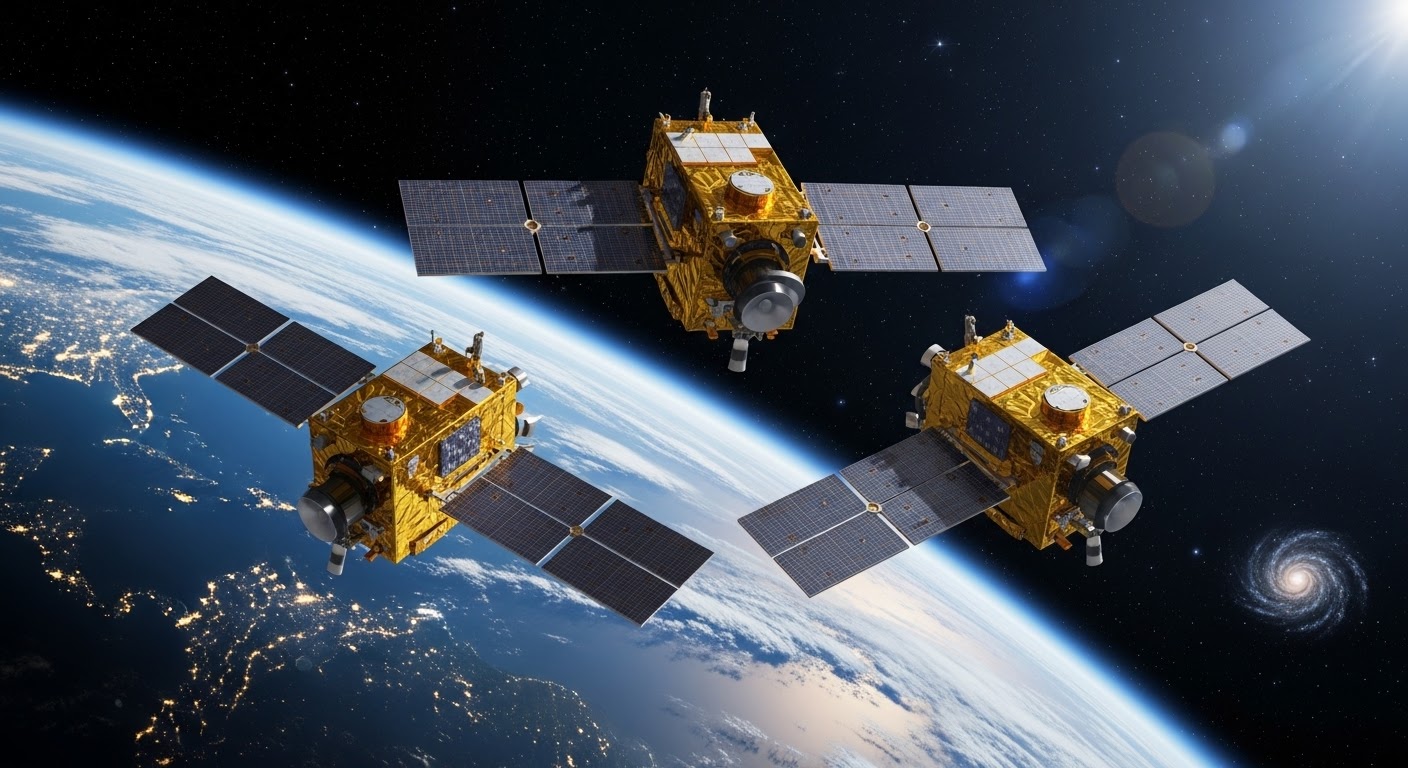
ISRO to Launch Three New Satellites: India is lining up a fresh set of navigation satellite launches, part of an ongoing effort to keep its homegrown positioning system stable and up to date.
The Indian Space Research Organisation (ISRO) plans to put three satellites into orbit over the next year under its regional navigation programme. The timeline was outlined in Parliament by Minister of State for Space, Jitendra Singh, who said the launches would be spaced out rather than carried out all at once.
The first in the series, NVS-03, is expected to go up by the end of this year. Two more—NVS-04 and NVS-05—are likely to follow at roughly six-month intervals.
Officials describe it as routine on paper. In practice, it’s more about keeping a critical system from developing gaps.
Keeping the system steady
Navigation constellations aren’t something you launch once and forget about. Satellites age, signals drift, and sometimes things fail without much warning.
That’s why agencies tend to replace or upgrade them in phases.
In this case, the new satellites will feed into India’s Indian Regional Navigation Satellite System, better known as NAVIC. The system covers India and nearby regions, offering positioning services similar to GPS, but under domestic control.
People working on the programme say the goal right now isn’t expansion for its own sake—it’s consistency.
“You don’t want blind spots, even temporary ones,” one official said, speaking on condition of anonymity because they weren’t authorised to brief the media. “The idea is to keep the network stable while gradually improving it.”
Why it matters beyond space
On the surface, navigation satellites don’t attract the same attention as lunar missions or rocket launches.
But they sit behind a lot of everyday systems.
From vehicle tracking and shipping routes to emergency response during floods or cyclones, accurate positioning data is now built into how things function. If that data becomes unreliable—even briefly—the impact can spread quickly.
There’s also a strategic angle.
Relying entirely on foreign systems has long been seen as a vulnerability, particularly in sensitive situations. NAVIC gives India a measure of independence in that area, ensuring access to navigation data without depending on external providers.
A gradual upgrade, not a sudden leap
The three upcoming satellites are expected to improve the system, though officials haven’t gone into much technical detail yet.
Typically, each new generation brings small but important changes—better signal accuracy, more stable timing, sometimes additional frequency bands.
None of that is especially visible to the public. But over time, those incremental improvements add up.
The staggered launch schedule also reduces risk. If something needs adjustment after the first satellite goes up, there’s room to tweak plans before the next one follows.
Adoption still catching up
One issue that comes up repeatedly with NAVIC is usage.
While the system is fully operational, it still competes with global networks like GPS, which are deeply embedded in devices and applications worldwide.
That’s slowly changing.
Some Smartphone manufacturers now support NAVIC, and there’s been a push to integrate it into transport systems and government services. Still, wider adoption will take time, especially on the consumer side.
“Technology alone isn’t enough,” said a space industry analyst. “You also need ecosystem support—devices, apps, and services that actually use it.”
Part of a larger push
The navigation programme also fits into a broader pattern.
Over the years, ISRO has been steadily building capabilities across different areas—communications, Earth observation, and now deeper space missions. Navigation tends to get less attention, but it’s just as essential.
It’s also tied to the government’s wider focus on reducing dependence on foreign technology in key sectors.
In that sense, NAVIC is less about competing globally and more about ensuring reliability at home.
What happens next
If things stay on schedule, NVS-03 will launch before the end of the year, with the next two satellites following into 2027.
From the outside, it may look like a routine update to an existing system.
But for those involved, it’s a necessary cycle—one that keeps the network running without interruption.
Conclusion
Navigation systems rarely get noticed when they work.
They just sit in the background, quietly doing their job.
But keeping them that way takes constant effort—replacements, upgrades, and careful planning over years, not months.
With these next three launches, ISRO isn’t trying to make headlines. It’s trying to make sure nothing breaks.
And in this case, that’s the real achievement.