
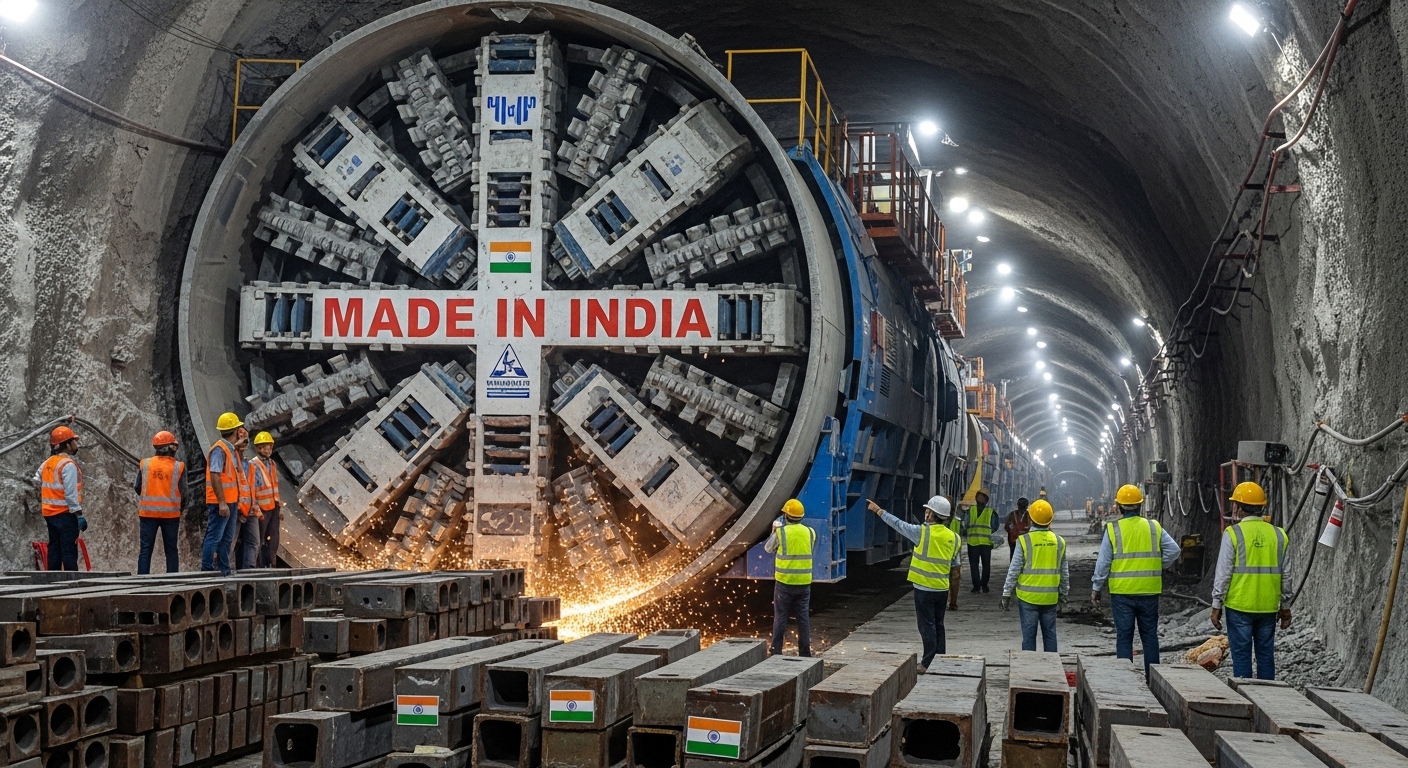
Tunnel Boring Machines, known as TBMs, arrived in parts or as complete units from factories in China and Europe. They were essential to the country’s expanding metro systems and highway tunnels, but they also came with a built-in dependence: when the machines stalled, expertise often had to come from outside too.
That arrangement is beginning to change, though not all at once.
Across a handful of projects, Indian companies are taking on a more active role in how these machines are put together. The shift is partial—assembly in some cases, component work in others—but it marks a departure from the earlier model of full import.
Companies such as Larsen & Toubro are among those working with international manufacturers to handle parts of the process within India. For now, the core technology still comes from abroad. But more of the physical work is happening closer to the project sites themselves.
Learning by Working
At construction sites, the change is not immediately visible.
The machines still cut through the earth at a steady pace. Workers monitor pressure levels, alignment, and soil conditions much as they did before. But some engineers say the difference lies in what happens when something goes wrong.
“In the past, there were limits to what could be done locally,” said one engineer involved in a metro project. “Now, you have more access—more understanding. That changes how quickly you can respond.”
TBMs operate in environments that are rarely predictable. Layers of rock can suddenly give way to softer ground. Water ingress is not uncommon. Small technical faults, if not addressed quickly, can slow down an entire project.
Costs, Delays, and Control
Importing these machines has never been straightforward.
Beyond the cost of the equipment itself, there are logistics, customs, and the need for specialised personnel. Repairs can take time. Replacement parts do not always arrive quickly.
Local assembly does not remove these challenges, but it does appear to soften them.
Project teams now have shorter supply lines for certain components. Technical decisions, in some cases, can be made without waiting for external approvals. It does not eliminate delays, but it can reduce them.
Partnerships Over Independence
This shift is not being framed, at least within the industry, as immediate self-reliance.
Instead, it is being built around partnerships.
Indian firms are working with manufacturers from countries such as Germany, where tunneling technology has been refined over decades. The approach is incremental—learning through collaboration rather than attempting to replicate entire systems from the ground up.
The policy backdrop is also there, though less visible on the surface. The Make in India programme has encouraged more domestic manufacturing across sectors, including infrastructure equipment.
Government discussions have supported this direction. Union Minister Piyush Goyal has previously engaged with counterparts in Germany on industrial cooperation, including areas linked to transport and construction.
Still Dependent, For Now
Even with these developments, India remains reliant on foreign technology for several critical parts of TBMs.
What is changing is not the entire system, but parts of it.
Engineers describe it as a gradual process—first assembly, then components, and possibly more in the future. There is no fixed timeline for how far that shift will go.
A Wider Context
The move comes at a time when global supply chains have become less predictable.
Delays in shipping, rising costs, and geopolitical tensions have all affected how quickly large infrastructure projects can move. For equipment as specialised as TBMs, dependence on imports can add another layer of uncertainty.
Local involvement offers some insulation from that, even if it is limited.
It may also create space for smaller manufacturers. TBMs require a range of supporting systems—electronics, mechanical parts, materials. As more work is done domestically, that network could expand.
A Change That Stays Largely Out of Sight
For most people, the shift will go unnoticed.
A metro line opens. A tunnel becomes operational. The machinery that made it possible remains out of view.
But within the industry, there is a sense that something is adjusting—slowly, unevenly, but in a different direction than before.
India is not yet building these machines on its own. But it is no longer entirely on the outside of the process either.
And for a sector that depends heavily on precision, time, and cost, that distinction may begin to matter more in the years ahead.