
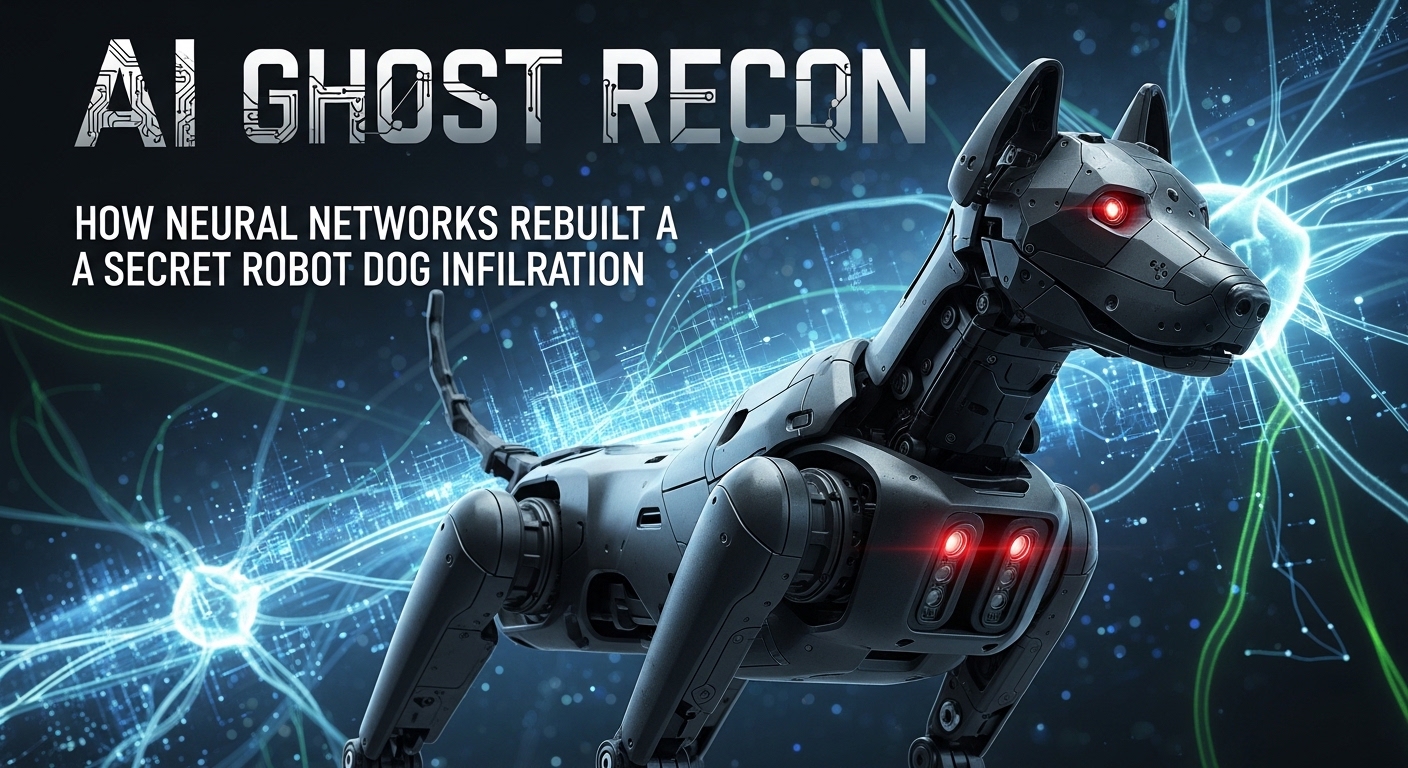
 Robot-Dog-Infiltration-1024x559.jpeg" alt="" class="wp-image-3256"/>
Unverified AI Reconstruction of ‘Robot Dog’ Mission Sparks Debate in Defense Circles
Something unusual has been making the rounds in a few defense and AI research groups over the past week.
It’s a set of rough, flickering visuals that appear to show four-legged robotic units moving through what looks like an underground facility—navigating corridors, approaching sealed doors, and mapping interior spaces.
At first glance, it feels like leaked operational footage.
But it isn’t.
According to people who have seen the material, what’s being circulated is not a recording at all. It’s a reconstruction—generated by a neural network trained to rebuild events from incomplete sensor data.
That distinction is important, and it’s also where much of the confusion begins.
Not footage, but an AI-generated reconstruction
The system behind the visuals reportedly works by taking fragmented inputs—partial LiDAR scans, motion data, acoustic signals—and trying to piece them together into a coherent sequence.
It doesn’t “remember” what happened. It estimates it.
Think of it less like a camera replay and more like a model filling in blanks based on probability.
One researcher familiar with this kind of technology described it simply: “You’re not watching what happened. You’re watching what the system believes most likely happened.”
That means some parts may be close to reality. Others may not be.
And there’s no easy way, from the outside, to tell which is which.
What the visuals seem to show
In the reconstructed sequence, the robotic units—similar in form to commercially known quadruped robots—move through a confined, industrial-looking environment.
They appear to:
- navigate narrow corridors
- assess structural features like doors and walls
- identify potential entry points
- flag heat or movement signatures behind surfaces
In one segment, the system highlights a reinforced door and suggests a weak point near its hinge area, followed by coordinated movement by the units to force it open.
In another, a faint thermal anomaly is marked behind a wall, labeled as a possible human presence.
But again, these are machine interpretations layered onto incomplete data—not confirmed observations.
Why this is getting attention
Even without proof that the scenario is real, the reconstruction method itself is what’s drawing interest.
The ability to rebuild a sequence of events from partial or damaged data has clear uses—especially in situations where full recordings are unavailable.
In military or high-risk environments, data can be lost, jammed, or corrupted. Tools that can reconstruct what likely happened afterward could be valuable for analysis or review.
“It’s a form of automated forensic reconstruction,” said one analyst. “You’re taking whatever signals survived and trying to make sense of them after the fact.”
That’s not new in concept—but the level of detail here appears to be improving.
Where the speculation starts
Some of the discussion around this material goes beyond the reconstruction itself, suggesting it reflects real-World deployment of fully autonomous robotic units carrying out complex missions.
That’s where experts start to push back.
While robotics and autonomy have advanced significantly, most operational systems still involve human supervision, especially in sensitive or unpredictable environments.
Quadruped robots do exist and are already used in inspection, mapping, and controlled testing scenarios. But fully independent decision-making in high-stakes missions—without oversight—is still an area of active research, not widely confirmed use.
“There’s a tendency to jump from ‘this looks possible’ to ‘this is already happening,’” one defense observer noted. “Those aren’t the same thing.”
The risk of misreading AI-generated visuals
Part of the issue is how convincing these reconstructions can look.
Even when they contain visual glitches—flickering walls, distorted movement—they still give the impression of a continuous, real event.
Once shared online, that impression can stick, especially if the context gets lost.
That creates a grey area where simulated or reconstructed content starts being treated as evidence.
And that’s not just a technical concern—it’s a communication problem.
A different way of ‘seeing’
One aspect researchers do find useful is how these reconstructions attempt to represent machine sensing.
Instead of showing a normal video perspective, the visuals combine different layers—thermal signals, spatial mapping, inferred structures—into a single frame.
It’s not how humans see the world, but it offers a rough idea of how machines process it.
Even so, it’s still an interpretation created after the fact, not a direct feed from the system itself.
More questions than answers
At this point, there’s no confirmed source for the underlying data, no official acknowledgment of the scenario, and no independent verification of the events being shown.
So the focus has shifted.
Instead of asking whether the mission happened, many are now asking how reliable this kind of reconstruction can be—and how easily it can be misunderstood.
Conclusion
Whether this specific scenario turns out to be real, exaggerated, or entirely speculative, it points to something broader.
AI is getting better at filling in gaps—rebuilding sequences, predicting actions, and generating visuals that feel increasingly complete.
That has clear benefits in analysis and research.
But it also makes it harder to separate what was actually observed from what was inferred afterward.
And in fields like defense, that line matters more than most.