
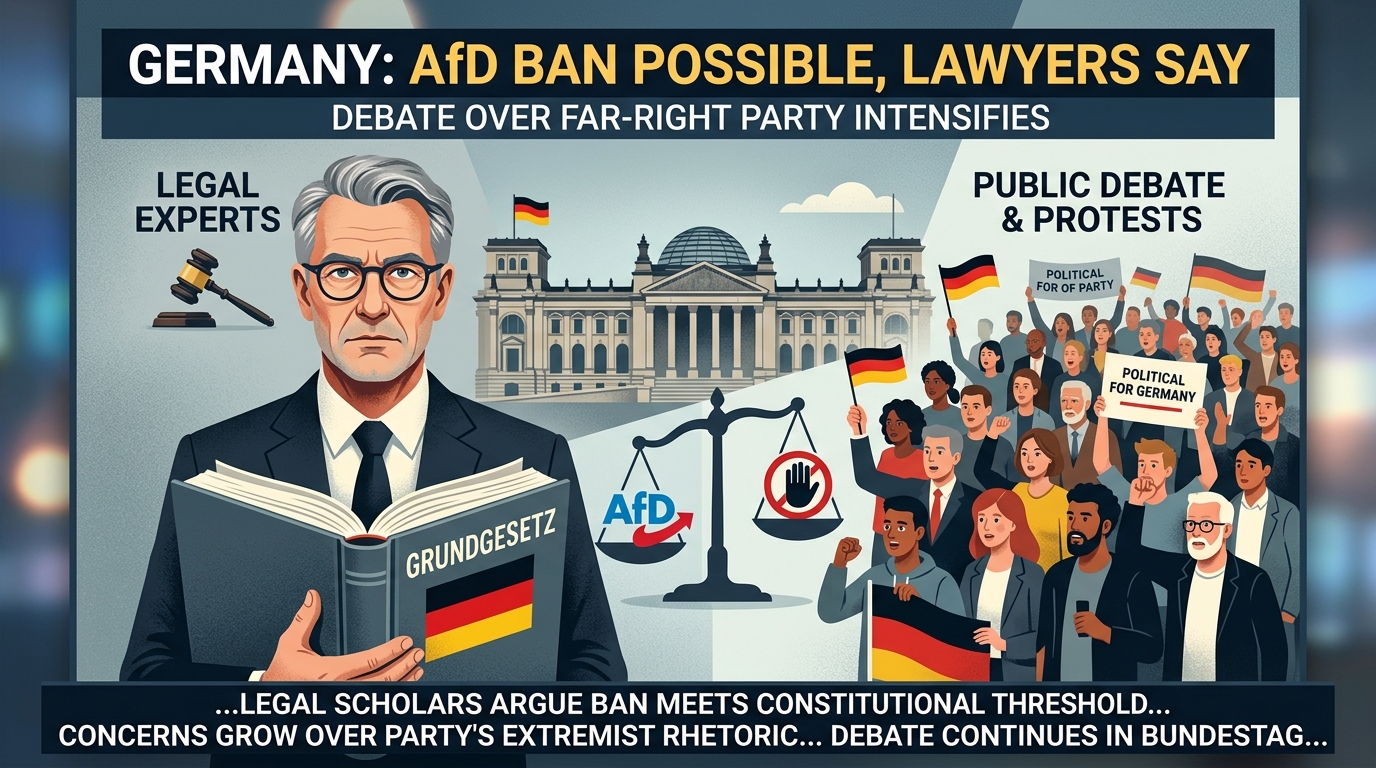
New Legal Report Claims Germany’s AfD Party May Violate Constitutional Principles, Sparking Political Discussion
Germany’s political landscape has been shaken by a new legal assessment suggesting that a ban on the far-right Alternative for Germany (AfD) party could potentially succeed in court. The report, prepared by legal experts from the Society for Civil Rights (GFF), has reignited a long-running debate over whether Germany should use constitutional measures to restrict a party that critics argue threatens democratic values.
The findings arrive at a sensitive moment for German politics. The AfD has become one of the country’s most popular political parties, attracting significant voter support while also facing accusations of promoting extremist ideas. Supporters of the party reject those allegations and argue that attempts to ban it would undermine democratic competition.
The discussion surrounding a possible ban has now moved back into the national spotlight, with legal experts, politicians, and civil society groups offering sharply different views on the issue.
What the New Report Says
According to the Society for Civil Rights, the AfD is “demonstrably unconstitutional” and could face a successful legal challenge if a formal ban request were brought before Germany’s Federal Constitutional Court. The organization spent more than a year researching the party’s activities, reviewing thousands of parliamentary documents, press releases, and social media posts.
Researchers concluded that the party’s positions and public statements may conflict with key constitutional principles, including human dignity and democratic governance. The report argues that these concerns provide a legal foundation for considering a ban.
The phrase AfD Ban in Germany has gained renewed attention following the publication of the report, which supporters describe as one of the most comprehensive legal examinations of the party to date.
How Party Bans Work in Germany
Germany has strict constitutional safeguards designed to protect democracy from extremist movements. Following the experiences of the Nazi era, the country’s Basic Law allows political parties to be banned if they are found to actively undermine the democratic constitutional order.
However, the process is extremely difficult.
Only the federal government, the Bundestag (Germany’s lower house of parliament), or the Bundesrat (upper house) can formally request a ban. Even then, the final decision rests solely with the Federal Constitutional Court.
Legal experts note that German courts have historically set a very high standard for banning political parties, making any such case both complex and politically sensitive.
Political Challenges Remain
Although the legal report argues that an AfD Ban in Germany could succeed, political obstacles remain significant.
Several major political parties have expressed skepticism about pursuing a ban. Some leaders worry that a failed court challenge could strengthen the AfD politically by allowing it to claim vindication. Others argue that voters should defeat political movements through elections rather than court proceedings.
At present, there appears to be limited support within Germany’s parliament for formally launching a ban process. Previous discussions failed to gain enough political backing, and many lawmakers remain cautious about taking such a dramatic step.
This reality means that even if legal experts believe a ban could be successful, translating that view into actual government action remains uncertain.
AfD Rejects the Allegations
AfD leaders have strongly rejected the report and dismissed its conclusions.
Party co-leader Alice Weidel criticized the assessment and argued that it is politically motivated. Party officials insist that the AfD operates within Germany’s democratic system and represents the concerns of millions of voters.
Supporters of the party often point to its electoral success as evidence that it reflects legitimate public concerns about issues such as immigration, economic policy, and national identity.
The AfD has consistently denied accusations that it seeks to undermine democracy or constitutional protections.
Civil Society Groups Push for Action
Several organizations and activists have welcomed the report as a significant development.
Campaign groups advocating an AfD Ban in Germany argue that democratic institutions have a responsibility to respond when parties are believed to threaten constitutional values. They point to public statements made by some party members as evidence supporting stronger action.
Supporters of a ban say Germany’s constitutional framework was specifically designed to prevent anti-democratic movements from gaining power. They argue that waiting too long could create greater risks in the future.
At the same time, critics warn that banning a major political party could deepen political polarization and create new tensions within society.
Growing Popularity Adds Complexity
One of the biggest challenges facing advocates of a ban is the AfD’s growing popularity.
Recent polls have shown the party performing strongly nationwide, with support levels that place it among Germany’s leading political forces. This growth has intensified the debate over how democratic societies should respond to movements that attract large numbers of voters while facing accusations of extremism.
Analysts note that an AfD Ban in Germany would have consequences extending far beyond legal questions. It would likely influence election campaigns, public trust in institutions, and Germany’s broader political future.
Some experts also argue that banning a party does not automatically eliminate the political concerns driving voter support.
What Happens Next?
For now, the report serves primarily as a legal assessment rather than an official government initiative.
No formal ban proceedings have been launched, and political leaders remain divided over whether such a step would be appropriate. However, the publication has undoubtedly revived national discussion about the future of the AfD and the limits of democratic tolerance.
The coming months may reveal whether lawmakers choose to pursue further action or continue relying on political competition to challenge the party’s influence.
What is clear is that the debate surrounding an AfD Ban in Germany is far from over. As Germany navigates questions about democracy, extremism, and political representation, the issue is likely to remain one of the country’s most closely watched political discussions.