NATO Summit, U.S. Defense Deals, and Sharp Criticism of Israel Highlight Türkiye’s Complex Foreign Policy Strategy
Türkiye is preparing to host one of the most significant diplomatic gatherings of the year as leaders from across the NATO alliance arrive in Ankara for a major summit. The event is expected to reinforce Türkiye’s strategic importance within the Western security alliance and strengthen defense cooperation with the United States.
At the same time, Turkish President Recep Tayyip Erdogan continues to deliver some of the strongest criticism of Israel heard from any leader of a NATO member state. His comments regarding the war in Gaza, Israeli policies, and the future role of Türkiye in the Middle East have attracted international attention and sparked debate among allies.
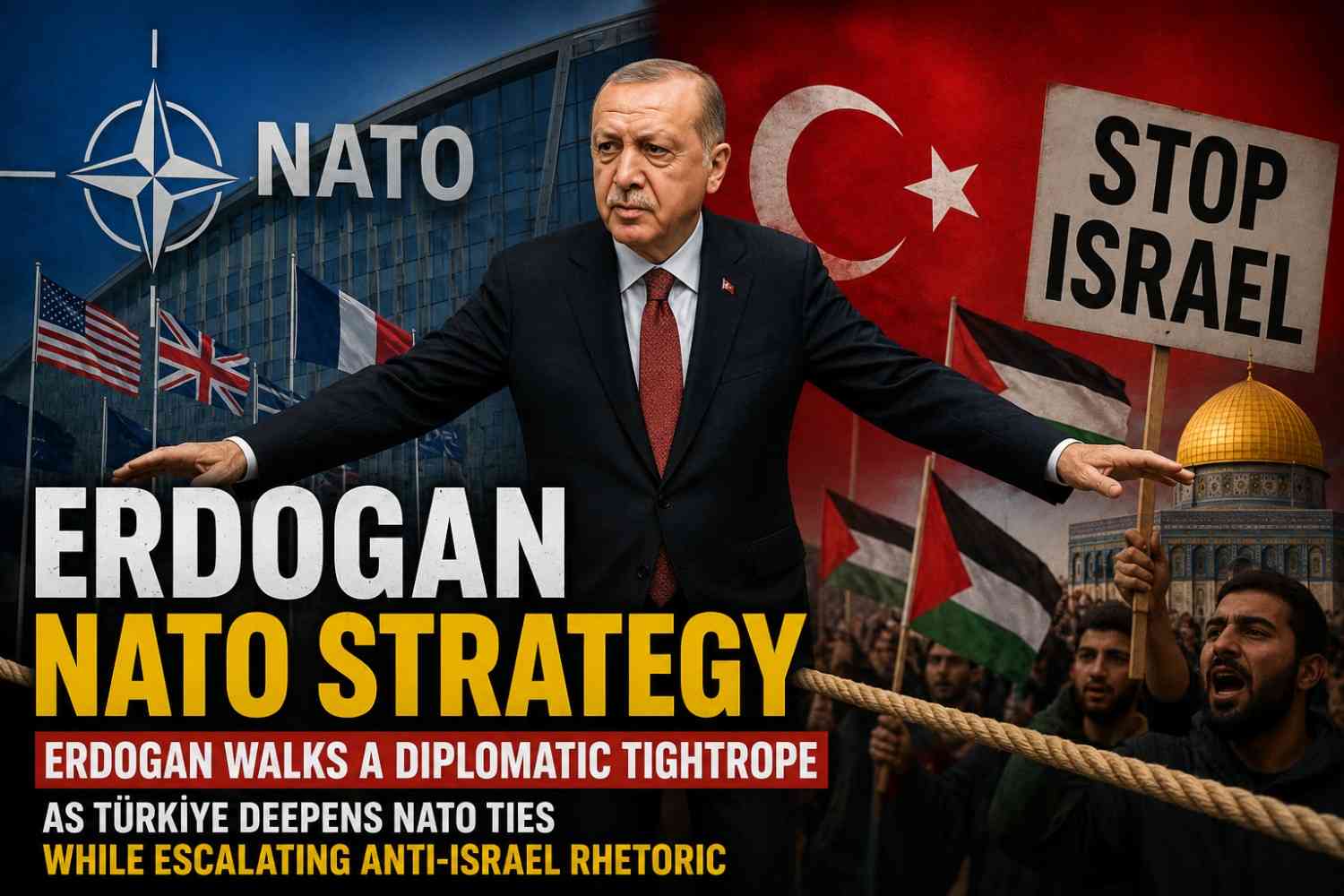
The growing contrast between Ankara’s expanding cooperation with NATO and Erdogan’s increasingly confrontational rhetoric toward Israel has become a defining feature of the country’s foreign policy. Many analysts describe this balancing act as a central element of the current Erdogan NATO strategy, allowing Türkiye to maintain influence in both Western and regional political spheres.
NATO Summit Reinforces Türkiye’s Strategic Importance
Ankara is expected to welcome leaders from across the alliance, including U.S. President Donald Trump and other senior officials, for a high-profile NATO summit. The gathering will focus on collective security, defense cooperation, and regional challenges facing the alliance.
Türkiye remains a critical NATO member due to its geographic position between Europe, the Middle East, and the Black Sea region. The country controls key maritime access points and hosts military facilities that are considered vital to alliance operations.
Western governments continue to view Ankara as an essential partner despite periodic disagreements over regional policies. As a result, cooperation between Türkiye and NATO has remained strong even during moments of diplomatic tension.
The upcoming summit is expected to further showcase the Erdogan NATO strategy, which emphasizes maintaining Türkiye’s role as an indispensable security partner while pursuing an independent regional agenda.
U.S. Defense Cooperation Gains Momentum
Another major development involves expanding defense ties between Washington and Ankara. Reports indicate that the United States is considering a package worth approximately $700 million involving GE F110 jet engines that could support Türkiye’s indigenous KAAN fighter aircraft program.
Discussions have also emerged regarding Türkiye’s gradual return to parts of the F-35 ecosystem after years of strained relations following Ankara’s purchase of the Russian-made S-400 air defense system.
For many observers, these developments signal a shift toward rebuilding trust between the two allies. Defense cooperation is increasingly viewed as necessary given growing security concerns across Europe, the Middle East, and the Black Sea region.
The renewed military partnership strengthens the broader Erdogan NATO strategy, which seeks to position Türkiye as both a regional power and a key contributor to Western security structures.
Erdogan Intensifies Criticism of Israel
While strengthening relations with NATO partners, Erdogan has simultaneously intensified his criticism of Israel.
Over recent months, the Turkish president has repeatedly accused Israel of committing serious violations during the conflict in Gaza. He has described Israeli actions in strong terms and portrayed the Palestinian issue as one of the most important moral and political challenges facing the Muslim World.
His speeches have frequently framed support for Palestinians as a matter of national responsibility and regional leadership. These remarks have resonated with many domestic supporters and audiences across parts of the Middle East.
In some statements, Erdogan has also suggested that Türkiye must remain prepared to defend its interests if regional instability expands further. Such comments have generated concern among some Western observers who fear additional tensions in an already volatile region.
The contrast between military cooperation with NATO and sharp criticism of Israel remains one of the most visible aspects of the current Erdogan NATO strategy.
Domestic and International Audiences Receive Different Messages
Political analysts argue that Erdogan’s approach reflects the need to address two very different audiences.
Internationally, Türkiye presents itself as a reliable NATO ally, a security partner, and an important mediator in regional conflicts. The country continues to participate in alliance operations and diplomatic initiatives that strengthen its global standing.
Domestically, Erdogan often emphasizes themes of national sovereignty, regional independence, and support for Muslim communities affected by conflict. His criticism of Israel fits within a broader political narrative that highlights Türkiye’s role as a leading voice in the Islamic world.
This dual messaging has allowed Ankara to maintain influence in multiple diplomatic arenas while avoiding a complete break with either Western partners or regional constituencies.
Many experts believe the Erdogan NATO strategy is designed precisely to preserve this flexibility, enabling Türkiye to benefit from alliance support while pursuing policies that appeal to domestic political priorities.
Growing Questions for NATO and Regional Partners
The evolving relationship between Türkiye, NATO, and Israel continues to raise important questions for policymakers.
Some analysts argue that Ankara’s strategic value ensures it will remain a key ally despite disagreements on regional issues. Others believe increasingly confrontational rhetoric could create future challenges for alliance unity and regional stability.
For Israel, Erdogan’s statements are viewed as more than ordinary diplomatic criticism. For NATO members, the challenge lies in balancing cooperation with one of the alliance’s most important states while managing disagreements over Middle East policy.
As leaders gather in Ankara and defense cooperation expands, Türkiye’s unique position at the intersection of Europe, the Middle East, and global security will remain under close international scrutiny.
Whether this balancing act strengthens Türkiye’s influence or creates new tensions will likely shape regional politics for years to come.