
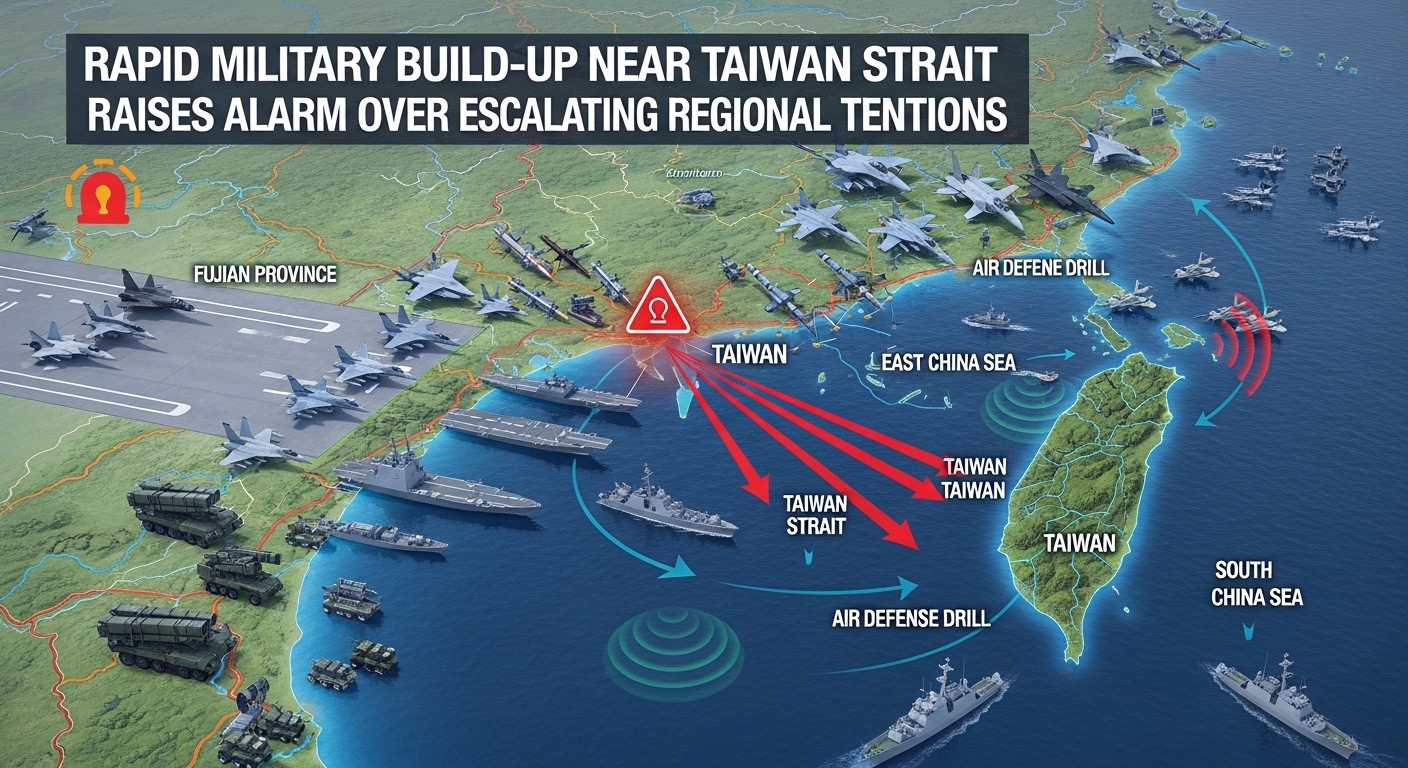
Increased naval and air activity signals growing strategic pressure in one of the World’s most sensitive maritime regions
A rapid increase in military activity has been observed near the Taiwan Strait, raising fresh concerns among regional powers and international observers about escalating security tensions in East Asia. Reports indicate heightened deployments of naval vessels, air patrols, and surveillance operations in and around the sensitive waterway separating mainland China and Taiwan.
The build-up comes at a time of already strained relations in the region, with analysts warning that even a small miscalculation could trigger a wider crisis affecting global trade, energy routes, and geopolitical stability.
Military experts say the situation is one of the most closely watched developments in the Indo-Pacific region, as the Taiwan Strait remains a key strategic chokepoint for global shipping and military movement.
Surge in Naval and Air Activity Detected
According to regional Defense monitoring sources, there has been a noticeable increase in the movement of warships, fighter jets, and reconnaissance aircraft operating near the Taiwan Strait. These activities include patrol missions, training exercises, and intelligence-gathering operations.
While such movements are not uncommon in the region, the frequency and scale of recent operations have drawn attention from defense analysts. Some reports suggest that both sides are increasing their readiness levels, reflecting growing mistrust and heightened alert status.
The increased presence of military assets has also led to closer monitoring by international naval forces operating in nearby waters. Surveillance satellites and maritime tracking systems have recorded repeated activity patterns consistent with strategic signaling.
Strategic Importance of the Taiwan Strait
The Taiwan Strait is one of the most important waterways in the world. It serves as a major shipping route connecting East Asia with global markets and carries a significant portion of international trade, including electronics, energy supplies, and industrial goods.
Any disruption in this region could have serious consequences for global supply chains and economic stability. This is why even routine military exercises in the area often attract global attention.
Security analysts emphasize that the strait is not only economically important but also militarily sensitive. Its narrow geography makes it a potential flashpoint where naval and air forces operate in close proximity.
Rising Regional Security Tensions
Tensions in the region have been building for years due to political differences and competing territorial claims. The latest military build-up is seen as part of a broader pattern of strategic posturing involving multiple regional actors.
Officials in several countries have expressed concern about the risk of accidental escalation. Even minor incidents—such as close encounters between aircraft or ships—could quickly escalate if not carefully managed.
Diplomatic channels remain open, but trust between key parties is reported to be low. Efforts to establish long-term stability in the region have so far produced limited results.
International Concerns Over Stability
Global powers are closely monitoring the situation, given the Taiwan Strait’s importance to international trade and security. Any conflict in the region could disrupt global shipping routes and impact industries far beyond East Asia.
Economists warn that even temporary disruptions could affect supply chains for semiconductors, consumer electronics, and manufacturing sectors worldwide. Many of these industries rely heavily on smooth maritime transport through the region.
Defense experts also caution that increased militarization could lead to a long-term arms buildup, further complicating efforts to reduce tensions.
Taiwan’s Security Preparations
In response to the growing military presence, Taiwan has reportedly increased its own defense readiness. This includes enhanced coastal monitoring, air defense drills, and coordination with allied security partners.
Military officials emphasize that their focus remains on defensive preparedness and maintaining stability. However, they acknowledge that the security environment has become more challenging in recent months.
Public awareness campaigns in Taiwan have also encouraged citizens to remain informed about emergency procedures in the event of heightened tensions.
China’s Strategic Positioning
Mainland China continues to assert its position on sovereignty and territorial integrity in the region. Military exercises and patrols near the Taiwan Strait are often described by Chinese officials as routine training activities aimed at safeguarding national security.
However, international observers note that the scale and frequency of such exercises have increased in recent years, contributing to rising regional unease.
China maintains that external interference in the region only complicates matters and has repeatedly called for diplomatic dialogue instead of military escalation.
Risk of Miscalculation Remains High
Security analysts warn that the biggest danger in the Taiwan Strait is not necessarily planned conflict, but accidental escalation. With multiple military forces operating in close proximity, the risk of miscommunication or unintended encounters remains significant.
Even small incidents, such as radar lock-ons or airspace crossings, could quickly escalate if not carefully managed through established communication channels.
Experts stress the importance of maintaining hotlines and crisis communication mechanisms to prevent misunderstandings from turning into larger conflicts.
Calls for Diplomatic Engagement
International organizations and regional governments are urging all parties to prioritize diplomacy and avoid actions that could increase tensions. There are growing calls for renewed dialogue frameworks aimed at reducing military pressure in the region.
Some analysts suggest confidence-building measures such as joint communication protocols, notification of military exercises, and increased transparency in defense activities.
While such proposals have been discussed in the past, implementation has been limited due to ongoing political disagreements.
Conclusion
The rapid military build-up near the Taiwan Strait highlights the fragile security balance in one of the world’s most strategically important regions. As naval and air activity intensifies, concerns are growing about the potential for miscalculation and escalation.
For now, the situation remains under close international observation. While no direct conflict has been reported, the increased military presence underscores the urgency of diplomatic engagement to prevent tensions from spiraling into a broader regional crisis.