
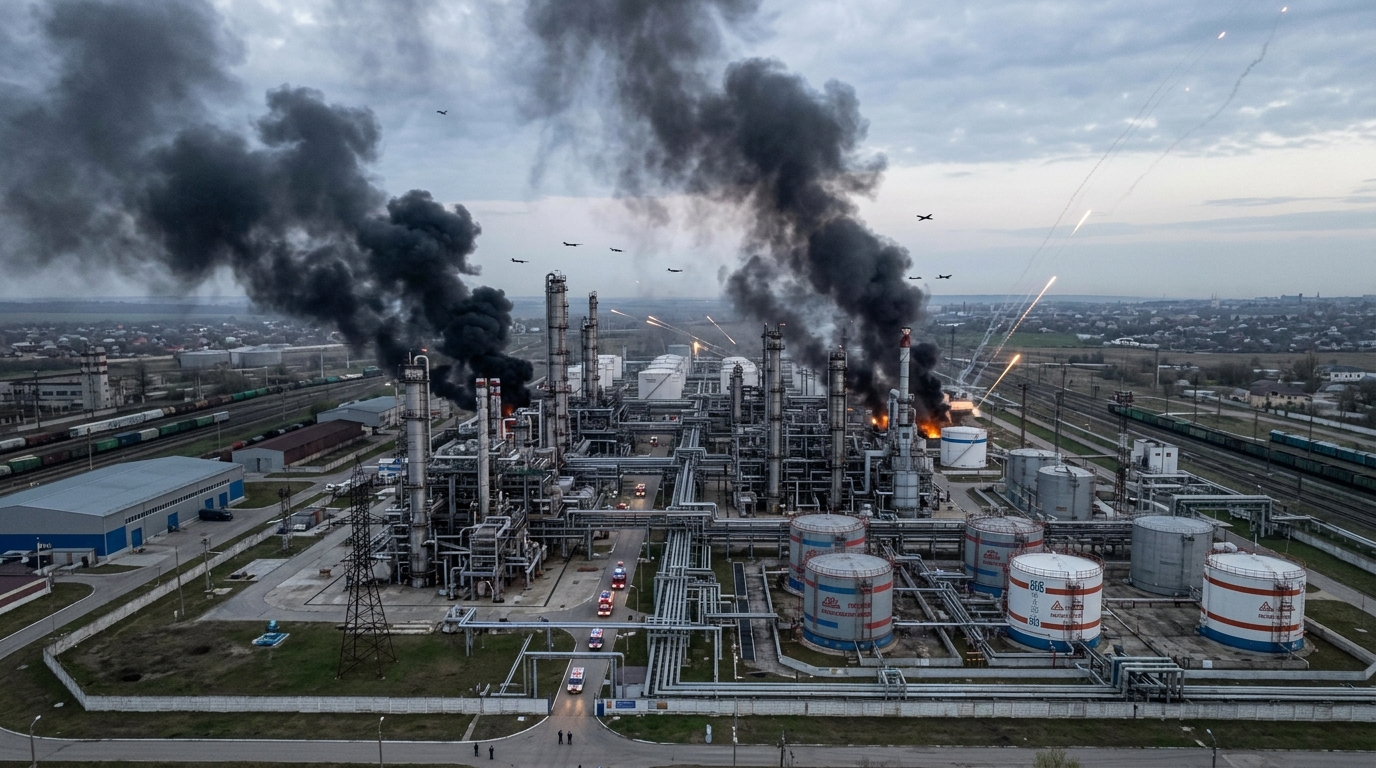
Coordinated overnight drone attacks reportedly struck oil and industrial infrastructure near St. Petersburg, Belgorod, and Moscow as both sides exchanged claims over damage and air Defense operations.
Ukraine and Russia exchanged another wave of long-range strikes overnight, with Ukrainian drone operations reportedly targeting several key energy and industrial facilities across western Russia. Officials from both countries described the attacks as among the latest efforts to disrupt critical infrastructure as the war continues into another year.
According to statements released by Ukrainian and Russian authorities, drones targeted locations near St. Petersburg, Belgorod, and the Moscow region during the overnight operation. Russian officials said air defense systems intercepted dozens of drones, while Ukrainian sources claimed several strategic facilities were successfully hit.
The Ukraine drone strikes on Russian energy infrastructure campaign has increasingly focused on oil terminals, refineries, fuel depots, and industrial facilities that support Russia’s military logistics and energy sector. Ukrainian officials argue that these sites play a key role in sustaining Russia’s war effort.
One of the main reported targets was the St. Petersburg Oil Terminal, one of the largest fuel handling facilities in northwestern Russia. Local reports indicated that explosions and fires were observed near the terminal after drones entered the area. Videos circulating on social media appeared to show smoke rising above the industrial complex, although the extent of the damage could not be independently verified.
Russian authorities also reported drone activity near the Baltic Sea port of Vysotsk, where debris reportedly fell close to facilities operated by the Lukoil fuel terminal. Emergency services responded to the scene, while officials said air defense systems had intercepted several incoming drones before they reached their intended targets.
The Ukraine drone strikes on Russian energy infrastructure operation also extended to the Belgorod region, which borders northeastern Ukraine and has experienced repeated attacks throughout the conflict. Regional authorities reported disruptions to electricity and water supplies after drone strikes damaged local infrastructure.
Officials said emergency repair teams were dispatched to restore essential services, while residents in several communities temporarily experienced power outages. Authorities did not immediately provide a complete assessment of the damage or indicate when full services would resume.
Meanwhile, Russian officials reported additional drone activity approaching the Moscow region. The Russian Ministry of Defense stated that multiple unmanned aerial vehicles were intercepted overnight by air defense systems operating around the capital and other western regions. Officials maintained that most of the drones were destroyed before reaching their targets.
Ukraine has not publicly confirmed every reported strike, but military officials have consistently stated that long-range drone operations are designed to reduce Russia’s ability to support military operations by targeting fuel production, logistics, and industrial infrastructure.
The latest attacks follow a series of previous operations directed at Russian oil refineries and storage facilities. Over recent months, Ukraine has expanded its campaign beyond front-line military positions, increasingly striking facilities located hundreds of kilometers inside Russian territory.
Military analysts say these operations are intended to create economic pressure while forcing Russia to allocate additional air defense resources far from the battlefield. Protecting industrial facilities, fuel depots, and transportation networks requires significant military assets that might otherwise be deployed closer to active combat zones.
The Ukraine drone strikes on Russian energy infrastructure campaign has become one of Kyiv’s most significant long-range military strategies. By targeting refineries, oil terminals, and logistics hubs, Ukrainian planners hope to reduce fuel availability for military operations and increase the financial cost of maintaining Russia’s war effort.
Russia’s energy industry remains one of the country’s most important economic sectors, generating substantial export revenue while supplying domestic transportation and industrial demand. Damage to oil terminals or refining facilities can temporarily interrupt fuel distribution, although repairs often begin immediately after attacks.
Russian officials have repeatedly emphasized the effectiveness of their air defense network, saying that the majority of incoming drones are intercepted before causing major destruction. Ukraine, meanwhile, continues to argue that even limited damage to strategic infrastructure can have lasting economic and logistical consequences.
Independent verification of battlefield claims remains difficult because journalists have limited access to many of the affected locations. Both Ukraine and Russia regularly publish military updates that cannot always be confirmed through independent sources while hostilities continue.
Despite the uncertainty surrounding specific damage assessments, attacks on energy infrastructure have become a defining feature of the conflict. Both sides increasingly view energy facilities, transportation networks, and industrial complexes as strategically important targets capable of influencing military operations beyond the front lines.
International observers continue to monitor the growing use of long-range drones, which have allowed both Ukraine and Russia to conduct strikes far beyond traditional battlefields. Advances in drone technology have expanded the reach of military operations while increasing pressure on governments to strengthen air defense systems around critical infrastructure.
As fighting continues, energy facilities are expected to remain among the highest-priority targets for both sides. With neither country showing signs of reducing military operations, long-range drone strikes are likely to remain a central element of the conflict in the months ahead.
While officials continue to investigate the latest attacks, the broader campaign highlights how the war has expanded beyond direct combat, increasingly affecting industrial production, energy security, and civilian infrastructure across the region.