
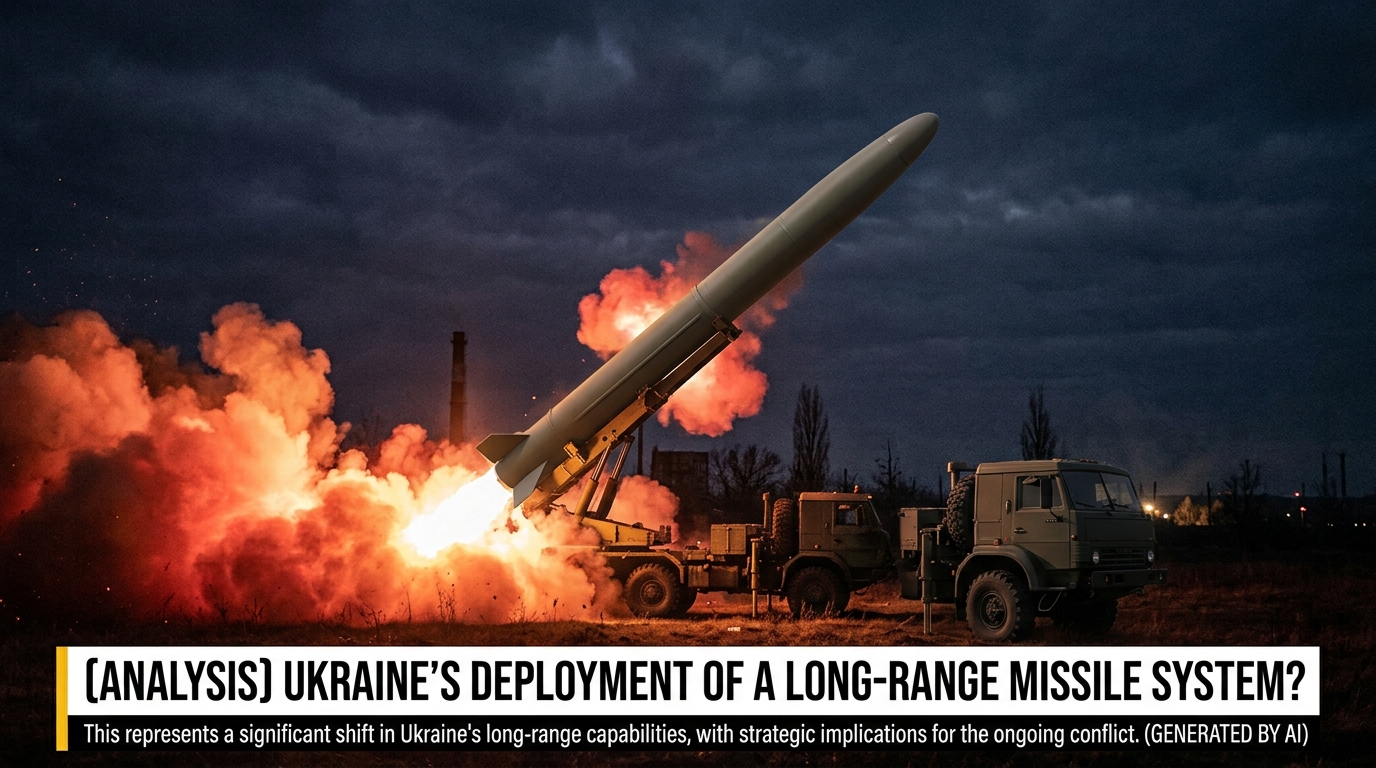
Moscow Says New Strike Suggests Kyiv Is Expanding Its Domestic Missile Capabilities as Long-Range Warfare Intensifies
Russia has indicated that Ukraine may have used a domestically developed ballistic missile in combat for the first time, a development that could mark a significant shift in the ongoing war if confirmed.
According to Russian officials, recent strikes on targets inside Russian territory showed characteristics consistent with the use of a new Ukrainian ballistic missile. While Moscow has not provided detailed technical evidence, the claim has drawn attention because Ukraine has spent several years investing in indigenous missile technology aimed at strengthening its long-range strike capabilities.
The Ukraine First Ballistic Missile claim has not been independently verified, and Ukrainian authorities have not officially confirmed that a ballistic missile was used during the reported operation.
For much of the war, Ukraine has relied on long-range drones, cruise missiles, and Western-supplied precision weapons to target military infrastructure deep inside Russia and Russian-occupied territories. In recent months, Kyiv has also accelerated domestic weapons production to reduce dependence on foreign military assistance.
Military analysts say that if Ukraine has successfully fielded its own ballistic missile, it would represent an important milestone for the country’s Defense industry. Ballistic missiles generally travel at much higher speeds than cruise missiles, making them significantly more difficult to intercept with conventional air defense systems.
The Ukraine First Ballistic Missile report emerged after Russian officials assessed debris and flight characteristics from a recent strike. Moscow suggested the weapon differed from previously known Ukrainian cruise missiles and drones, leading to speculation that Kyiv may have introduced a new missile system into operational service.
Ukraine has previously acknowledged working on several long-range missile programs.
President Volodymyr Zelenskyy has repeatedly emphasized the importance of expanding domestic defense production, including advanced missile systems capable of reaching military targets far beyond the front lines. Ukrainian officials have argued that locally produced weapons provide greater operational flexibility and reduce reliance on foreign deliveries.
Over the past year, Ukraine has demonstrated increasingly sophisticated long-range strike capabilities. Deep attacks have targeted Russian oil refineries, military command posts, ammunition depots, air bases, logistics centers, and defense manufacturing facilities located hundreds of kilometers from the battlefield.
If confirmed, the Ukraine First Ballistic Missile would complement these existing capabilities rather than replace them.
Defense experts note that ballistic missiles and cruise missiles serve different operational purposes. Cruise missiles typically fly at lower altitudes and can maneuver around terrain, while ballistic missiles follow a high-speed trajectory that makes interception more challenging. Each system offers distinct advantages depending on the target and mission requirements.
Russia has significantly expanded its own missile production throughout the conflict. Ukrainian cities continue to face large-scale attacks involving ballistic missiles, cruise missiles, and long-range drones.
On the same day that reports about Ukraine’s possible ballistic missile use emerged, Russia launched one of its largest combined missile and drone attacks on Kyiv, killing civilians and causing widespread damage across the capital. Ukrainian officials said the assault involved dozens of missiles, including ballistic weapons, alongside hundreds of drones.
The growing missile competition reflects how the war has evolved.
Rather than relying solely on ground offensives, both countries increasingly seek to weaken each other’s military infrastructure through precision strikes against strategic targets. Energy facilities, transportation hubs, defense factories, command centers, and logistics networks have become frequent objectives.
The Ukraine First Ballistic Missile report also highlights the importance of domestic weapons manufacturing.
Since the beginning of the full-scale invasion, Ukraine has invested heavily in expanding its own defense industry. Officials have encouraged local companies to accelerate development of drones, electronic warfare systems, artillery ammunition, and long-range missiles.
Analysts believe indigenous production offers several advantages. It allows Ukraine to sustain operations even when international weapons deliveries slow, while enabling engineers to adapt designs based on battlefield experience.
Russia, meanwhile, continues strengthening its own missile arsenal.
According to military assessments, Moscow has increased production of ballistic missiles, cruise missiles, and attack drones while adapting tactics to overcome Ukrainian air defenses. The result has been increasingly complex attacks involving multiple weapon types launched simultaneously.
Military experts caution that Russian statements regarding Ukrainian weapons should be viewed carefully until independently verified.
Governments involved in armed conflicts frequently avoid disclosing technical details about newly developed military systems. In many cases, countries intentionally delay official confirmation to preserve operational secrecy or strategic surprise.
For that reason, independent analysts are likely to examine satellite imagery, impact locations, recovered debris, and other available evidence before reaching firm conclusions regarding the reported missile.
Even without official confirmation, the report has attracted attention because it suggests Ukraine’s long-range strike capabilities continue to evolve.
Throughout the conflict, Kyiv has repeatedly surprised observers by introducing new domestically produced technologies, particularly in unmanned aerial systems. Ukrainian drones have successfully struck targets more than 1,000 kilometers from the border, forcing Russia to expand protection for military and industrial facilities across its territory.
Should Ukraine successfully deploy an operational ballistic missile, it could further complicate Russia’s defensive planning.
Protecting strategic infrastructure across such a vast geographic area already requires substantial resources. A new category of high-speed precision weapon would add another layer of complexity to an increasingly demanding air defense mission.
The reported Ukraine First Ballistic Missile therefore represents more than a technical development. It reflects the broader transformation of the war into a contest driven by innovation, industrial production, and long-range precision capabilities.
For now, the available information remains limited, and Ukrainian officials have neither confirmed nor denied Russia’s assessment. Until additional evidence emerges, the reported use of a domestically developed ballistic missile should be regarded as an unverified Russian claim.
Nevertheless, the report underscores how rapidly military technology continues to evolve in the conflict. As both sides expand missile production, develop new weapons, and adapt their tactics, long-range strike capabilities are likely to remain a defining feature of the war in the months ahead.