
Pope Leo XIV’s Vatican Announces Excommunications Following Defiant Traditionalist Ordinations in Switzerland
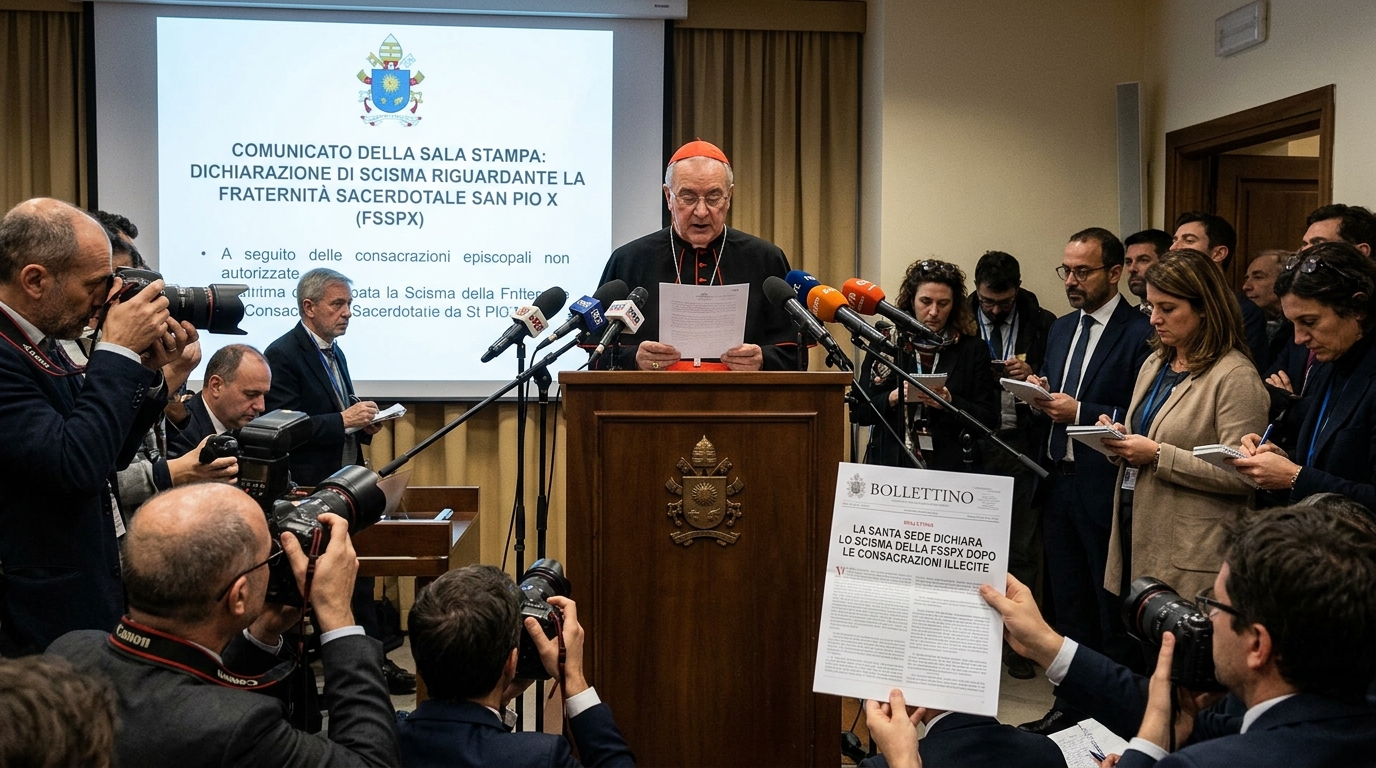
The Vatican has formally declared the Society of St. Pius X (SSPX) to be in schism after the traditionalist Catholic group consecrated four bishops without papal approval. The move marks one of the most significant internal crises facing the Catholic Church in decades and signals a decisive response from Pope Leo XIV against a group that has challenged Vatican authority for years.
The decision came just one day after the SSPX carried out the bishop consecrations at its seminary in Écône, Switzerland, despite repeated warnings from the Vatican that such an action would violate Church law and result in severe penalties. The Vatican’s Dicastery for the Doctrine of the Faith announced that the unauthorized ordinations constituted a schismatic act and imposed the Church’s highest canonical sanctions.
The Vatican Declares SSPX in Schism decision goes beyond the automatic penalties normally required under canon law. In addition to confirming the excommunication of the bishops involved in the consecrations, the Vatican declared that SSPX priests are also excommunicated and warned that Catholics who formally join or adhere to the society could face the same penalty. The Holy See also stated that sacraments such as confession and marriage celebrated by SSPX clergy are considered invalid.
The Society of St. Pius X was founded in 1970 by French Archbishop Marcel Lefebvre following the reforms introduced by the Second Vatican Council. The group rejects many of the Council’s changes, including liturgical reforms, ecumenical dialogue, and the wider use of local languages during Mass. Instead, it continues celebrating the traditional Latin Mass and argues that the post-Vatican II Church has departed from authentic Catholic teaching.
Relations between the Vatican and SSPX have remained strained for decades.
In 1988, Archbishop Lefebvre consecrated four bishops without permission from Pope John Paul II, resulting in automatic excommunication and a declaration that the act constituted schism. Although Pope Benedict XVI later lifted the personal excommunications of those bishops in 2009 as part of efforts toward reconciliation, the society itself never achieved full communion with the Catholic Church.
Since becoming pope, Leo XIV had expressed a desire to heal divisions within the Church and maintain dialogue with traditionalist Catholics. Vatican officials held discussions with SSPX leaders earlier this year and offered to continue theological talks if the group abandoned plans to ordain new bishops. Those efforts ultimately failed after SSPX leaders confirmed they would proceed with the ceremony.
The Vatican Declares SSPX in Schism announcement followed the ordination ceremony attended by thousands of supporters in Switzerland. During the five-hour event, four new bishops were consecrated without papal authorization. SSPX leaders defended their actions, arguing that they were necessary to preserve traditional Catholic doctrine and ensure the future leadership of the society.
The Vatican strongly rejected that explanation.
Church officials emphasized that only the pope has the authority to approve the consecration of bishops. According to Catholic canon law, episcopal ordinations carried out without papal approval represent a direct challenge to the unity and governance of the Church. Vatican leaders said the SSPX had knowingly ignored repeated warnings before carrying out the ceremony.
Cardinal Víctor Manuel Fernández, head of the Dicastery for the Doctrine of the Faith, had previously described the planned ordinations as a grave schismatic act. Before the ceremony, he appealed to SSPX leaders to reconsider their decision and continue dialogue with the Holy See. After the consecrations went ahead, the Vatican concluded that stronger action had become necessary.
The Vatican Declares SSPX in Schism decision is expected to have significant consequences for Catholics associated with the movement around the World.
The SSPX operates hundreds of chapels, schools, seminaries, and religious communities across Europe, North America, Latin America, Africa, and Asia. The society reports having more than 700 priests and a substantial international following devoted to traditional Catholic worship and the Latin Mass.
Church experts say the Vatican’s declaration is intended to remove any uncertainty regarding the group’s canonical status. For years, many Catholics viewed the SSPX as existing in an irregular relationship with Rome rather than in formal schism. The latest decree makes the Vatican’s position unmistakably clear.
The decision also represents one of Pope Leo XIV’s first major tests as leader of the world’s 1.4 billion Catholics.
Since his election, Pope Leo has emphasized unity while also reaffirming the authority of the Second Vatican Council and its reforms. Vatican officials have repeatedly stated that acceptance of Vatican II remains essential for full communion with the Catholic Church.
Traditionalist Catholics outside the SSPX continue to celebrate the Latin Mass in many dioceses with Vatican approval. Church officials stressed that the current sanctions apply specifically to the Society of St. Pius X because of its unauthorized bishop consecrations rather than to Catholics who prefer traditional liturgical practices while remaining in communion with Rome.
Religious scholars believe the dispute highlights broader tensions within global Catholicism over tradition, authority, and the interpretation of Church reforms introduced more than sixty years ago. While some conservative groups have accepted Vatican authority despite disagreements over liturgical changes, the SSPX has consistently argued that extraordinary circumstances justified its independent actions. The Vatican has firmly rejected that claim.
As the Church moves forward, the consequences of the ruling are expected to extend well beyond the immediate disciplinary measures. The Vatican Declares SSPX in Schism decision closes another chapter in decades of difficult negotiations and underscores the Holy See’s determination to defend papal authority and Church unity.
Whether future dialogue between Rome and the Society of St. Pius X becomes possible again remains uncertain. For now, the Vatican’s decree marks one of the most significant developments in Catholic Church governance in recent years and a defining moment in Pope Leo XIV’s young pontificate.