
Long-Range Attacks Target Energy Infrastructure and Military Facilities Deep Inside Russian Territory
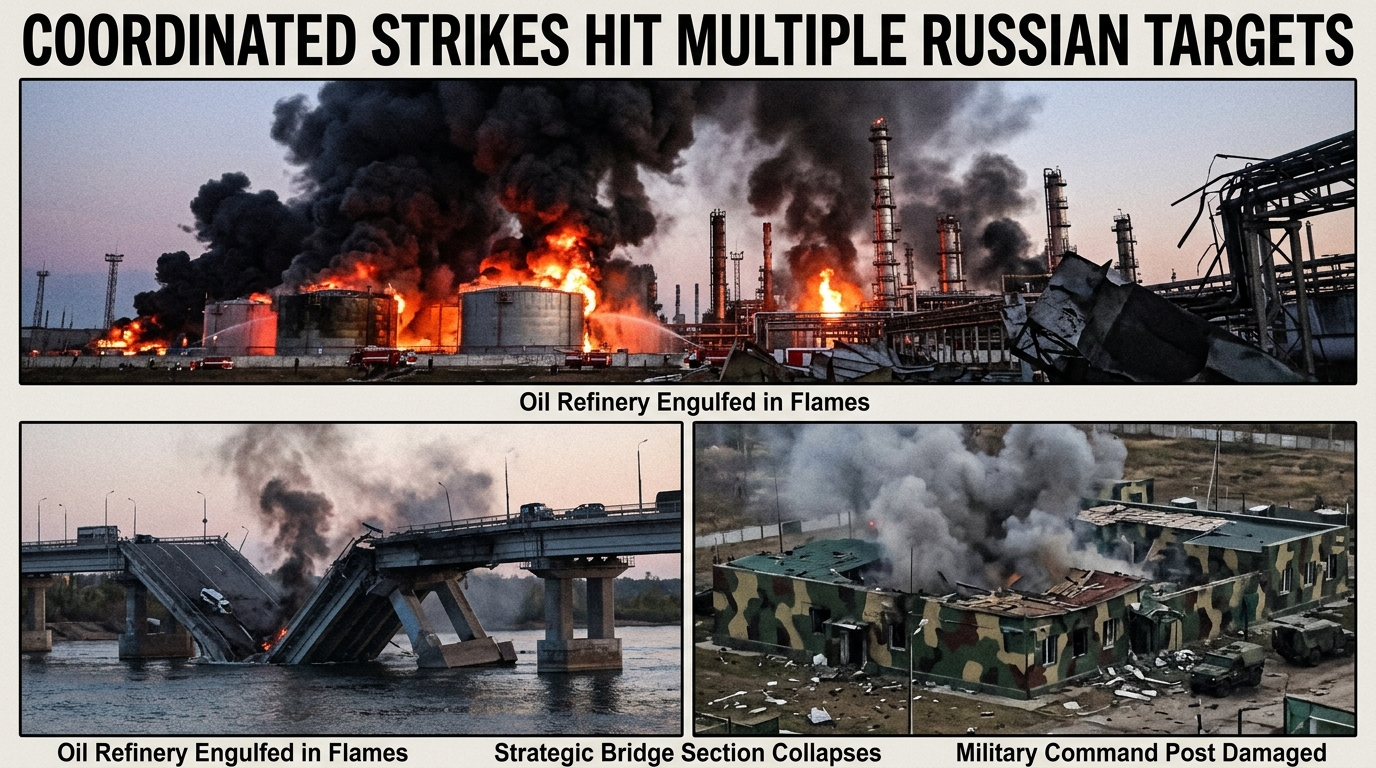
Ukraine has launched another coordinated series of long-range strikes against key military and energy facilities inside Russia, targeting one of the country’s largest oil refineries, a strategic bridge, and a military command post. Ukrainian officials say the operation is part of an ongoing campaign to weaken Russia’s military logistics and reduce its ability to sustain combat operations.
According to Ukraine’s General Staff, the attacks successfully hit the Lukoil-Nizhegorodnefteorgsintez refinery in Kstovo, located in Russia’s Nizhny Novgorod region. The refinery is one of Russia’s largest petroleum processing facilities and plays an important role in producing fuel for both civilian use and military operations. Ukrainian authorities reported that the strike triggered a fire at the refinery, while Russian officials acknowledged the incident without immediately providing details about the extent of the damage.
The Ukraine Strikes Russian Oil Refinery operation reflects Kyiv’s continued strategy of targeting facilities that support Russia’s military-industrial complex rather than focusing exclusively on frontline positions.
The Ukrainian military also announced that its forces struck a Russian military command post believed to coordinate operations in occupied Ukrainian territory. Officials said the command facility was being used to manage combat units and military logistics, making it a high-value target. Ukrainian authorities did not release additional operational details but described the strike as successful.
Another objective of the coordinated operation was a strategically important bridge used for military transportation. According to Ukrainian military sources, the bridge has played a role in moving personnel, equipment, and supplies supporting Russian operations. Damaging transportation infrastructure has become a recurring element of Ukraine’s long-range campaign, as it seeks to slow Russian logistics and complicate supply routes.
The latest attacks come as Ukraine continues expanding its ability to conduct precision strikes hundreds of kilometers beyond the active front lines. Improvements in domestically produced long-range drones and other strike systems have enabled Ukrainian forces to reach military and industrial targets deep inside Russian territory.
Military analysts say these operations represent a significant evolution in Ukraine’s strategy. Instead of concentrating solely on battlefield engagements, Kyiv is increasingly attempting to reduce Russia’s ability to manufacture weapons, process fuel, and coordinate military operations.
The Ukraine Strikes Russian Oil Refinery campaign has become one of the most visible examples of this broader approach.
Oil refineries occupy a particularly important place in Russia’s wartime Economy. They produce gasoline, diesel fuel, aviation fuel, and other petroleum products essential for transportation, industry, and military logistics. Damage to major refining facilities can interrupt production, create distribution challenges, and increase pressure on domestic fuel supplies.
The Lukoil-Nizhegorodnefteorgsintez refinery is considered one of Russia’s largest and most technologically advanced refineries. Located near the city of Kstovo, it processes significant volumes of Crude Oil and supplies petroleum products to several regions across Russia. Ukrainian officials argue that facilities supporting military logistics are legitimate military objectives under international law.
In recent months, Ukrainian forces have expanded attacks against refineries, fuel depots, ammunition storage facilities, air bases, radar installations, and military production plants. The strategy aims to impose costs on Russia while forcing Moscow to dedicate additional resources to protecting critical infrastructure.
Military observers note that defending such a vast territory presents enormous challenges. Russia must protect thousands of kilometers of pipelines, numerous refineries, airfields, industrial complexes, logistics hubs, and command centers spread across the country’s extensive geography.
The Ukraine Strikes Russian Oil Refinery campaign demonstrates how relatively low-cost drones can create significant operational challenges even for countries with advanced air Defense systems.
Russian authorities reported responding to drone attacks in several regions during the overnight operation. Air defense units were activated, and officials said multiple drones had been intercepted before reaching their intended targets. However, fires reported at industrial facilities suggest that at least some strikes successfully penetrated defensive measures.
The attacks also underline the growing importance of long-range precision warfare in the conflict. Both Russia and Ukraine increasingly rely on drones, cruise missiles, and precision-guided weapons capable of striking infrastructure far from traditional battlefields.
Analysts believe that disrupting logistics may prove just as important as battlefield victories in a prolonged conflict. Limiting fuel production, damaging transportation routes, and targeting command centers can reduce operational efficiency without requiring large-scale ground offensives.
International observers continue monitoring these developments closely. While Ukraine maintains that the strikes are directed exclusively at military-related objectives, each new operation raises questions about the evolving nature of modern warfare and the expanding geographic scope of the conflict.
Meanwhile, Russia has continued its own campaign of missile and drone attacks against Ukrainian cities and infrastructure. Overnight attacks on Ukrainian territory have targeted residential neighborhoods, transportation networks, and energy facilities, causing civilian casualties and significant damage.
The latest Ukrainian operation highlights how both sides increasingly view infrastructure as a central element of the war. Rather than focusing exclusively on territorial gains, each country is attempting to weaken the other’s ability to sustain military operations through strikes on strategic assets.
The Ukraine Strikes Russian Oil Refinery operation also reflects Ukraine’s broader effort to demonstrate that key facilities inside Russia remain vulnerable despite extensive air defense networks. By reaching targets located far from the front, Kyiv aims to place additional pressure on Russia’s military planning and industrial capacity.
Military experts note that long-range strike campaigns are likely to remain an important feature of the conflict. As drone technology continues advancing, both offensive capabilities and defensive systems are expected to evolve rapidly.
For Ukraine, these operations represent an opportunity to affect Russia’s military capabilities beyond the battlefield. For Russia, protecting strategic infrastructure while maintaining offensive operations presents an increasingly complex challenge.
As the conflict enters another phase, attacks on energy infrastructure, logistics centers, command facilities, and transportation networks are expected to remain central to both countries’ military strategies. The success or failure of these campaigns could influence not only battlefield operations but also the broader economic and industrial resilience of each side in the months ahead.