
Reports Raise Questions About Connections Between U.S. Critical Minerals Policy and Private Investment Interests
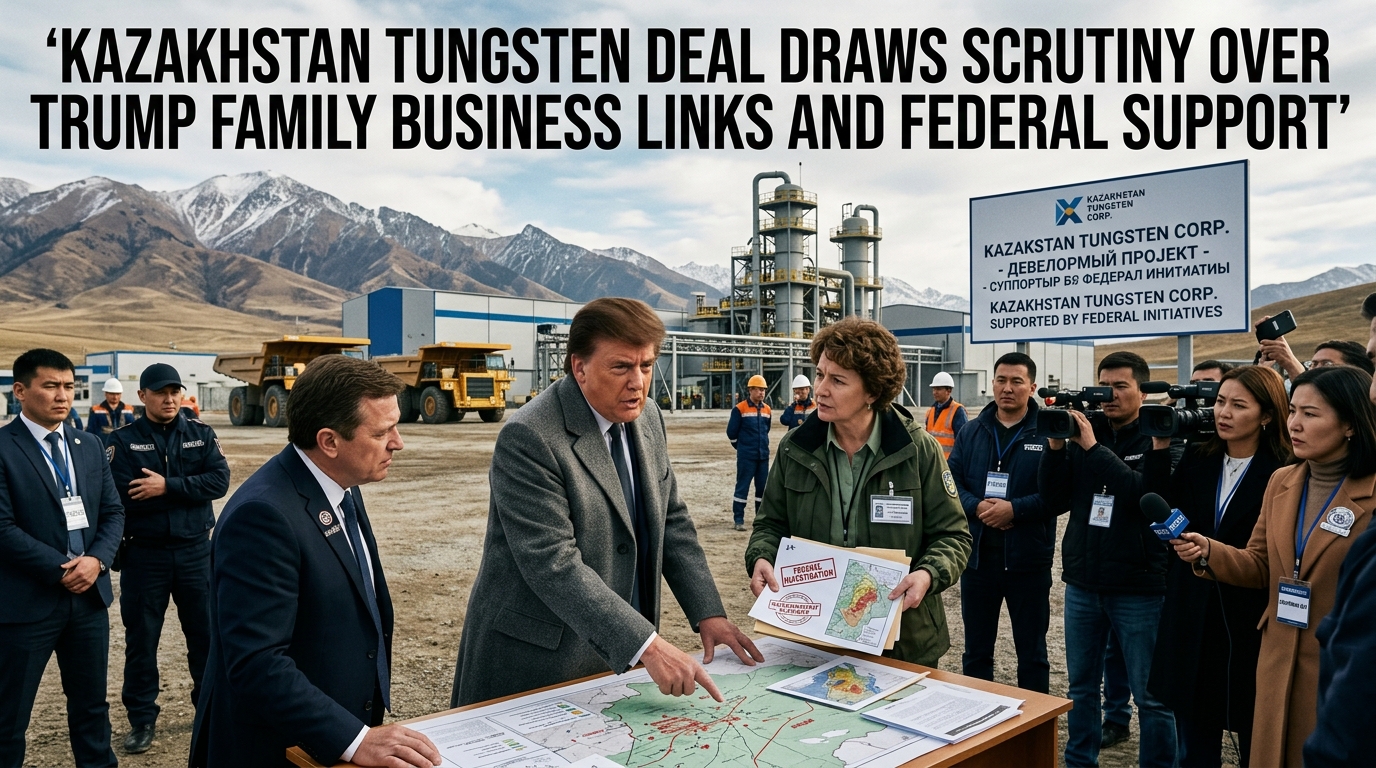
A major tungsten mining project in Kazakhstan has become the center of political and financial scrutiny after reports revealed connections between U.S. government-backed financing, critical minerals policy, and business interests linked to the families of President Donald Trump and Commerce Secretary Howard Lutnick.
The controversy comes as the United States intensifies efforts to secure access to critical minerals needed for advanced technologies, Defense systems, semiconductors, and aerospace manufacturing. Officials have repeatedly emphasized the need to reduce dependence on China, which currently dominates global supply chains for several strategic minerals.
However, recent reports have sparked debate over whether private investors with political connections could benefit from government-backed initiatives designed to strengthen America’s mineral security.
At the center of the discussion is a major Kazakhstan tungsten deal, which involves one of the World’s largest undeveloped tungsten deposits and billions of dollars in potential federal support.
Strategic Importance of Tungsten
Tungsten is considered one of the most important critical minerals in modern industry. The metal is widely used in military equipment, aircraft components, electronics, industrial machinery, and advanced manufacturing technologies.
Because China controls a significant share of global tungsten production and processing capacity, U.S. policymakers have increasingly sought alternative sources of supply. Kazakhstan, with its large mineral reserves and strategic location, has emerged as an attractive partner in these efforts.
The reported Kazakhstan tungsten deal is viewed by supporters as an opportunity to diversify global supply chains and strengthen economic security. Advocates argue that developing new sources of tungsten could reduce dependence on foreign competitors and improve resilience across key industries.
Details of the Reported Agreement
According to reports, discussions surrounding the project intensified during meetings involving senior U.S. and Kazakh officials. The mining venture reportedly centers on a large tungsten reserve that has remained largely undeveloped despite its significant commercial potential.
Reports indicate that U.S. government agencies explored financing commitments totaling up to $1.6 billion through programs designed to support strategic economic and industrial objectives. The funding discussions reportedly involved institutions such as the Export-Import Bank and the U.S. International Development Finance Corporation.
The amount reportedly discussed exceeds the estimated development cost of the mining project itself, drawing additional attention from analysts and political observers.
Supporters of the project argue that large-scale investments are often necessary to accelerate production of critical minerals that are essential to national security and industrial competitiveness.
Investment Links Spark Debate
The controversy intensified after reports revealed that investors connected to Dominari Securities acquired a significant stake in a corporate vehicle associated with the mining venture.
Public filings reportedly show that investors linked to the firm secured ownership interests shortly before the final agreement was completed. The timing of those investments has generated questions from critics who argue that government-backed projects should maintain clear separation from politically connected business interests.
Additional attention has focused on financial institutions involved in fundraising activities related to the project. Reports indicate that entities connected to the mining venture successfully raised hundreds of millions of dollars through investment transactions linked to firms with family connections to senior government officials.
As a result, the Kazakhstan tungsten deal has become part of a broader debate about transparency, ethics, and oversight within government-supported industrial programs.
Critical Minerals Become a National Priority
The United States has increasingly treated critical minerals as a strategic priority over the past several years. Policymakers from both major political parties have supported initiatives designed to strengthen domestic production and secure reliable international partnerships.
Federal programs aimed at boosting critical mineral supplies have expanded significantly, reflecting concerns about global competition, supply chain vulnerabilities, and national security risks.
Supporters of these efforts argue that government participation is necessary because private investors alone may be unwilling to finance large, long-term mining projects with uncertain returns.
At the same time, critics warn that strong oversight is essential to ensure that taxpayer-backed programs serve national interests rather than private financial gains.
The debate surrounding the Kazakhstan tungsten deal reflects these competing concerns, particularly as government-backed funding increasingly intersects with private investment opportunities.
Broader Questions About Federal Support
Reports have also highlighted multiple companies connected either directly or indirectly to business interests associated with prominent political figures. Several of these firms are reportedly pursuing critical minerals projects while seeking federal financial assistance.
Analysts note that government support for strategic industries is not unusual. Similar programs exist across sectors including energy, infrastructure, technology, and manufacturing.
The key question for policymakers is whether sufficient safeguards exist to prevent conflicts of interest and maintain public confidence in the decision-making process.
Transparency advocates argue that detailed disclosure requirements and independent oversight mechanisms are essential whenever public funds support large-scale private ventures.
Looking Ahead
As demand for critical minerals continues to grow, governments around the world are expected to increase investments in mining, processing, and supply-chain development.
The reported Kazakhstan tungsten deal highlights both the opportunities and challenges associated with this global competition. While securing strategic mineral resources remains a major objective for policymakers, questions regarding accountability and transparency are likely to remain part of the public conversation.
Whether the project ultimately becomes a model for future critical minerals partnerships or a case study in political controversy may depend on how regulators, lawmakers, and investors address the concerns that have emerged.
For now, the deal underscores the growing importance of critical minerals in global geopolitics and the increasingly complex relationship between government policy, private investment, and national security.