
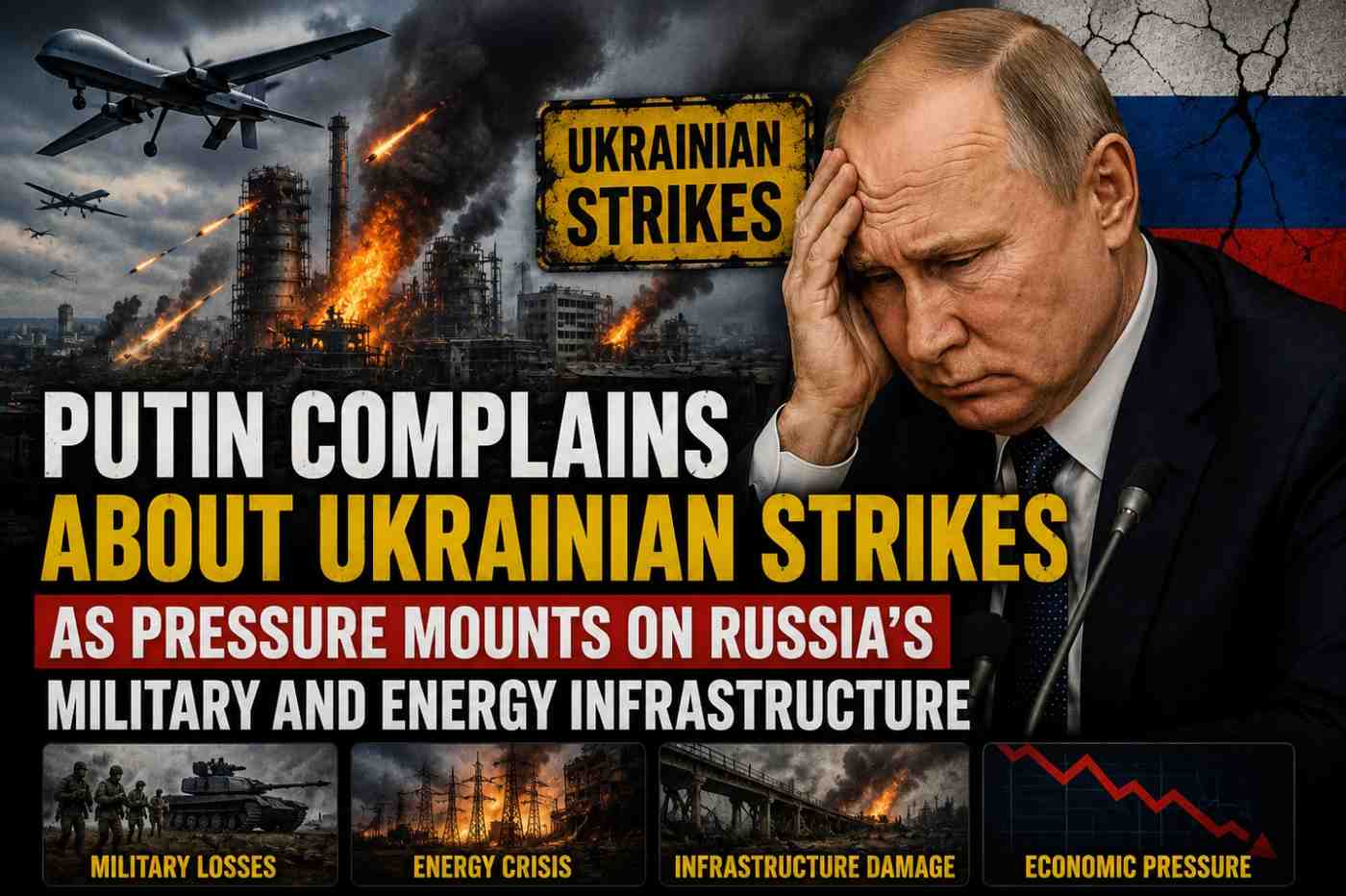
Kremlin Leader Cites Drone Attacks and Western Measures While Insisting Russia Will Continue Its War Effort
Russian President Vladimir Putin has publicly voiced frustration over Ukraine’s expanding campaign of long-range strikes against military and energy targets inside Russia, while also criticizing what he described as growing pressure from Western nations.
The remarks come at a time when Ukraine has intensified attacks on Russian oil refineries, fuel depots, logistics hubs, and military infrastructure, creating new challenges for Moscow as the conflict continues into another year. At the same time, Russia remains under extensive sanctions and economic restrictions imposed by Western governments in response to the war.
The Putin Complains About Ukrainian Strikes story has attracted significant attention because it reflects increasing concerns within Russia about the impact of attacks occurring far beyond the front lines.
Speaking during a public appearance, Putin acknowledged that Ukrainian strikes have targeted both military facilities and oil-processing infrastructure. He also referred to what he called “unprecedented pressure” from Western countries, arguing that Russia is facing challenges on multiple fronts simultaneously. Despite those concerns, he maintained that Russia would continue pursuing its objectives and adapt to the changing situation.
Ukraine’s strategy has evolved significantly over the past year. Rather than focusing solely on battlefield operations, Ukrainian forces have increasingly used long-range drones and other systems to strike facilities deep inside Russian territory. These operations have targeted infrastructure linked to military production, fuel distribution, and transportation networks.
Military analysts say the objective is to reduce Russia’s ability to sustain long-term operations while forcing Moscow to divert resources toward protecting critical infrastructure. By expanding the battlefield beyond traditional combat zones, Ukraine is attempting to increase pressure on Russia’s Economy and logistics systems.
The Putin Complains About Ukrainian Strikes narrative gained additional significance after reports of attacks on multiple oil refineries and fuel facilities. Several incidents in recent months have disrupted operations at energy sites, prompting Russian authorities to introduce measures aimed at stabilizing fuel supplies and protecting strategic infrastructure.
Energy infrastructure has become one of the most important fronts in the conflict.
Oil refineries, fuel depots, and logistics hubs play a critical role in supporting transportation, industry, and military operations. Damage to these facilities can create ripple effects throughout the economy, affecting supply chains and increasing operational costs.
According to recent reports, Russian authorities have acknowledged challenges related to fuel availability in some regions. Government officials have introduced export restrictions and additional measures intended to maintain domestic supplies while repairs continue at affected facilities.
The Putin Complains About Ukrainian Strikes discussion also highlights the growing role of drone warfare in modern conflicts.
Small and relatively inexpensive unmanned systems have become increasingly capable of reaching targets hundreds or even thousands of kilometers away. Military experts note that defending large territories against such threats presents major challenges, particularly when attackers can launch large numbers of drones simultaneously.
For Russia, protecting military installations, energy facilities, transportation networks, and industrial centers spread across a vast geographic area requires significant resources. Analysts argue that this reality is forcing Moscow to rethink aspects of its defensive strategy.
Beyond military concerns, Putin’s comments focused heavily on pressure from Western countries.
Since the beginning of the conflict, the United States, European Union, United Kingdom, and other partners have imposed extensive sanctions targeting Russian financial institutions, exports, technology access, and key industries. Western leaders argue that these measures are designed to limit Russia’s ability to finance and sustain military operations.
Russian officials, however, continue to criticize the sanctions regime, describing it as an attempt to weaken the country economically and politically. Putin reiterated those arguments, claiming that Russia remains under extraordinary external pressure while continuing to adapt its economy to wartime conditions.
The combination of sanctions and infrastructure attacks has created a complex environment for Russian policymakers.
Economic analysts point out that Russia has demonstrated resilience in several sectors despite restrictions. However, repeated disruptions to energy infrastructure and industrial facilities can create additional costs and logistical complications that accumulate over time.
Meanwhile, Ukraine views the strikes as an important component of its broader Defense strategy.
Ukrainian officials have repeatedly argued that facilities supporting Russia’s military operations are legitimate targets. They maintain that attacks on fuel depots, refineries, and military infrastructure help reduce Russia’s operational capabilities while limiting its ability to continue large-scale offensives.
International reactions remain divided.
Western governments generally support Ukraine’s right to defend itself, while continuing to monitor developments closely. Some observers have expressed concern that deeper strikes inside Russia could increase the risk of escalation, while others argue that such operations are becoming an increasingly important part of modern warfare.
The Putin Complains About Ukrainian Strikes story reflects a broader shift in how the conflict is being fought. Rather than focusing exclusively on territorial battles, both sides are increasingly targeting infrastructure, logistics networks, and economic assets that support military operations.
This transformation has made the war more complex and less predictable.
Modern technology allows countries to project force far beyond traditional front lines, creating new vulnerabilities and forcing military planners to consider threats across much larger areas. As a result, infrastructure protection has become nearly as important as battlefield performance.
For Russia, the challenge is maintaining economic stability and military effectiveness while responding to attacks on critical facilities. For Ukraine, the goal is to continue applying pressure without exhausting its own resources.
As the conflict evolves, infrastructure attacks, economic measures, and long-range drone operations are likely to remain central features of the war. Putin’s public criticism of Ukrainian strikes and Western pressure underscores how significant these factors have become.
While Russia insists it can manage the challenges and continue its military campaign, the growing frequency of attacks on strategic targets suggests that the conflict is increasingly affecting areas far from the front lines.
The coming months will reveal whether these pressures significantly alter the balance of the war or simply mark another stage in a prolonged conflict that continues to reshape security, economics, and politics across the region.