
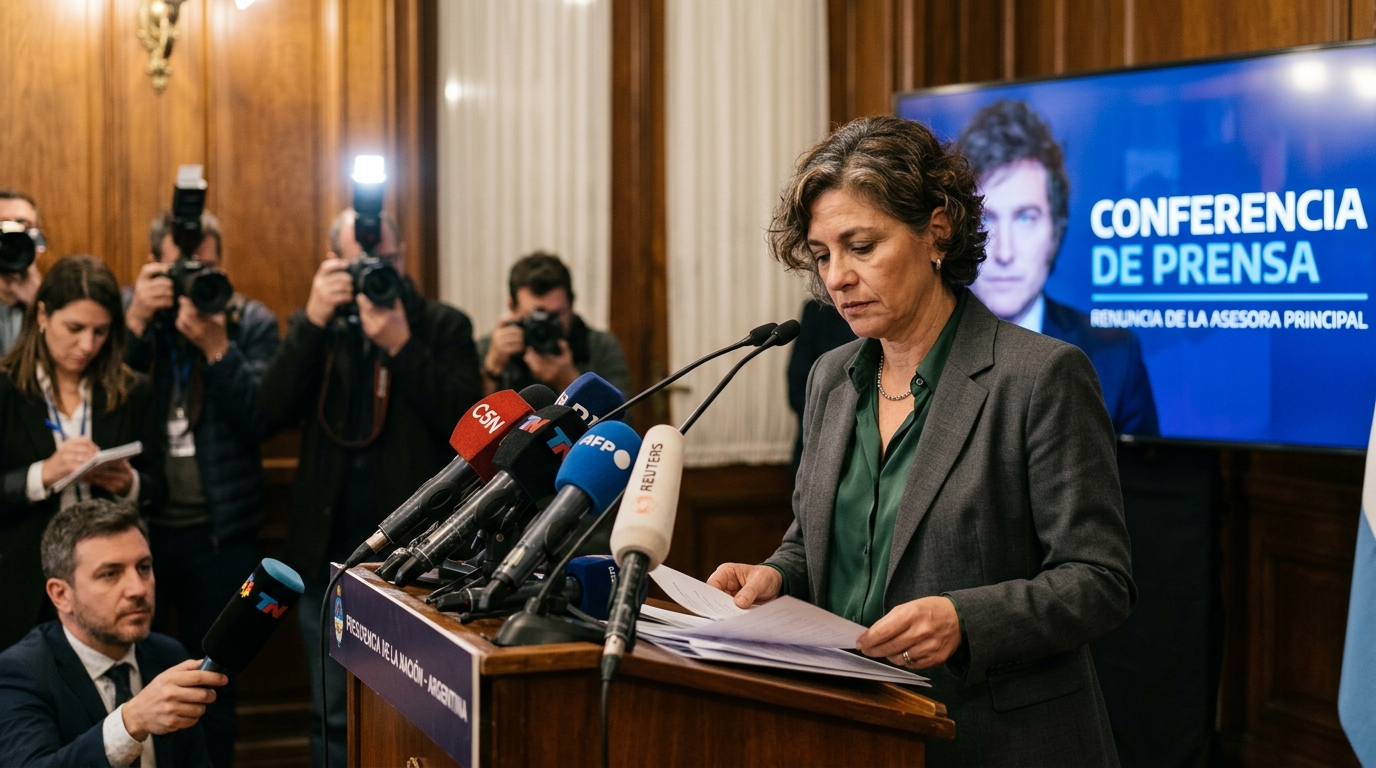
Departure of Cabinet Chief Manuel Adorni Creates New Political Challenge for Argentina’s Libertarian Government
Argentine President Javier Milei is facing one of the most significant political setbacks of his presidency after his top aide and Cabinet Chief, Manuel Adorni, announced his resignation amid a growing corruption scandal that has dominated national headlines.
The resignation marks a major blow for Milei’s administration, which came to power promising transparency, economic reform, and a strong fight against corruption. Adorni, one of the president’s closest allies and most recognizable political figures, had become a central figure in the government’s efforts to communicate and defend its ambitious reform agenda.
The Javier Milei Top Aide Resigns story has quickly become one of the biggest political developments in Argentina this year, raising questions about the future of the government and its credibility among voters.
Adorni submitted his resignation after months of controversy surrounding his personal finances and spending habits. Federal investigators have been examining allegations of illicit enrichment following reports that his lifestyle and expenditures appeared inconsistent with his official income. The controversy intensified after media reports highlighted luxury travel, property acquisitions, and undeclared assets linked to the senior government official.
In his resignation letter, Adorni insisted that he had committed no crime and maintained that he would prove his innocence through legal proceedings. He said he was stepping down to avoid causing further political damage to the administration and expressed confidence that the truth would emerge during the investigation.
The scandal gained momentum after reports surfaced about several expensive trips taken by Adorni and his family, including international travel and luxury accommodations. Critics questioned how such expenses could be covered through his government salary alone. As public scrutiny intensified, Adorni acknowledged that previous financial disclosures had omitted approximately $500,000 in savings, which he later amended in official filings.
The Javier Milei Top Aide Resigns development is particularly significant because of Adorni’s role within the administration. Before becoming Cabinet Chief, he served as the government’s spokesperson and was widely regarded as one of the president’s most trusted political allies. His rise through the government reflected his close relationship with Milei and his importance within the ruling coalition.
For much of the controversy, President Milei publicly defended Adorni. The president repeatedly argued that allegations alone should not be enough to force a resignation and emphasized the principle of innocence until proven guilty. However, as the scandal continued to attract media attention and political criticism, pressure on both Adorni and the administration continued to grow.
Political analysts say the resignation represents more than just the departure of a senior official. It also creates a challenge for a government that has built much of its public identity around fighting corruption and reforming Argentina’s political system. Critics argue that the controversy undermines one of the administration’s most important campaign promises.
The Javier Milei Top Aide Resigns controversy arrives during a sensitive period for Argentina’s Economy. Milei’s government has implemented aggressive austerity measures and sweeping economic reforms designed to reduce inflation, stabilize public finances, and attract investment. While some economic indicators have shown improvement, many Argentines continue to face financial pressure from high prices and reduced purchasing power.
Recent polling has suggested that public support for Milei has declined compared with earlier stages of his presidency. Analysts believe the corruption scandal could further complicate efforts to maintain political momentum as the government seeks congressional support for additional reforms.
The resignation also creates uncertainty regarding future negotiations between the executive branch and provincial leaders. As Cabinet Chief, Adorni played a key role in coordinating government strategy and maintaining communication with lawmakers and regional authorities. His departure leaves a significant gap within the administration’s leadership structure.
Government officials have not immediately announced a permanent replacement. However, political observers expect President Milei to move quickly to restore stability and reassure both supporters and investors that the administration remains focused on its economic agenda.
The Javier Milei Top Aide Resigns story has also fueled broader discussions about accountability and transparency in Argentine politics. Supporters of the government argue that allowing investigations to proceed demonstrates respect for democratic institutions. Critics, meanwhile, contend that stronger oversight mechanisms are needed to prevent similar controversies from emerging in the future.
Across Argentina, reactions have been mixed. Some voters view the resignation as a necessary step that allows investigations to continue without political interference. Others believe the case highlights deeper challenges facing the country’s political system and raises concerns about ethics within public office.
International investors and financial markets are also closely monitoring developments. Argentina has spent years attempting to restore economic confidence after repeated financial crises, and political stability remains an important factor in investor decision-making. While markets have not shown major signs of panic, analysts caution that prolonged political uncertainty could affect confidence in future reforms.
For President Milei, the coming weeks may prove critical. His administration must now manage the political fallout from the resignation while continuing efforts to implement economic changes that formed the foundation of his election campaign.
As investigations continue, attention will remain focused on whether additional evidence emerges and how the government responds. The outcome could influence not only the future of Adorni’s political career but also public perceptions of Milei’s broader reform movement.
For now, the resignation of one of the president’s closest allies represents a significant moment in Argentina’s political landscape. The Javier Milei Top Aide Resigns controversy has become a major test for an administration that promised a new era of transparency, accountability, and change, and its long-term impact may shape Argentine politics for months to come.