
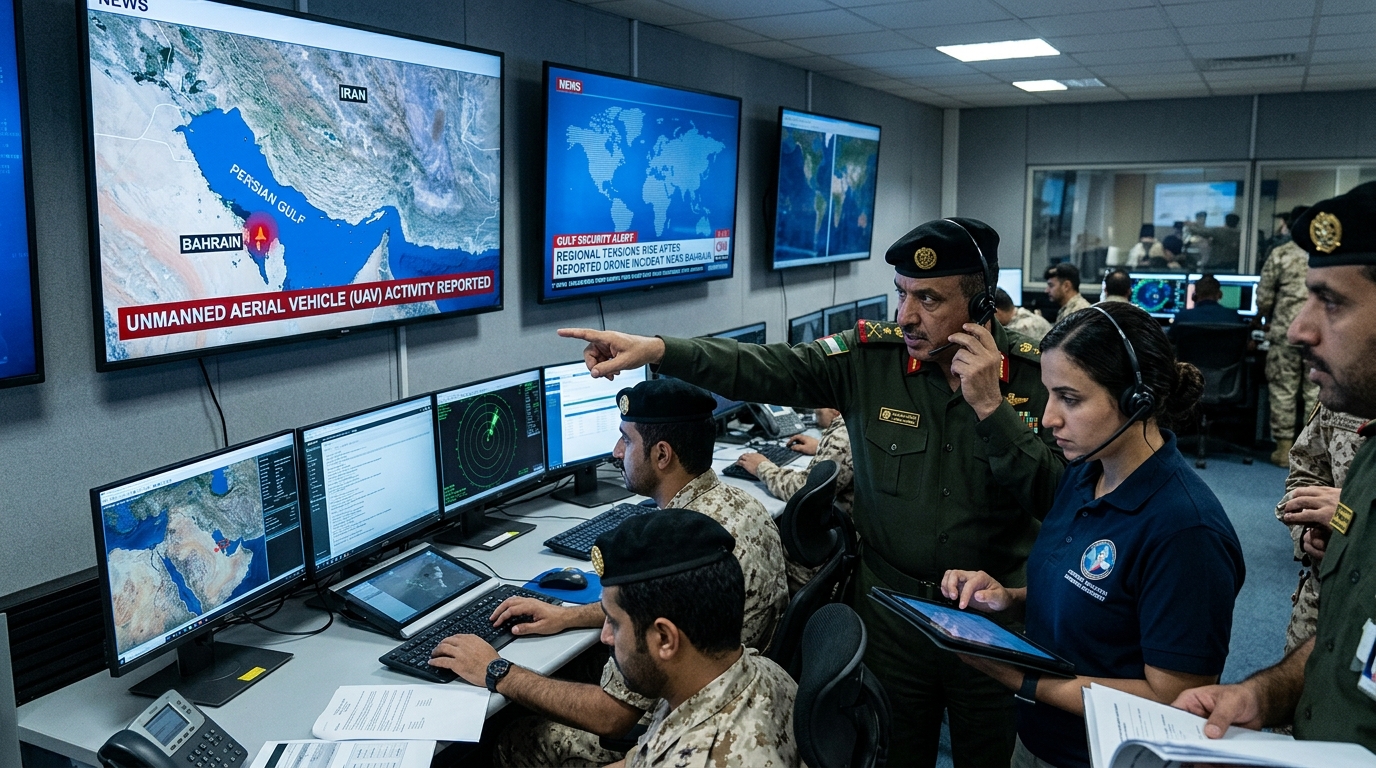
Bahrain Condemns Reported Iranian Drone Strike While Shipping and Security Risks Increase Across the Gulf
The Middle East witnessed a fresh escalation in tensions after Bahrain accused Iran of launching drone attacks against its territory, adding new uncertainty to an already fragile regional security situation. The incident comes amid renewed military exchanges between the United States and Iran, raising concerns about stability in the Gulf and the future of ongoing diplomatic efforts.
According to Bahraini authorities, multiple drones entered the country’s airspace and were linked to Iranian military actions. Bahrain, which hosts the United States Navy’s Fifth Fleet, described the incident as a serious violation of its sovereignty and national security. Iranian officials, meanwhile, stated that they had targeted locations associated with U.S. forces in response to recent American airstrikes on Iranian facilities.
The reported Iran Bahrain Drone Attack has quickly become one of the most closely watched developments in the region, drawing international attention from governments, security analysts, and global markets.
Bahrain Condemns the Incident
Bahrain’s government strongly criticized the reported drone operation, calling it a direct threat to regional stability. Officials stated that the attack endangered civilian safety and undermined efforts to reduce tensions in the Gulf. The kingdom also reserved the right to take measures necessary to protect its territory and citizens.
The island nation occupies a strategically important position in the Gulf and serves as host to major international military installations. Because of this role, any security incident involving Bahrain often attracts broader international concern.
The Iran Bahrain Drone Attack immediately sparked reactions from regional partners, many of whom urged restraint and called for diplomatic solutions to prevent a wider conflict.
Iran Says Strikes Were a Response
Iran defended its actions by describing them as a response to what it called American aggression.
Iranian officials stated that recent U.S. military strikes on coastal surveillance and military facilities along Iran’s southern coast violated previous understandings designed to reduce hostilities. Tehran argued that its actions were defensive in nature and directed at U.S.-linked targets rather than civilian infrastructure.
However, Bahrain rejected those explanations and maintained that its sovereignty had been violated.
The disagreement highlights the deep mistrust that continues to exist between regional actors despite ongoing diplomatic efforts.
Strait of Hormuz Security Concerns
The latest developments occurred alongside separate incidents in the Strait of Hormuz, one of the World’s most important energy shipping routes.
Maritime security agencies reported that a commercial oil tanker sustained damage after being struck by an unidentified projectile while traveling through the strategic waterway. Although no injuries were reported among crew members, the incident raised concerns about shipping safety and energy security.
The Strait of Hormuz handles a significant percentage of global oil exports, making any disruption a matter of international concern.
Analysts note that the Iran Bahrain Drone Attack and incidents involving commercial shipping have increased worries about the possibility of broader instability affecting regional trade routes.
International Reactions
Governments across the region and beyond have been closely monitoring developments.
Several countries called for restraint and emphasized the importance of dialogue. Diplomatic observers warned that continued military exchanges could complicate efforts to maintain stability in the Gulf and protect international shipping lanes.
Security experts also highlighted the risk of miscalculation. In a region where multiple military forces operate in close proximity, even limited incidents can rapidly escalate if communication channels break down.
The international community has therefore continued encouraging all parties to pursue diplomatic solutions rather than military confrontation.
Impact on Energy Markets
Energy traders and investors reacted cautiously to reports of new tensions.
Because the Gulf region remains a major source of global oil supplies, developments affecting the Strait of Hormuz often influence energy prices and market sentiment. While immediate disruptions remained limited, analysts noted that uncertainty itself can affect trading activity and investment decisions.
Shipping companies have also increased monitoring of security conditions in the area. Maritime organizations continue issuing advisories to vessels operating near sensitive routes.
The broader economic implications of the Iran Bahrain Drone Attack could depend on whether tensions continue to rise or whether diplomatic efforts succeed in restoring calm.
Strategic Importance of Bahrain
Bahrain’s role in regional security makes it a particularly significant location during periods of tension.
The country hosts the headquarters of the U.S. Navy’s Fifth Fleet, which plays an important role in maritime security operations throughout the Gulf region. This strategic position has often placed Bahrain at the center of regional security discussions.
Security analysts say incidents involving Bahrain are closely watched because they can influence military planning, diplomatic negotiations, and regional alliances.
The latest Iran Bahrain Drone Attack has therefore attracted attention far beyond the immediate area where the incident occurred.
Diplomatic Efforts Face Challenges
Recent months have seen multiple attempts to reduce tensions through negotiations and temporary agreements.
However, the latest military exchanges demonstrate how fragile those arrangements can be. Both Iran and the United States have accused each other of violating previous understandings, making it more difficult to rebuild trust.
Experts argue that successful diplomacy will require continued communication, confidence-building measures, and a willingness from all sides to avoid actions that could provoke further escalation.
Without such efforts, regional security risks may remain elevated.
What Happens Next?
The coming days are expected to be critical as investigators, diplomats, and military officials assess the situation.
Authorities in Bahrain continue reviewing evidence related to the drone incident, while international observers monitor developments in the Gulf and the Strait of Hormuz. Additional diplomatic contacts are likely as governments seek to prevent the situation from deteriorating further.
For now, the Iran Bahrain Drone Attack remains a significant reminder of the volatility that continues to affect one of the world’s most strategically important regions.
As tensions persist, global attention will remain focused on whether diplomatic engagement can prevent further escalation and preserve stability across the Gulf.