
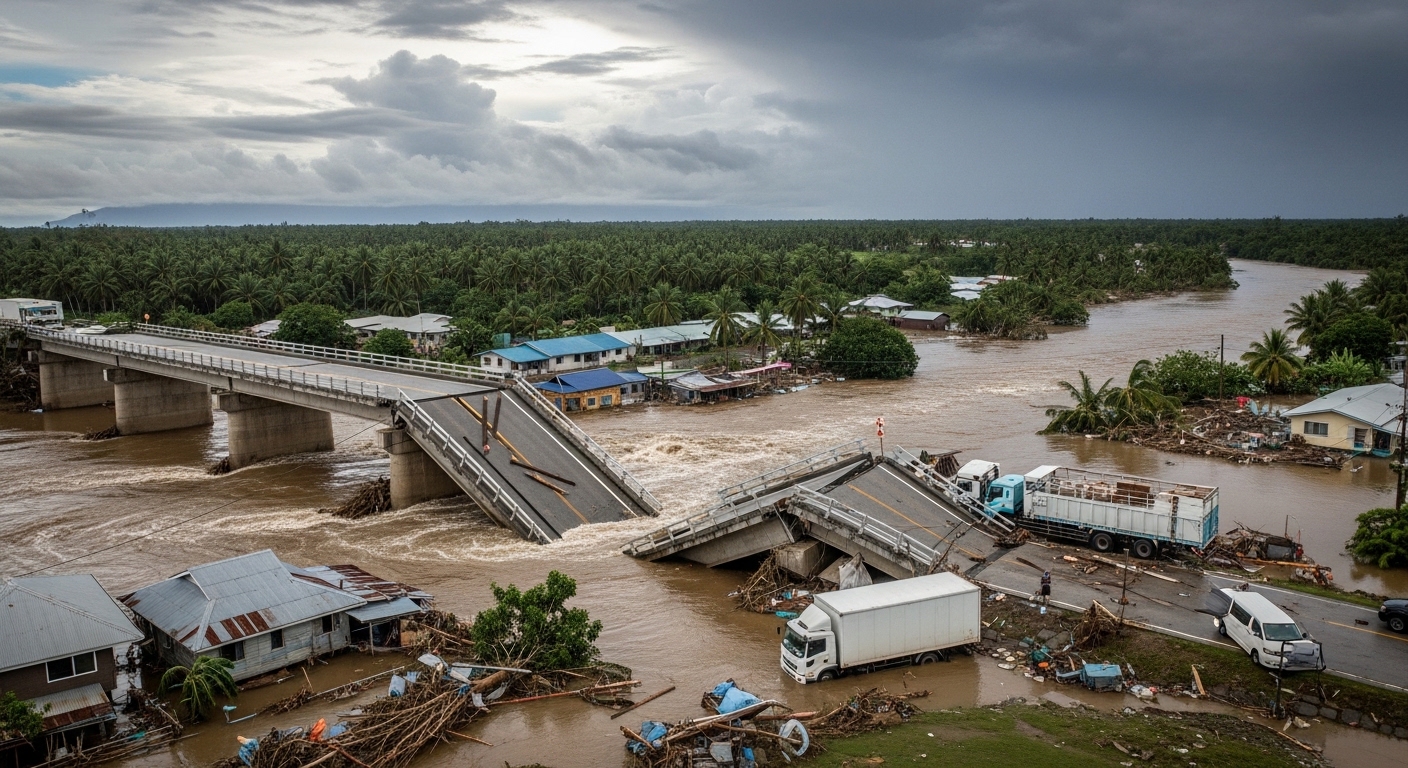
Severe weather event cuts off transport routes, isolates communities, and raises global concerns over food and fuel supply stability
A series of historic flash floods has caused widespread destruction across parts of the South Pacific region, washing away critical infrastructure and severely disrupting supply chains that connect remote islands and coastal communities. The extreme weather event, triggered by days of heavy rainfall, has destroyed key bridges, damaged roads, and isolated several populated areas.
Authorities and disaster response teams across affected island nations are now working urgently to restore connectivity, deliver emergency aid, and assess the full scale of the damage. Experts say this could become one of the most disruptive climate-related disasters in the region in recent years.
Torrential Rains Trigger Sudden and Deadly Flooding
Meteorological agencies report that an intense low-pressure system stalled over the South Pacific for several days, leading to continuous rainfall far beyond seasonal averages. The saturated ground quickly gave way, causing rivers to overflow and flash floods to sweep through valleys and coastal settlements.
Unlike slow-rising floods, flash flooding occurs within minutes or hours, giving residents little time to evacuate. In many areas, water levels rose so quickly that vehicles, homes, and livestock were swept away before emergency services could respond.
Local officials confirmed that several villages were cut off entirely after roads collapsed and bridges were destroyed by fast-moving water and debris. Communication networks have also been disrupted in some remote regions, making rescue coordination more difficult.
Critical Bridges Destroyed, Supply Chains Severed
One of the most serious impacts of the disaster has been the destruction of key transport bridges that connect inland agricultural zones to coastal ports. These structures play a vital role in moving food, fuel, medical supplies, and construction materials across islands and territories.
With multiple bridges now unusable, supply chains have been severely disrupted. Shipping schedules have been delayed, warehouses report shortages, and fuel distribution has slowed significantly in several affected areas.
Economists warn that if repairs are not completed quickly, the disruption could lead to rising prices of essential goods such as rice, fuel, and imported food items. Island economies, which are heavily dependent on imports, are particularly vulnerable to such shocks.
Communities Isolated and Emergency Response Underway
Emergency response teams from local governments, supported by international aid agencies, are conducting search-and-rescue operations in the hardest-hit regions. Helicopters and boats are being used to reach isolated communities where road access has been completely cut off.
Temporary shelters have been set up in schools and public buildings for displaced families. Relief organizations are distributing clean drinking water, food supplies, and medical kits to prevent outbreaks of waterborne diseases.
Officials have urged residents in low-lying and coastal areas to remain alert, as additional rainfall is still forecast in some parts of the region. Landslides are also a growing concern in mountainous zones where soil has been weakened by prolonged saturation.
Economic and Trade Impact Spreads Beyond the Region
The South Pacific plays a key role in regional maritime trade routes, and disruptions to its infrastructure are already being felt beyond the immediate disaster zone. Shipping companies have reported delays in cargo movement, while insurers are reassessing risk exposure across multiple island states.
Agricultural exports, including coconut, fish, and tropical fruits, are expected to decline in the short term due to damaged roads and ports. This could affect supply chains in nearby markets across Asia and Oceania.
Experts say that rebuilding efforts will require significant international assistance, as many island nations lack the financial capacity to fully restore damaged infrastructure on their own.
Climate Change Concerns Intensify
Scientists and climate experts say this disaster is another reminder of the increasing intensity of extreme weather events linked to climate change. Warmer ocean temperatures are contributing to stronger storm systems and heavier rainfall in the South Pacific.
Environmental researchers warn that without improved climate adaptation strategies, such disasters may become more frequent and severe in the coming years. They are calling for stronger investment in resilient infrastructure, including elevated bridges, flood-resistant roads, and improved early warning systems.
Local governments are also being urged to strengthen disaster preparedness plans and improve evacuation systems for vulnerable coastal populations.
International Aid and Recovery Plans
Several international organizations have expressed readiness to assist in recovery efforts. Humanitarian aid shipments, including food, water purification systems, and temporary shelter materials, are being prepared for deployment.
Reconstruction of destroyed bridges is expected to take months, if not longer, depending on funding and weather conditions. In the meantime, temporary ferry services and alternative transport routes are being explored to restore limited connectivity.
Governments in the region are also discussing coordinated recovery plans to ensure that supply chains are restored as quickly as possible.
Conclusion
The historic flash flooding across the South Pacific has left a trail of destruction, with critical bridges washed away and essential supply chains severely disrupted. As rescue and recovery operations continue, the focus remains on reaching isolated communities and restoring basic services.
While immediate relief efforts are underway, the disaster highlights a deeper long-term challenge: building infrastructure that can withstand increasingly extreme weather conditions in a changing global climate.