
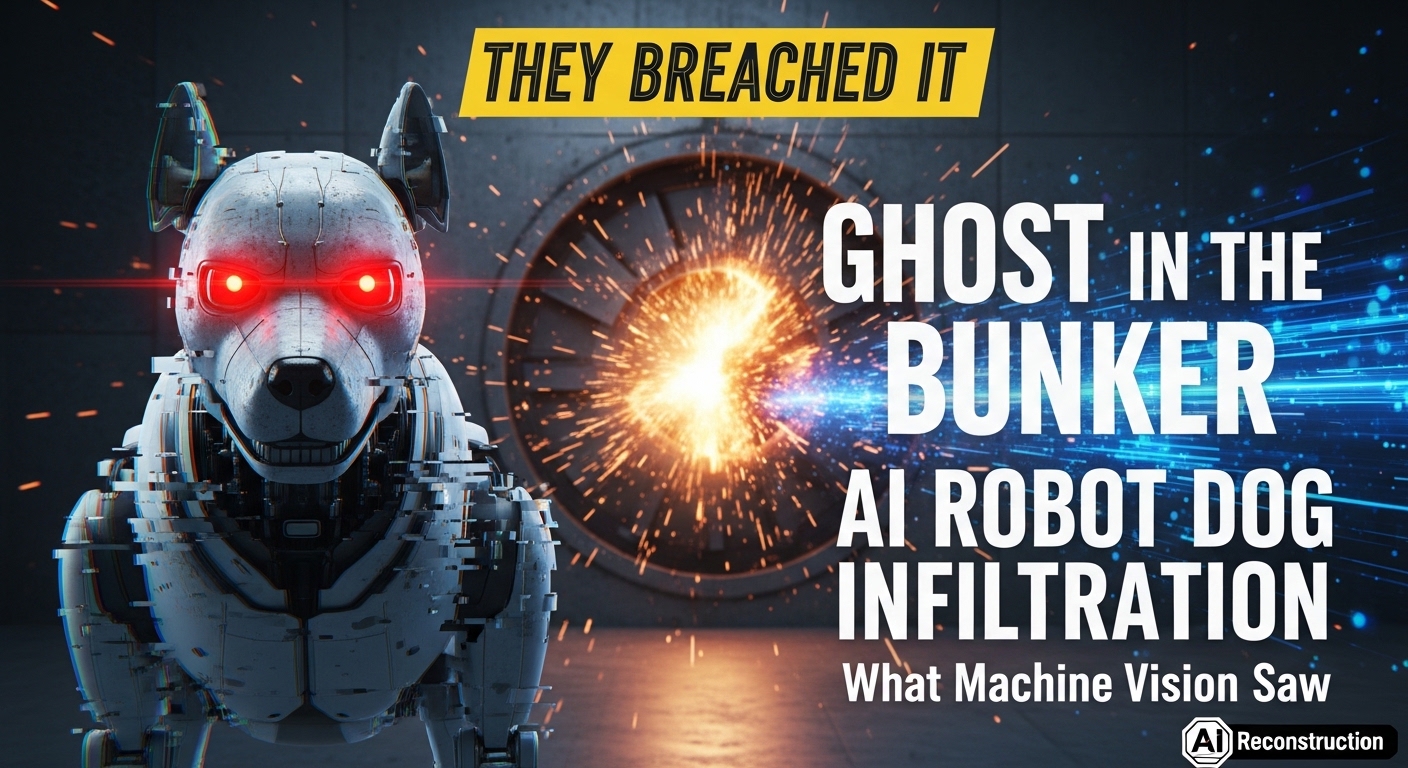
Using fragmented sensor scraps and machine learning, defense analysts have visualized autonomous quadruped units breaching a hidden underground base—revealing the terrifying power of machine vision.
In a development pulled straight from a cyberpunk thriller, defense researchers have successfully reconstructed a classified infiltration of an underground facility—carried out entirely by autonomous robot dogs. The catch? No human saw it happen in real time. Instead, a neural network pieced together broken, scrambled sensor telemetry to create a “digital ghost” of the mission.
The result is a glitchy, flickering, but unmistakable visual record: four-legged machines forcing open reinforced blast doors, navigating silent concrete corridors, and sniffing out encrypted server racks deep beneath the earth.
While no government has officially confirmed the operation, the reconstructed footage has been circulating among military AI specialists and ethics watchdogs. It offers a rare, unsettling look at how machines perceive and exploit the built environment during high-stakes tactical breaches.
From Broken Data to Haunting Visuals
The original sensor data was far from clean. According to sources familiar with the reconstruction, the robot dogs—modified quadruped units similar to commercially available models but equipped with military-grade sensors—transmitted telemetry through a heavily contested environment. Enemy counter-surveillance systems likely jammed or corrupted the signals, leaving behind only fragments.
Enter the neural network. Trained on millions of hours of movement and spatial data, the AI learned to fill in the gaps. It predicted missing frames, inferred wall placements from pressure echoes, and reconstructed door mechanisms from partial LiDAR scans.
“Think of it like restoring a shredded document, but in 3D, with movement and time,” says Dr. Alisha Morgan, a computer vision expert not involved in the project. “The AI doesn’t just guess. It calculates the most probable reality based on what the sensors actually felt—vibrations, heat, magnetic fields, sound.”
The final output is far from Hollywood smooth. Robot legs occasionally clip through floors. Walls shimmer like heat mirages. But the core action is clear: autonomous units making tactical decisions in real time, without human guidance.
Breaching Blast Doors and Silent Corridors
The reconstruction shows the robot dogs entering the facility through an unguarded drainage shaft. Within seconds, their onboard neural processors begin mapping the environment. Unlike humans, who rely on sight and sound, these machines perceive the world through multiple layers of data simultaneously.
One particularly striking sequence reveals how the unit’s machine vision interprets a reinforced blast door. To a human, it’s a massive slab of painted steel. To the robot dog, it’s a collection of thermal gradients, acoustic reflections, and magnetic seal signatures. The AI identified a weak point near the hinges and coordinated two units to apply synchronized mechanical force. The door swung open in under 12 seconds.
Inside, the corridors are cold and silent. But the reconstruction shows how the robots “see” sound—visualizing echoes to detect open spaces and hidden alcoves. When they reach a room labeled in the telemetry as a server hub, the lead unit pauses. Its sensors detect encrypted data streams radiating from the racks. The AI marks the target, and within moments, a data tap is established—all without a single key pressed by a human.
A Near-Miss with a Hidden Guard
Perhaps the most gripping moment in the reconstruction involves a hidden threat. As one robot dog approaches a seemingly empty corridor, its thermal sensors pick up a faint heat signature behind a false wall. The AI cross-references the shape and movement and classifies it as a human guard—likely asleep or resting.
What happens next is chillingly calculated. The robot does not attack. It does not retreat in panic. Instead, it freezes for 47 seconds, runs a threat assessment, and then silently reroutes through an adjacent ventilation shaft. The guard never wakes up. The mission continues.
“That level of restraint is actually more disturbing than aggression,” says retired Colonel James Hartley, a former special operations planner. “It shows the AI is optimizing for the mission, not just killing. It decided engagement was riskier than silence. That’s tactical reasoning.”
What Machine Vision Sees That We Don’t
The reconstruction also serves as a rare window into machine perception. Throughout the infiltration, the visual feed overlays what the robots actually “see”—and it’s nothing like human vision.
Walls appear as wireframes. Humans glow like embers. Active electronics pulse in bright blue. The robots ignore shadows and focus on patterns: a loose cable, a slight temperature drop near a vent, a micro-vibration in the floor indicating movement one room over.
In one telling scene, a robot dog passes a steel door that looks identical to others. But the AI flags it immediately—not because of how it looks, but because of how it sounds when the robot’s own footsteps echo off its surface. The door is thicker. Behind it: a weapons cache.
The Bigger Picture: Autonomous Warfare’s Quiet Dawn
While this specific infiltration remains officially unconfirmed, experts agree that the technology is not only real but already in limited use. Several nations have tested quadruped robots for reconnaissance, and neural reconstruction techniques are increasingly used to salvage battlefield data.
What makes this case unique is the combination of autonomy and reconstruction. The robot dogs did not simply follow a programmed path. They adapted, improvised, and made mission-critical decisions without a human in the loop. And now, thanks to AI reconstruction, that invisible decision-making has been made visible.
“This is the first time we’re seeing a playback of autonomous tactical reasoning,” says Dr. Morgan. “It’s glitchy. It’s fragmented. But it’s real. And it’s a preview of what’s coming.”
No Claim, No Denial—But Plenty of Questions
As of today, no government or military body has claimed responsibility for the operation. Requests for comment from defense agencies in the U.S., China, and Russia went unanswered. But the reconstruction itself—leaked via defense forums and AI research circles—has already sparked urgent debates.
Ethicists worry about fully autonomous weapons making life-and-death decisions. Engineers marvel at the neural network’s ability to rebuild reality from scraps. And military strategists are taking notes: if robot dogs can breach a secret base without human help, then no bunker, however reinforced, is truly safe.
For now, the digital ghost of the infiltration continues to circulate online—a flickering, glitchy reminder that the future of warfare isn’t just unmanned. It’s unseen, autonomous, and already here.