Mass protests, military divisions, and political tensions shaped one of Latin America’s most dramatic power struggles
On April 11, 2002, Hugo Chávez, the then President of Venezuela, was briefly removed from office in a dramatic coup attempt that stunned the World. The события, widely known as the 2002 Venezuelan coup attempt, marked a turning point in Venezuela’s Political History and highlighted deep divisions within the country.
What followed was a fast-moving political crisis that saw Chávez removed, an interim government installed, and then—within just 47 hours—his return to power, driven by mass public protests and support from sections of the military.
Background: Rising Political Tensions in Venezuela
Before the coup attempt, Venezuela was already facing intense political polarization. Hugo Chávez, elected in 1998, had launched what he called the “Bolivarian Revolution,” a political movement aimed at reducing poverty, redistributing wealth, and increasing state control over key industries.
While Chávez enjoyed strong support among working-class citizens and marginalized communities, his policies faced opposition from business elites, segments of the middle class, and parts of the political establishment. Critics accused his government of becoming increasingly authoritarian, while supporters saw him as a leader challenging inequality and foreign influence.
Tensions escalated in early 2002, particularly after disputes involving the state oil company PDVSA. Protests, strikes, and political confrontations became more frequent, setting the stage for a major crisis.
The Coup Begins: April 11, 2002
On April 11, large opposition protests took place in Caracas, Venezuela’s capital. What began as a demonstration against Chávez’s government soon turned into a chaotic and violent situation.
Clashes erupted between protesters, government supporters, and security forces. Gunfire broke out, leading to multiple deaths and injuries. The exact circumstances of the violence remain debated, but the unrest created an atmosphere of instability that opposition leaders and dissident military officers used to justify action against Chávez.
Later that day, segments of the Venezuelan military withdrew support for Chávez and demanded his resignation. Under pressure, Chávez was detained by military officers, effectively removing him from power.
Pedro Carmona Takes Control
Following Chávez’s removal, Pedro Carmona, head of Venezuela’s main business federation, was declared interim president.
Carmona quickly moved to consolidate power. In a controversial decree, he dissolved the National Assembly, dismissed the Supreme Court, and suspended key democratic institutions. These actions shocked many observers, including some who had initially supported Chávez’s removal.
Instead of stabilizing the situation, these decisions deepened the crisis. Critics argued that the interim government had overstepped its authority and undermined democratic norms.
Public Resistance and Street Mobilization
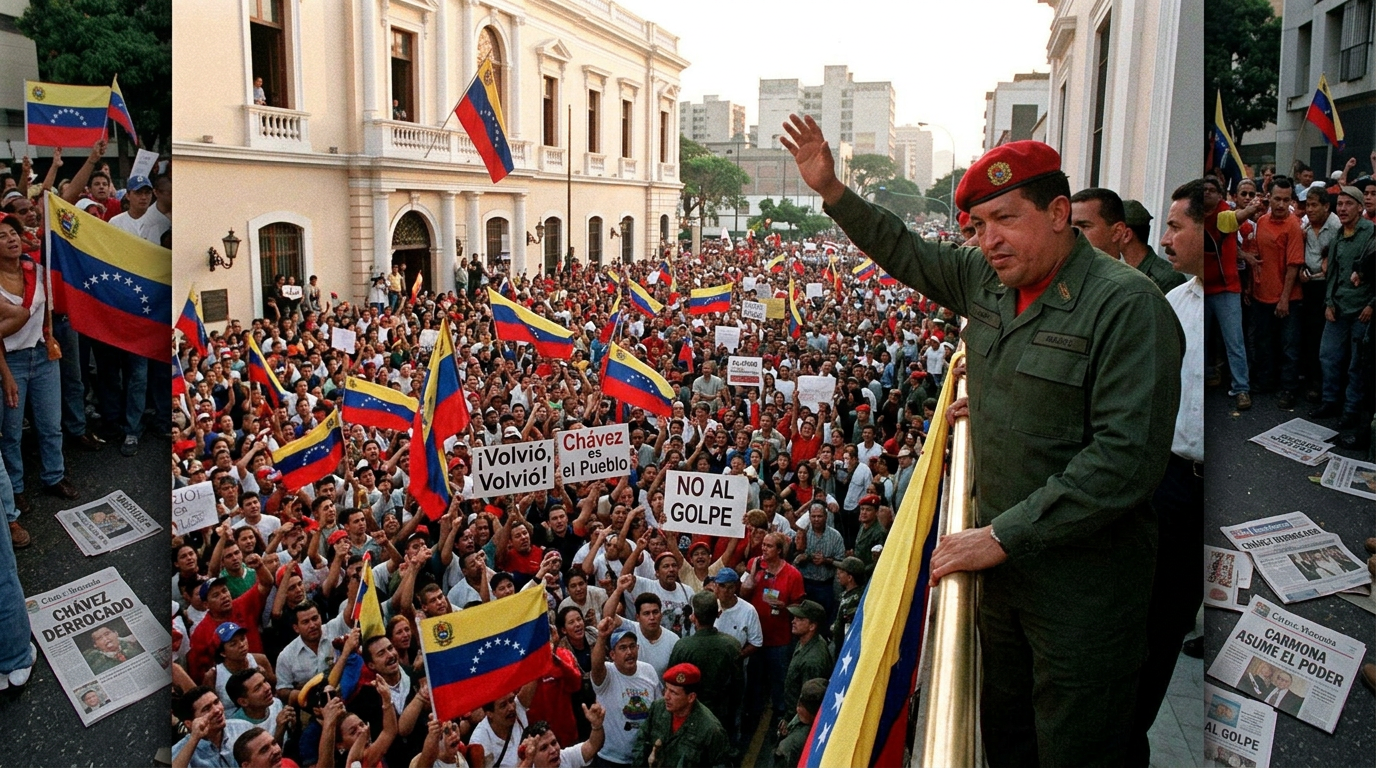
As News of Chávez’s removal spread, thousands of his supporters began organizing protests across Venezuela. Large crowds gathered in Caracas and other cities, demanding the return of their elected president.
These demonstrations were especially strong in poorer neighborhoods, where Chávez had built a loyal base through social programs and political outreach. Protesters blocked roads, marched through streets, and called on the military to restore constitutional order.
The scale and intensity of these protests surprised many observers. What had initially appeared to be a successful coup quickly turned into a mass movement of resistance.
Military Divisions Shift the Balance
At the same time, divisions within the Venezuelan military played a crucial role in the unfolding events. While some senior officers had supported Chávez’s removal, others refused to recognize the interim government.
Key military units remained loyal to Chávez and began coordinating efforts to reverse the coup. As pressure mounted, support for Carmona within the armed forces weakened.
The combination of public protests and military dissent created a situation in which the interim government struggled to maintain control.
Chávez Returns to Power
In a dramatic reversal, Chávez was restored to power on April 13, just 47 hours after his removal. Loyalist forces regained control, and the interim government collapsed.
Chávez returned to the presidential palace, greeted by supporters who celebrated his reinstatement. His return marked the failure of the coup and a major victory for his political movement.
The speed of the turnaround was remarkable, demonstrating how quickly political dynamics can shift during times of crisis.
International Reaction and Debate
The events surrounding the coup drew widespread international attention. Governments and organizations around the world called for respect for democratic processes and expressed concern over the instability in Venezuela.
The role of external actors, including the United States, has been the subject of ongoing debate. Some reports suggested that U.S. officials had prior knowledge of the coup, while others denied any direct involvement.
To this day, interpretations of international involvement vary, and the issue remains a topic of discussion among historians and political analysts.
Aftermath: A More Polarized Venezuela
The failed coup had lasting consequences for Venezuela’s political landscape. Chávez emerged from the crisis with strengthened support among his base, who viewed his return as a victory for democracy and popular will.
In the months and years that followed, his government took steps to consolidate power and expand social programs. Grassroots organizations, often referred to as Bolivarian collectives, became more active in political life.
At the same time, divisions between supporters and opponents of Chávez deepened. The events of April 2002 reinforced mistrust between different sectors of society and contributed to ongoing political polarization.
Impact on Latin America and Beyond
The 2002 coup attempt had implications beyond Venezuela. It became a reference point in discussions about democracy, foreign influence, and the role of popular movements in Latin America.
For many left-leaning governments in the region, the events were seen as a warning about potential threats to political stability. For others, they highlighted concerns about governance and institutional strength.
The crisis also underscored the importance of public mobilization in shaping political outcomes. The rapid return of Chávez demonstrated that popular support can play a decisive role in moments of political upheaval.
Lessons from the 2002 Crisis
More than two decades later, the events of April 11–13, 2002 continue to offer important lessons:
- Political polarization can escalate quickly into crisis
- Military loyalty is crucial in determining outcomes during coups
- Public mobilization can influence power dynamics
- Institutional stability is essential for maintaining democracy
These lessons remain relevant not only for Venezuela but for countries around the world facing political tensions.
Conclusion
The 2002 Venezuelan coup attempt stands as one of the most dramatic episodes in modern Latin American history. The brief removal and swift return of Hugo Chávez highlighted the power of public resistance, the importance of military divisions, and the fragility of political systems during times of crisis.
What began as a coordinated effort to remove a sitting president ultimately failed due to a combination of popular mobilization and institutional pushback. The events not only reshaped Venezuela’s political trajectory but also left a lasting impact on global discussions about democracy, sovereignty, and the role of citizens in defending elected governments.
Even today, the legacy of April 2002 continues to influence political debates, serving as a powerful reminder of how quickly power can shift—and how strongly people can respond when they feel their democracy is at stake.