
Understanding Orbital Physics, Atmospheric Entry, and the Science Behind Extreme Kinetic Forces
April 3, 2026 — Global — Advances in digital simulation are helping scientists better understand how objects traveling at extremely high speeds from space behave when they enter Earth’s atmosphere. These studies highlight a powerful concept in physics: velocity alone can generate enormous energy, even without any explosives or fuel.
By modeling orbital motion and atmospheric entry, researchers are exploring how gravity and speed interact to create intense forces. While the topic often captures public imagination, experts emphasize that these simulations are primarily used for scientific research, safety planning, and space exploration.
The Basics of Orbital Motion
Objects in low Earth orbit (LEO) travel at speeds of around 28,000 kilometers per hour (17,500 miles per hour). At this velocity, they are constantly falling toward Earth but also moving forward fast enough to stay in orbit.
When an object leaves orbit and begins to descend, gravity accelerates it toward the planet. As it moves into thicker layers of the atmosphere, it encounters increasing air resistance. This interaction creates heat, pressure, and rapid changes in speed.
The key concept behind this process is kinetic energy, a fundamental idea in physics that describes the energy of motion. The faster an object moves, the more energy it carries. Because energy increases with the square of velocity, even small increases in speed can result in dramatically higher energy levels.
What Happens During Atmospheric Entry
As an object reenters Earth’s atmosphere, several forces come into play:
- Friction with air molecules generates extreme heat, often causing objects to glow or burn.
- Shockwaves form around the object due to its high speed.
- Deceleration occurs as the atmosphere becomes denser at lower altitudes.
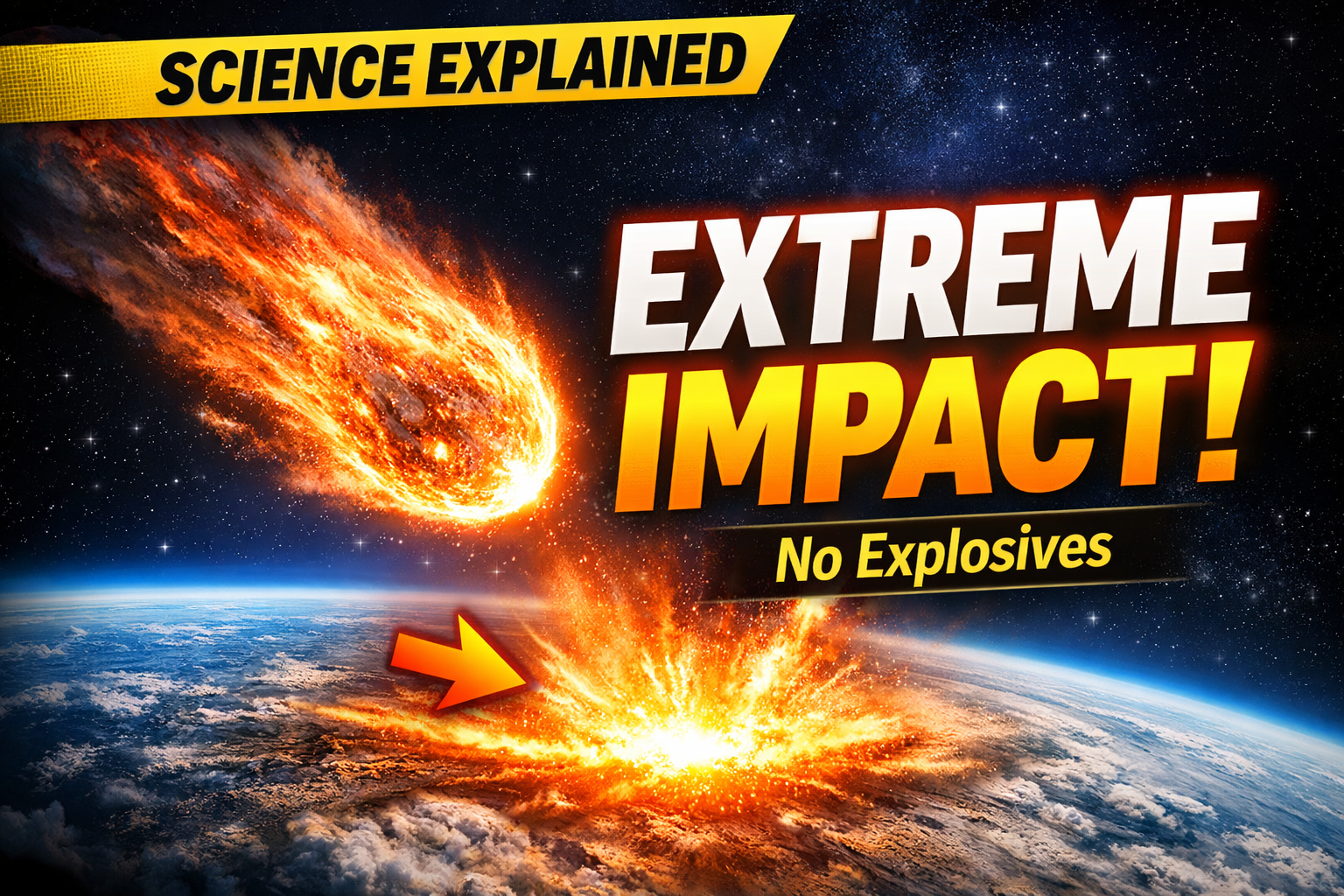
Most small objects, such as space debris or tiny meteoroids, burn up completely before reaching the ground. However, larger or denser objects can survive the journey and impact the surface.
This process is similar to what happens with natural space rocks. Meteorites entering Earth’s atmosphere provide real-world examples of how speed and gravity combine to produce visible streaks of light and, in rare cases, ground impacts.
Insights From Digital Simulations
Modern simulations allow scientists to recreate these conditions in a virtual environment. Using advanced physics models, researchers can track how objects behave at every stage of their descent.
These simulations typically examine:
- Trajectory and orbital decay
- Heat buildup during reentry
- Structural stress on the object
- Energy release upon impact
By analyzing these factors, scientists can estimate how much energy is transferred when an object hits the ground. The findings show that high-speed impacts can release significant energy, depending on the object’s size, mass, and velocity.
Real-World Importance of This Research
Understanding high-velocity impacts has several important applications:
1. Space Debris Management
Thousands of defunct satellites and fragments orbit Earth. Agencies like NASA closely monitor these objects to predict when and where they might reenter the atmosphere. Accurate models help reduce risks to people and infrastructure on the ground.
2. Planetary Defense
Organizations such as the European Space Agency study asteroids and other near-Earth objects. By understanding how fast-moving objects behave, scientists can better assess potential threats and develop strategies to protect the planet.
3. Spacecraft Design
Engineers use this knowledge to build spacecraft that can safely withstand reentry conditions. Heat shields, for example, are designed to handle extreme temperatures caused by friction with the atmosphere.
Energy Without Explosives
One of the most interesting findings from these studies is how energy can be generated purely through motion. Unlike chemical reactions or explosions, which rely on stored energy, kinetic energy depends entirely on speed and mass.
This principle is why even relatively small objects can have powerful effects if they are moving fast enough. It also explains natural events like meteor impacts, where no explosive material is involved, yet the results can still be dramatic.
Ethical and Global Considerations
As with many advanced technologies, the study of high-speed impacts raises important ethical questions. The international community has long agreed that space should be used for peaceful purposes. Agreements like the Outer Space Treaty set guidelines to prevent the militarization of space and encourage cooperation among nations.
Experts stress that research in this field should remain focused on safety, science, and exploration, rather than conflict. Transparency and international collaboration are key to ensuring that space technology benefits all of humanity.
Looking Ahead
As technology improves, simulations will become even more accurate, allowing scientists to better predict and understand high-speed events. This knowledge will play a crucial role in:
- Protecting Earth from potential impacts
- Managing space traffic and debris
- Advancing future space missions
At the same time, these studies serve as a reminder of the immense forces at work beyond our planet. The combination of gravity and speed can produce extraordinary energy, shaping both natural phenomena and human-made systems.
Conclusion
The science of high-speed objects entering Earth’s atmosphere highlights the incredible power of motion. Through digital simulations and real-world observations, researchers are uncovering how velocity alone can generate significant energy on impact.
While the topic often sparks curiosity and speculation, its true value lies in improving safety, expanding knowledge, and supporting the peaceful exploration of space. As humanity continues to push the boundaries of what is possible, understanding these forces will remain essential for building a secure and sustainable future in space.