
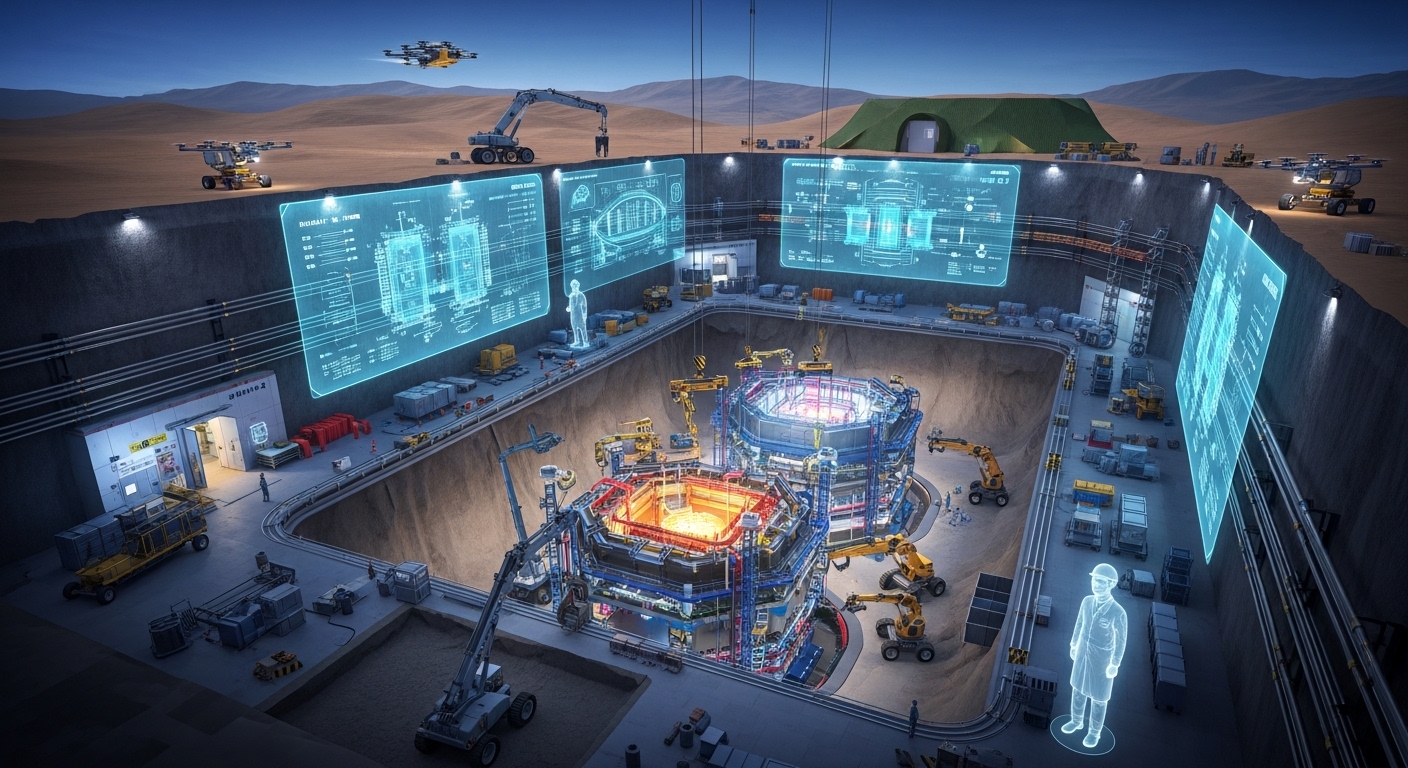
A deep investigative thriller exploring how a hidden facility could evade detection, challenge global surveillance, and reshape geopolitics — in a purely Fictional AI-driven scenario
Introduction: The Age of Total Visibility… or Is It?
We live in a World where satellites can read license plates from orbit, Artificial Intelligence can track patterns across continents, and governments collaborate in unprecedented ways to monitor global activity. In theory, nothing significant should remain hidden—especially something as consequential as a nuclear facility.
And yet, what if that assumption is wrong?
This long-form investigative thriller is based on a fictional AI simulation, designed to explore a provocative question: Could a nation, using advanced engineering and strategic deception, construct and operate a covert underground nuclear facility without detection?
The scenario is not real. It is not based on verified intelligence or any specific country. Instead, it serves as a lens to examine how secrecy, technology, and geopolitics might collide in a world where visibility is both a strength and a vulnerability.
The First Anomalies
Every major investigation begins with something small—an inconsistency, a deviation from the norm.
In this simulation, analysts begin noticing irregular logistics patterns in a vast desert region. Cargo shipments appear in customs data but never arrive at declared destinations. Heavy machinery is transported under civilian contracts, only to vanish from tracking systems. Night-time convoys move along remote routes, avoiding major checkpoints.
Individually, these anomalies are easy to dismiss. Supply chain errors happen. Data gaps are common. But when analysts overlay satellite imagery, trade logs, and movement patterns, something unusual begins to emerge.
There is no clear project. No official announcement. No visible construction.
And yet, something is happening.
Engineering the Invisible
According to the AI simulation, the hypothetical facility is not built above ground—but far beneath it.
The design is deliberate and sophisticated:
- Excavation occurs deep within geologically stable rock formations
- Multiple underground chambers are constructed, each serving a specific purpose
- Access tunnels are concealed within natural terrain features
- Surface structures are designed to resemble harmless industrial or agricultural facilities
The deeper the facility, the harder it becomes to detect. Layers of rock act as natural shields against thermal imaging and radiation detection. Structural reinforcements ensure durability against both natural disasters and potential attacks.
What emerges is not just a hidden facility—but an invisible one.
Beating the Watchers
Modern surveillance is powerful—but not infallible.
In this simulated scenario, the operators of the facility exploit the limitations of global monitoring systems:
1. Thermal Signature Masking
Most large facilities generate heat. However, advanced cooling systems and heat dispersion techniques allow the structure to blend into the surrounding environment.
2. Satellite Timing Gaps
Even with constant satellite coverage, there are intervals between passes. Critical movements—such as material transport—are timed precisely within these gaps.
3. Civilian Camouflage
Supply chains are routed through legitimate commercial channels. Equipment is labeled for unrelated industries, making it difficult to flag without deeper investigation.
4. Data Fragmentation
Instead of large, obvious shipments, materials are transported in small quantities over long periods. The pattern only becomes visible when viewed holistically—a task that requires both time and advanced analytics.
These strategies create a layered Defense—not against weapons, but against awareness.
The Intelligence Dilemma
For global intelligence agencies, the challenge is not just detection—it is verification.
Suspicion alone is not enough to act. Evidence must be concrete, verifiable, and defensible on the world stage. Without direct access, even organizations like the International Atomic Energy Agency would struggle to confirm the existence of such a facility.
This creates a dangerous gray zone:
- If the facility exists, it represents a major security concern
- If it does not, false accusations could trigger unnecessary conflict
In this scenario, uncertainty becomes the most powerful weapon of all.
The Geopolitical Shockwave
What happens if the truth comes out?
The simulation outlines a cascade of consequences:
Diplomatic Fallout
Nations demand explanations. Alliances are tested. Emergency meetings are convened at the highest levels.
Economic Sanctions
Global powers impose restrictions aimed at isolating the suspected state, targeting trade, finance, and technology access.
Military Tension
Neighboring countries increase defense readiness. Surveillance intensifies. The risk of miscalculation grows.
Public Reaction
Media coverage explodes. Citizens demand transparency. Trust in global systems is shaken.
The discovery of a hidden nuclear facility would not just be a technical revelation—it would be a geopolitical earthquake.
The Psychology of Secrecy
Beyond engineering and politics lies a deeper question: Why attempt such secrecy in the first place?
The simulation suggests several motivations:
- Strategic deterrence without public escalation
- Protection from preemptive strikes
- Preservation of bargaining power in international negotiations
Secrecy, in this context, becomes a tool—not just for concealment, but for influence.
Fiction vs Reality
It is essential to reiterate:
This entire narrative is fictional.
There is no verified evidence of such a facility existing anywhere in the world as described. The purpose of this AI simulation is not to make claims, but to explore possibilities.
By examining a hypothetical extreme, we gain insight into real-world challenges:
- The limits of surveillance technology
- The complexity of global intelligence
- The fragile balance of trust between nations
Infrastructure and Vulnerability
The scenario also highlights a critical issue: infrastructure resilience.
If a facility can be hidden so effectively, what does that say about our ability to monitor other forms of critical infrastructure?
From supply chains to energy grids, the same principles of concealment and deception could apply. The line between visibility and invisibility is thinner than we might think.
The Future of Detection
As technology evolves, so too must detection methods.
The simulation points toward future solutions:
- AI systems capable of identifying subtle, long-term patterns
- Improved satellite coverage with reduced timing gaps
- Greater international cooperation in data sharing
- Advanced sensors capable of penetrating deeper underground
The race between concealment and detection is ongoing—and accelerating.
Conclusion: What Lies Beneath
In the end, this fictional investigation leaves us with a powerful question:
In a world where everything is watched, can something truly remain hidden?
The answer is not simple.
Technology has given us unprecedented visibility—but it has also created new ways to deceive. As nations adapt, so too must the systems designed to monitor them.
This AI-simulated scenario is not a warning of what is—but a reflection of what could be.
And sometimes, the most important stories are not the ones we can see…
but the ones buried deep beneath the surface.